Showing posts with label Rolling Thunder. Show all posts

Wednesday, August 14, 2013

"Saigon Was No Rear Area"

It was early evening in I Corps (eye core), northernmost of the four tactical zones where US military advisors could be found in South Vietnam (SVN) in 1964. It was the first weeks of spring and already dark enough that Jeff Sharlet, my brother, and a GI buddy with him in the jeep had to turn on the headlights. They were headed back from Hue on the coast of the South China Sea to their base near the small ville of Phu Bai.

The two GIs were on a narrow deserted road flanked with scrub growth when their lights picked up something in the roadbed directly ahead. Jeff hit the brakes; they got out with carbines at the ready and cautiously approached. At that point in the Vietnam War, there wasn’t much Viet Cong (VC) activity in that part of the country – most of the attacks were far to the south in IV Corps, the Mekong Delta, below the capital, Saigon – but occasional incidents were not unknown.

As they got closer, they saw that it was a Vietnamese peasant woman curled up on the road, probably from the nearby tiny hamlet of Huong Thuy just north of Phu Bai, but was it a trap – did she have a concealed weapon or was she dead, a grenade under her body rigged to explode if she was moved? Happily neither – the old woman was just sleeping soundly on the road still warm from the day’s sun, no doubt a more comfortable berth than the bramble to the left and right. False alarm.

That, of course, was the ‘bush’ in Vietnam where groups of American ‘advisors’ to the Army of the Republic of Vietnam (ARVN) – as they were then called – were scattered up and down the countryside, relatively isolated in a sea of Vietnamese, friendlies and unfriendlies. One might reasonably assume that Saigon, the HQ of the US military effort to help SVN cope with a guerrilla war directed from Communist North Vietnam (NVN) – was a relatively safe area. Alas, not so.      

During the previous year, Jeff had been based in the Saigon area from late summer into the fall. The concentration of Americans there – enjoying the pleasures of the city called the ‘Paris of the Orient’ – instead proved a magnet for persistent and well-coordinated terrorist attacks by VC cadres who were indistinguishable from other Saigonians.


A Saigon street scene, 1961

Once in office in early ’61, President Kennedy (JFK) had begun a build-up of the small US military commitment in SVN inherited from outgoing Dwight Eisenhower. In effect, during the next 1000 days in the White House until his assassination in late ’63, JFK had significantly escalated the sleepy, low-key internal war between ‘our guys’ in the South and the Communists in the North of the divided country. At that stage of what became the long war in Vietnam, the NVN carried out their campaign to overthrow the government of SVN through their proxy, the shadowy National Liberation Front (NLF) and its tough fighting arm, the VC.

♫They said you're pretty safe when the troops deploy
But don't turn your back on your house boy
When they ring the gong, watch out for the Viet-Cong†

In response to JFK’s moves during 1961-62, the underground VC units of the capital responded at first with numerous incidents of terror against the Vietnamese population of Saigon – the implied message being that the regime of President Diem couldn’t effectively fulfill the basic function of government, i.e., the protection of its citizens. However, as the numbers of US military personnel multiplied three-fold in the next two years, the VC began directing carefully planned attacks against venues in the city where Americans – both military personnel and the growing host of civilian contractors and dependents – gathered for diversions.

By the end of ’63, the toll of dead and wounded Americans in Saigon had registered in Washington, provoking discussions of possible retaliatory bombing attacks against the North. The NLF took note and in early ’64 directed its VC cadres to zero in on Americans in Saigon. The new policy of urban terrorism bore two implicit messages – the US should realize how vulnerable their people were in the capital if they decided to strike NVN, and high profile attacks against Americans should have a demonstration effect on their South Vietnamese ‘clients’, to wit the US cannot protect you.

In ’64-’65 the frequency and intensity of VC targeting of US billets and recreational facilities had increased five-fold from ’61. Years later, the atmosphere of bombs going off on the streets of Saigon was cinematically depicted in Robin Williams’ Good Morning Vietnam (1987). On the ground back in the ‘60s, Jeff and his GI pals, all Vietnamese linguists (lingys) attached to a communications intelligence outfit outside the city in ’63, were caught up in the rising tide of VC violence aimed at Americans as can be seen in the following account by a fellow GI of an eventful evening on the town with Jeff and three other lingys:

We were walking down Tu Do Street [the main drag],
headed for the Impérial, a little French open-air bar – a
corner bar – classic French, tile floor, zinc top bar,
uncomfortable stools, bistro menu, maybe a dozen tiny
tables open to the street on two sides, ancient Vietnamese
waiters in khakis, white shirts and flip-flops, no girls – the
 perfect venue for a Pernod or Pastis on a warm night.
Quelle ambiance! …

We were walking toward the bar five abreast, a short
block away, maybe 50-75 yards, when a grenade was
thrown from a motorbike into our intended destination.
It was, for all of us, a strange experience – our first sense
of the explosion was seeing waiters from the bar running
into the street followed, in slow motion, by a flash of light
and a huge horizontal column of a billowing dirty gray
cloud of smoke that appeared to be chasing the waiters –
only then came the sound of the explosion itself which
caused us to momentarily duck our heads before running
toward the explosion – a foolish impulse, but ….*

The bar was in shambles with overturned tables, broken glass, and waiters’ flip-flops scattered about. Happily their favorite waiters were unharmed, and there were no serious injuries. The following night the five guys made Bar Imperial their first stop of the evening and found all the waiters wearing brand new tennis shoes, the better to run with, they told the GIs.


Bar Impérial, Saigon, 1960s

The NLF’s new terror policy had gone into immediate effect in early ’64. On February 9th, the VC hit the sports stadium where two US service teams were playing a softball game before bleachers filled with cheering American military and civilians: 2 dead, 42 wounded. Exactly a week later on Sunday, a VC team in a well-coordinated attack bombed a packed movie theater exclusively used by Americans watching a Hollywood film. The first VC shot and killed the lone US military policeman (MP) on guard out front, followed by his accomplice rushing into the theater to plant a 25-pound bomb with a 15-second fuse: 3 killed, 32 wounded.

Lest the reader think this was an improvised operation, US forces later captured the 13-page VC document on the meticulous planning and post-attack evaluation for the theater bombing. The document noted with satisfaction that local Vietnamese residents had come by the next day to see the wreckage and were heard to say, “Once they [the VC] have succeeded in attacking this objective, they will easily succeed elsewhere.”**

♫Searching for the Viet Cong in vain.
They left a note that they had gone.
They had to get down to Saigon††

Near the end of ’64, on Christmas Eve, the VC pulled off another high profile strike designed to reinforce their ‘message’, to wit, that Americans in Saigon were vulnerable, hence the Vietnamese population should not count on them for protection. By then Jeff had completed his tour and was back in the States, but a couple of lingy buddies happened to be nearby and witnessed the carnage after a few minutes earlier a 200-pound bomb blew out the back of the 6-story Brink Hotel – quarters for US officers –  and obliterated the small buildings behind it. Dashing to the site, the two GIs instinctively rushed into the dense black smoke and, at personal risk, rescued three stunned and dazed Vietnamese employees of US armed forces radio housed in the building.


Aftermath of the Brink bombing, Christmas Eve, 1964

Again, it was later learned how carefully the VC commanders had planned the attack on the Brink. Observing that South Vietnamese officers freely mingled with Americans at the hotel, the VC assault team acquired ARVN uniforms on the black market, studied the officers’ mannerisms, their speaking style, and even how they smoked – and were thus able to infiltrate the building with their deadly cargo.

Meanwhile standing on the street as Vietnamese police and fire fighters responded, the two lingys could see “the floors buckled upward, re-bar and all, from the blast and ground floor walls now skeletal.”*** It was evident that anyone above the explosion would certainly be dead and, indeed, two were, plus 107 wounded.

Afterward, one of the GIs got cleaned up, changed his blackened uniform, and continued out on the town to celebrate Christmas Eve as initially intended. Therein lies the story of how Americans grew accustomed to VC violence as part of the Saigon landscape in the midst of war, but more on this further on.

The new year of 1965 – the fateful date of President Johnson’s major escalation of the US commitment to the Vietnam War – was another deadly period for American citizens in and about the capital of SVN. Responding to the first sustained US bombing attacks on NVN, dubbed ‘Rolling Thunder’, the VC hit the US embassy killing and wounding Americans, but far more Vietnamese who worked at the compound; in all, the attack left 23 dead and 183 wounded.


Wrecked interior of US Embassy, Saigon, March 1965

 However by far the most spectacular attack of the VC Saigon campaign took place in June ’65 – by which time Rolling Thunder had been backed up by the first waves of US combat troops who had already begun to engage the highly mobile and elusive VC battalions in the boonies. The site of the dramatic assault was the My Canh, a glamorous and popular floating restaurant aboard a boat tethered to a dock on the Saigon River mainly frequented by Americans and wealthy Vietnamese.

It was a two-part VC op – first a grenade was tossed into the restaurant during the dinner hour, predictably causing consternation. Then, as dazed and wounded diners rushed to shore over the boat’s gangplank, an electronically controlled Claymore anti-personnel mine (which fires metal balls 110 yards in a wide killing arc), planted in the riverbank, was remotely detonated causing mass casualties: 32 killed, 42 wounded.


Assisting victims at My Canh floating restaurant, June 1965

A US sailor helping rescue people, shocked to see blood everywhere and so many body parts, subsequently commented, “Saigon was no rear area. It was a very dangerous place.” But should we conclude that the large American community in Saigon was cowed and intimidated by the rash of well-aimed, lethal VC terror attacks in the city – no, according to a good friend of Jeff’s who was there for a number of years, first as a GI and then as a civilian contractor. He and everyone he knew had a personal story of a near miss, and certainly on those occasions emotions swirled, but fear was not one of them.

On the contrary, he told me, a backdrop of violence was a part of the fabric of daily life in the city, a feature of the urban scene in a country being torn apart by a raging war. Young American GIs either based in Saigon or there on furlough, accepted the explosions as a condition of life in a wartime capital and did not allow the bombs and grenades to change their routines or divert them from the city’s pleasures.

One could chalk it up to the conviction of invincibility among the young – it won’t happen to me – or perhaps recall similar reactions among many civilians who survived WWII London and Berlin. Both cities were savagely and relentlessly attacked by vast fleets of bombers, but life went on amidst the death and destruction and, in fact, a little defiantly in both wartime capitals. Sure, English and German children alike were sent to the countryside for safety and Berliners and Londoners of course took to the bomb shelters during air raids, but during intervals people shopped, ate meals, made love, and much else of the routines that define 'the human condition' even in times of crisis.

Back in Saigon during the war, a terrorist incident a few years later perhaps best illustrates the response to routine violence as part of the texture of everyday life. A couple of American civilians lived down the block from a Filipino aid mission – housed in a building protectively wrapped in anti-grenade fencing with a small guard post in front. There were a couple of small openings through which the sentry could fire if attacked.

Waiting for a taxi one evening, the Americans saw a speeding motorcycle with a Vietnamese teenager on the back go flying by the Filipino building as the passenger tried unsuccessfully to hurl a grenade through the firing slit of the guard post. It bounced off the fencing harmlessly and exploded in the street as the guard opened fire on the fleeing cycle.

Coincidentally, a week later to the day and hour, the Americans were again at the cab stand and witnessed an identical failed attack. Again the duo escaped unscathed. Word got around among Americans in the neighborhood, and every Tuesday at 7 PM they’d gather on a protected portico to watch the same scene repeat itself – for six straight weeks until on the seventh try, the guard finally managed to take down the teenage cao bồi, cowboys, ending the weekly entertainment.

By ’66 US security had greatly increased in capital, and by then local VC priorities were changing as their units increasingly faced large, well-armed US combat forces on search & destroy missions in the Saigon region. Although VC urban terrorism had taken a significant toll in life and limb, its intended psychological impact on Americans who served or worked in Saigon fell far short of VC expectations.

Saigon remained a dangerous posting throughout the Vietnam War, but of course the danger there paled in comparison to the extraordinary hazards and the appalling loss of life on both sides of the conflict elsewhere in war ravaged Vietnam.

Links to music videos


*Personal communication (8/1/13) from a Vietnam GI buddy and good personal friend of my late brother Jeff Sharlet – to whom I am greatly indebted for his help on the memoir project.

**Quoted in A Study of the Use of Terror by the Viet Cong (prepared by the Military Assistance Command, Nha Trang, South Vietnam, May 1966), 36. Declassified 5/1/78.

***Personal communication of 8/1/13 from Jeff Sharlet’s GI buddy and good friend.


Wednesday, December 5, 2012

Antiwarriors Mobilize – Brothers Divergent

Brother Jeff and I returned to the States in the late spring of ’64, he from the Vietnam War still in its infancy, and I from the Soviet Union. I had just finished a year’s study of Marxist legal theory at Moscow University Law School. While I had been studying Communism, Jeff had been fighting it in Southeast Asia. How our experiences shaped us couldn’t have been more different.

We met again that summer at our parents’ place in Coral Gables outside Miami. It was an all too brief reunion – Jeff and I both had to get on with our stateside lives. I headed north to Washington to finish up research on my doctoral dissertation at the Library of Congress. Jeff went west, back to Indiana University (IU) – where I was taking my PhD – to complete his undergraduate education.†

Back from Vietnam – Jeff in Florida, Summer ‘64

A half year later Jeff and I were again off on our different trajectories, I starting my academic career at the University of Missouri (Mizzou), Jeff beginning spring term at IU. I was teaching introductory courses on politics and international relations along with an upperclass course on Soviet politics with no prior classroom experience.
 
Jeff was taking a full course load, including US and comparative politics, American intellectual history, a course on the novel, and a course on totalitarian political patterns—totalitarianism at the time was very much in vogue as a descriptor of Soviet Bloc and Asian communist regimes. Colleagues and I would later successfully challenge the concept, but that’s another story.
 
Meanwhile back in South Vietnam (SVN), the low-key war had been steadily heating up. The South Vietnamese army (ARVN), assisted by some 15,000 US military advisers, was fighting a communist guerrilla insurgency against the Viet Cong (VC) supported by North Vietnam (NVN). The war was not going well for SVN, which had persuaded the late President Kennedy (JFK) to accede to the South Vietnamese generals’ coup against President Diem in November ’63.
 
Unfortunately, the situation in Saigon had only grown worse following the coup. A junta of generals, divided among themselves, could not effectively govern. Political instability combined with military ineptitude weighed down the floundering regime. A second coup toppled the junta a few months later.  Then followed a series of coups and attempted coups throughout ‘64. None of this confusion was lost on the VC, nor on their military mentors in the North. By early ’65, the VC had achieved de facto control of large parts of the country.
 
All this produced alarm among the Washington policy makers. The CIA had forecast that the time was near when the VC could triumph. The US guarantee of the independence of a non-communist SVN was at stake. More and more, the emboldened VC were infiltrating the cities and populated areas specifically to attack US military facilities and places where American personnel gathered for recreation.
 
On January 20, 1965, President Johnson (LBJ) was inaugurated, and just two days at a confidential briefing of the congressional leadership he broadly intimated that he was about to begin bombing North Vietnam. All he needed was a pretext; the VC obliged in early February with a destructive attack on the American base at Pleiku in the Central Highlands, and LBJ responded with air strikes against NVN. A few days later, a concerned Jeff wrote me, “I could get recalled very easily (Ready Reserves, Vietnamese linguist, Intelligence experience).”
 
It was soon evident that the retaliatory strikes had been pre-planned dress rehearsals for a full-scale bombing campaign, code-named Rolling Thunder, that was launched in March. Marine combat battalions soon followed to secure the air bases from which strikes against the North were being flown. By those two abrupt moves, LBJ had dramatically escalated the war. The sudden exponential increase in American involvement in the civil war of a country most people couldn’t find on a map, in turn elicited a sharp negative reaction among faculty and students at a number of major universities.

♫We'll smash down your doors, we don't bother to knock
We've done it before, so why all the shock
We're the biggest and the toughest kids on the block
And we're the Cops of the World, boys
We're the Cops of the World
††

The University of Michigan at Ann Arbor quickly became the focal point of opposition to the escalation. A number of UM students were veteran activists of the civil rights movement in the South, and the campus had a strong chapter of SDS, Students for a Democratic Society, a national organization formed there in the early ‘60s. Michigan was also home to a sizeable number of politically active professors. These forces came together to organize what became the first ‘Teach-In’ on Vietnam, an initial step toward what would eventually become a nationwide antiwar movement.
 
As a political and moral response to Washington, a group of Michigan faculty planned a one-day teaching strike. The strikers would refuse to teach their regular classes and instead spend the time introducing interested students to the critical issues of America’s war in Vietnam. Nearly 50 professors signed up, but Governor George Romney and the university president opposed the strike. At the 11th hour, a compromise was reached: instead of cancelling classes, concerned faculty would teach their courses, but continue teaching through the night; thus was born the idea of a teach-in as a forum for informed protest.


Ann Arbor Teach-In Poster
 
The first teach-in began at 8 PM on Wednesday, March 24th and went on through the night until daybreak the 25th. The dorm curfew for women was suspended, greatly swelling the turnout to over 3,000 students; along with 200 faculty, it was the largest demonstration in the university’s history.
 
The main speakers were two academics with field experience in Vietnam who knew the country well, an economist from the East, and a Michigan State anthropologist. One speaker recited Vietnam’s long history of fending off invaders, while the other simply pronounced the war unwinnable.


University of Michigan Teach-In, March 24-25, 1965

At other colleges and universities, small groups of activists gathered to listen in to the Michigan speakers via telephone hook-ups. At IU, Jeff was undoubtedly one of the best informed on the subject, judging by the discussion of Vietnam in his letters from that period.


Activist Leaders at Indiana – Bernella & David Satterfield, ‘64

Thanks to national media coverage of the Michigan event, the teach-in format was soon replicated at over 100 other campuses, including the University of Missouri. At Mizzou, however, the organizers decided to stage a teach-in as a balanced debate between pro- and anti-Administration speakers. In contrast to brother Jeff’s growing opposition to US policy, I along with an American historian was the lead debater on the pro side of the question. We were opposed by two scholars of South Asia, one a political scientist, the other a historian.
 
For nearly five hours, the four of us debated US policy in Vietnam before an audience of 500+ students crammed into an auditorium in the Business School. The South Asian specialists both viewed the Vietnam conflict in historical and regional contexts, emphasizing the need for a negotiated settlement before the US got in too deeply. At the time as a JFK liberal internationalist, I looked at the problem within the framework of the bi-polar Soviet-American Cold War conflict.
 
The Cold War was then at an uncertain point. Khrushchev, a reformer, had been ousted from power in Moscow by a coalition of former Stalinists just six months earlier. Although he’d been aggressive in the international sphere (witness the Cuban Missile Crisis of ’62), the following year he’d agreed to JFK’s proposed treaty banning nuclear tests in the atmosphere – a very important step in the effort to slow down the dangerous arms race. By the spring of ’65 when I spoke at Mizzou, the full foreign policy intentions of Khrushchev’s successors, especially in the former colonial world now called the Third World, were by no means yet clear.
 
Hence, I saw Vietnam as a surrogate war between NVN, a Soviet and Chinese Communist ally, and SVN, a US ally. In those years, the US had put in place a policy of global ‘containment’ by means of an encircling network of bases and military alliances. The idea was to keep the Soviet empire and, by then, its rival Chinese sphere of influence, in check, i.e., not permit either the Soviets or the Chinese to extend the authoritarian communist model beyond their borders.
 
The US was particularly concerned about the Third World, which was undergoing rapid decolonialization that left power vacuums in its wake. South Vietnam was, of course, a Third World country; from a Cold War angle of vision, both the USSR and China were probing, via their proxy NVN and its agent, the VC, to expand the international communist domain to the South. No one, not even the ‘doves’ had any illusions that the North could carry the fight to the South without massive military and economic aid from the two giants of the Communist world.
 
After the debaters presented, the Mizzou audience was invited to pose questions or make short statements from the floor. In retrospect, the most prescient remark of that long afternoon was made by Professor William Allen, a noted young historian of Germany. He vigorously opposed US policy and advocated complete withdrawal from Vietnam. Of course, he was right.

♫It's written in the ashes of the village towns we burn
It's written in the empty bed of the fathers unreturned
And the chocolate in the children's eyes will never understand
When you're white boots marching in a yellow land†††
 
At the end of the debate, the moderator asked the audience to signal by applause which set of arguments they found most persuasive. While both sides found support, by dint of applause, the pro-Administration position seemed to prevail.
 
Most notable of the post-Michigan teach-ins were the national teach-in in mid-May and the ‘mother’ of all teach-ins that season, the huge one at Berkeley toward the end of the month. At the national event in Washington, broadcast live on radio and television throughout the country, two leading specialists on Vietnam, Kahin of Cornell and Scalapino of Berkeley, duked it out.
 
The Berkeley affair attracted an aggregate of 30,000 participants from the San Francisco Bay area listening to nearly 50 speakers over a period of 36 hours, by far the longest and the largest teach-in that spring. Although not intended as a balanced debate, at least one pro-Administration speaker was included. He and the lead-off presenter ended up as polar opposites in the spectrum of comments at the teach-in – one wildly idealistic, the other darkly dystopian.
 
A historian from Yale opened the teach-in, proposing civil disobedience so massive and persistent that LBJ and his war cabinet “will forthwith resign.”* At the other end of the spectrum, a Berkeley political scientist foresaw – absent continued US resistance – SVN as “Communist totalitarian regime” with a regimented population wakened in the mornings to the sound of bugles and forced to work long days in pursuit of the regime’s goals.**
 
That first turbulent spring of the newly escalated American war in Vietnam came to an end with what would become legions of ‘antiwarriors’*** mobilizing on the nation’s campuses. As for Jeff and me, our respective academic business finished for the summer, we continued our separate ways – he off to Mexico to hang out with friends; I to Washington to advise on US-USSR arms control. Brothers divergent.
 
*L Menashe, ed, Berkeley Teach-In: Vietnam (1966), 3

**Ibid

***The term is from Melvin Small, Antiwarriors: The Vietnam War and the Battle for America’s Hearts and Minds (2002)† 


††† White Boots Marching in a Yellow Land:  http://www.youtube.com/watch?v=Fq42reX_MPA

Wednesday, November 7, 2012

Shadow Highway – "They Just Keep a-Coming"

It was a low-tech engineering marvel with a lethal purpose. North Vietnam’s (NVN) shadow highway to the south steadily and stealthily delivered men and materiel to the battlefields of South Vietnam (SVN). Its immense success was reflected in admiring nicknames coined by Americans tasked to shut it down. Because of Ambassador Harriman’s illusion of a neutral Laos through which the shadow highway passed, US Saigon Embassy personnel cynically referred to the Ho Chi Minh Trail (the Trail) as the “Averell Harriman Memorial Highway.” A Marine general called it the “Ho Chi Minh Autobahn,” while a Green Beret who had reconnoitered the route said that at times it was “like the Long Island Expressway – at rush hour.”
 
What Washington dubbed the Ho Chi Minh Trail (actually its official name was the Trường Sơn Strategic Supply Route) had ancient origins in the Annamite Mountains and jungles of Southeast Asia along the western border of what became SVN after the defeat of the French colonialists in 1954. It had long been a loosely connected network of primitive paths and trails through the wilderness trod only by aboriginal tribes inhabiting that sparsely populated, inhospitable area. Only in the late ‘40s during the long Vietnamese war for independence against the French did the network take on some semblance of a logistical trail system. The Viet Minh, the communist-nationalist guerrilla army created by Ho Chi Minh, used the system of trails as a clandestine route for moving fighters from the northern area of France’s Indochina colony to the Mekong Delta in the south below Saigon.
 
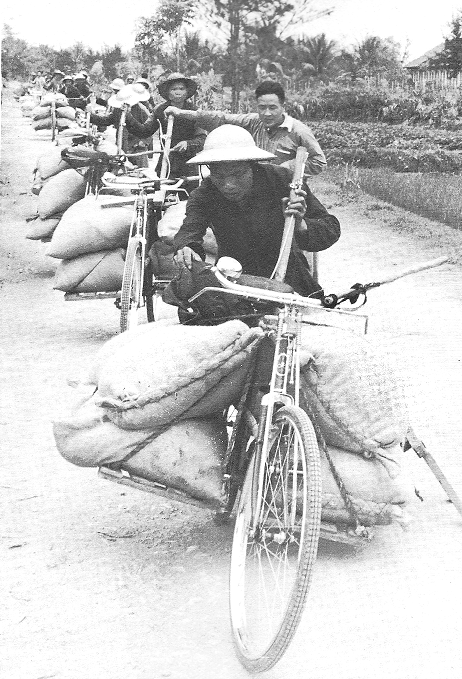
After ’54, the system fell into disuse, temporarily as it turned out. In ’59 the Communist Party of NVN decided to significantly support the ongoing low-level guerrilla insurgency against the government of SVN, and the Trail again saw military traffic. Because the early Trail involved climbing steep, heavily forested mountains and traversing rough jungle terrain, elephants were initially used to carry the heavy supplies. Eventually the preferred vehicle for transporting larger-caliber weapons, ammo, and foodstuffs became specially reinforced bicycles pushed, not ridden, by porters. Frames were strengthened, handlebars fixed with a long steering stick, and a pole for stabilizing the bike arose from the seat. Fully loaded, the bikes carried several hundred pounds.
 
 
Bike porters on the Ho Chi Minh Trail
 
After ’65 when the war escalated on both sides, the Trail was widened, and heavy duty Chinese army trucks replaced bikes. A truck-relay system was developed with designated individual sections of the Trail responsible for keeping their own fleets on the road. An underground pipeline was laid to provide fuel to the way stations along the Trail. Early on, Pentagon planners calculated that only as few as 20 truckloads of cargo a day, a fraction of the truck traffic on the Trail at any one time, had to get through for the NVN to meet its supply requirements in the south. By then the Trail had become a dual system – roads safe only at night for the trucks, while troops marched off-road by day, often having to cut trail as they went.
 
Throughout the Trail’s active service from ’59 to the fall of Saigon in ’75, North Vietnamese Army (NVA) troops moved along the route with heavy packs weighing as much as 85 lbs that contained food, clothes, and ammo for both the long journey and, ultimately, the SVN battlefields. To reach the Saigon-Mekong Delta region in ’64 by foot took five months.* Even later, after the system was considerably engineered and improved, the full trek still lasted as long as six weeks. To say that NVN’s ‘long march’ was arduous and tested the limits of human endurance would not be an exaggeration.
 
 
On the Trail through the mountains
 
Not all the NVA troops that moved as units were destined for the Mekong theater of operations. The Trail, which paralleled SVN’s border through Laos and Cambodia, had various ‘exits’, much like an American superhighway. The first exit was just below the Demilitarized Zone (DMZ) separating North and South Vietnam for units assigned to the Hue-Phu Bai sector, the area where brother Jeff Sharlet served in ’64. Although trail time was shorter for troops headed for that sector, they still had to climb over a rugged mountain range in northeast Laos to reach their destination.
 
While the Trail was NVN’s conduit for matching US troop levels in the south with NVA combat regiments and battalions, it was maintained by a separate command consisting of tens of thousands of engineering troops, anti-aircraft units, infantry for ground security, and huge numbers of young women volunteers assigned to roadwork – a highly dedicated and efficient combat support force stationed along the myriad byways and alternate routes of the 8000-mile road system.
 
 
The Trail and its ‘exits’
 
For the NVA troops trekking down trail, the terrain, predators, disease, and weather added to the ordeal. The foot trails were stony, rest areas rough-hewn, and the rainforests through which they passed either suffocatingly hot and humid or rain-drenched, perpetually damp, and steamy during monsoon season. Insects and jungle creatures plagued the transiting soldiers. Mosquitos swarmed in clouds; leeches abounded, whether in water crossings or dropping from trees; and poisonous snakes were ever a danger – everyone carried anti-snake venom, which had to be self-administered within three minutes of a bite. Many soldiers died enroute from disease – malaria, typhoid fever, amoebic dysentery, and many other infectious diseases, even plague, were endemic.
 
However, in terms of sheer ferocity and a staggering death toll, nothing along the Trail matched the US Air Force’s bombing and strafing campaign. When ‘Rolling Thunder’ was launched during spring ’65, Washington believed a relentless bombing campaign of NVN would ‘persuade’ the Communist regime to sue for peace or at least cause them to cease and desist stoking the southern insurgency with streams of men and supplies down the Trail. As the fighting intensified and US illusions about NVN’s commitment and steadfastness began to fall away, the strategic objective shifted to shutting down the pipeline feeding the Viet Cong’s (VC) insurgency against the SVN regime. In military-speak, the objective became ‘interdiction’ to prevent cross-border infiltration from NVN via Laos and Cambodia.
 
For this purpose, the hi-tech might of the world’s greatest military power was brought to bear on the Trail. The battle in the air against the enemy became a veritable separate, secret war apart from the ground war in SVN where GIs and Marines were going head to head with the VC and NVA battalions from the DMZ to the Mekong Delta. The air war was concealed from Congress as well as the American public because a large percentage of the thousands of air strikes were against the Trail in nominally neutral Laos and Cambodia.
 
At the outset prop-driven Douglas trainers were deployed to bomb and strafe enemy formations spotted along the shadowy trail. As the flow from the North increased, the air war escalated when Phantom jets armed with rockets and napalm entered the fray. B-52 bombers from Guam, designed for Cold War intercontinental warfare with the Soviets, were added to the order of battle. Carrying enormous bomb loads, the bombers cruised unseen seven miles up from where their deadly cargoes of 750 lb bombs were dropped from map coordinates.
 
 
B-52s over the Trail
 
As part of the Pentagon’s evolving electronic warfare, a device was created for detecting the presence of humans invisible in the impenetrable jungle below from the air. Colloquially known as ‘people sniffers’, the device was slung under a helicopter which reconnoitered suspected Trail areas, picking up the scent of urine. Coordinates would be transmitted, and perhaps the most destructive air weapon of all would be called in – a converted C-130 cargo plane nicknamed ‘Spooky’ because, being slow and flying at low altitude, it operated at night.  Bristling with automatic rapid-fire Gatling-type guns, Spooky would fly over the identified area, sometimes at only 1500’, and literally shower the jungle below with lead at the rate of 15,000 rounds a minute, eerily lighting up the night with red tracers.
 
One might think such overwhelming power would prevail, would have defeated NVN’s effort to sustain the war in the south. On the contrary, through surprising feats of Engineering 101 and often simple, even primitive countermeasures, the Trail remained a busy military thoroughfare as the vital route to the ground war in the south and ultimate victory in ’75. To counter relentless air attacks, the NVA positioned anti-aircraft guns at critical chokepoints on the Trail, ensuring that US bomb runs were not cost-free. Later, batteries of Soviet surface-to air missiles (SAM) were added, greatly increasing Air Force fixed-wing losses. In the course of the separate war over the Trail thousands of NVA trucks were destroyed and heavy casualties sustained, while the US lost 500 planes with their air crews.
 
Air attacks on the Trail were most effective against bridges over the many rivers that had to be crossed. Engineering crews could put pontoon bridges in place relatively quickly, but they too would be knocked out the next day by prowling Phantoms. For this special challenge to Trail traffic, combat engineers came up with a couple of workable, low-tech solutions. The first was a cable bridge, but one without a roadway. Two strong cables would be strung across a river invisible from the air at water level a truck-width apart. When a truck convoy arrived at a crossing, the tires were removed, the rims aligned on the cables, and the trucks driven across, and refitted with tires on the opposite bank.
 
This bridging technique worked well, but was time-consuming, so another equally simple but even more amazing solution found. A pontoon structure called a ‘peek-a-boo’ bridge was rigged out of the inner tubes of truck tires, and powerful pneumatic pumps were hidden on each side of a waterway. When not in use, the bridge would be concealed by deflating the tubes and letting the structure sink and float beneath the water’s surface. Upon arrival of the trucks, the pneumatic pump would inflate the tubes, the bridge would emerge from the depths, and the convoy would pass over it.
 
Road repair from bomb damage, a constant, was essentially a no-tech job. Without the availability of bulldozers, the largely female road crews posted along the Trail filled bomb craters overnight with just picks and shovels. Occasionally, when a stretch of trail was being repeatedly targeted, the engineers would cut an alternate route below the triple canopy jungle, thus hiding it from the air. Often this involved cutting down trees and clearing brush, but when the NVA realized that their hi-tech adversary had airborne means for detecting foliage decay, they changed tactics. Trees and bushes were instead carefully dug up and transplanted elsewhere, an elementary gardening procedure.
 
However, the NVA’s most primitive but effective countermeasure – and a devilishly clever and amusing one too – was its diversionary response to the vaunted airborne people sniffers. Pots of buffalo urine were hung in the trees in areas away from the Trail causing the planes to release their munitions harmlessly on empty stretches of jungle. Still, the relentless air attacks never ceased.
 
After the Communist Tet Offensive of ’68, Creighton Abrams replaced General Westmoreland (Westy) as overall US commander and inherited not only a grinding ground war, but also the shadowy, hotly contested air war over the Trail. The interdiction campaign remained his major preoccupation right up to the final days of active US involvement in the Vietnam War late ’72. Transcripts from Abrams’ regular briefings clearly indicate that in spite of the best efforts of a superpower, interdiction had remained a frustrating and elusive objective. In late ’70, his deputy commander for air operations conceded that the scope and effectiveness of the Trail had increased:
 
          Over the past year we’ve seen a continual increase
          in the road network, the trails, the alternate route
          structure … which gave the enemy many options
          in terms of moving his equipment and supplies ….


          [The NVA’s dispersal of their trucks] has been
          accomplished beautifully, they move at night, they
          move at regular predetermined times, they move to
          one place, stay and hide, unload, pick up another
          truck and move on down, hiding in the [jungle]
          canopy, it’s just an extremely difficult problem.**
 
As American involvement in the war was winding down 18 months later in ‘72, it was evident that NVA infiltration had trumped US interdiction. As a frustrated General Abrams exclaimed to his staff: “it’s a more or less continuous thing – you know, they just keep a-coming.”***
 
Years after in post-mortems on the war, a senior North Vietnamese officer conceded that US air attacks, especially Spooky’s saturation strafing, had hurt them badly, while Westy’s deputy stated flatly in an interview that the fact that the  “Ho Chi Minh Trail was never closed” was a major factor in the failure of the US mission in Southeast Asia.****
 
*J Zumwalt, Bare Feet, Iron Will (2010), 232
**L Sorley, ed, Vietnam Chronicles: The Abrams Tapes, 1968-1972 (2004), 495
***Ibid, 818
****Quoted in R McNamara, In Retrospect (1995), 212