Showing posts with label Viet Cong. Show all posts

Wednesday, January 6, 2016

Along the Roads of Vietnam at War – A Poet Remembers

The ex-Vietnam GI poet, John Buquoi, retraces his seven-year journey through wartime Vietnam in his recently published collection of poems. He was first in Vietnam as a soldier, 1963-65 – serving with my brother Jeff Sharlet*– and then as a civilian as an independent contractor supporting the military mission from 1965 to 1970.

Following his military tour as a Vietnamese linguist, John returned to the States in April ’65. Texas was home, but a strong attraction to the exotic land he had gotten to know soon drew him back to Southeast Asia. By midnight, Christmas ’65, John was aboard a PanAm flight winging his way again to Vietnam. This time working as a civilian in-country, the poet would range far and wide throughout South Vietnam.


With his language ability, civilian employment was not a problem for John. He was soon snapped up by a large US electrical sub-contractor. The firm was under contract to a giant construction outfit that built air fields and other military facilities for America’s growing involvement in the war against Communist North Vietnam and its southern proxy, the Viet Cong, or VC.  

After completing his initial contract, John signed on with Pacific Architects and Engineers and was assigned to the staff of a former general who had retired through the revolving door to a cushy position with the defense contractor. The poet traveled extensively throughout the embattled country, continuing apace as he subsequently became a Labor Relations manager for the Pentagon's largest defense contractor in South Vietnam. His poems look back nearly a half century to that unforgettable time in his young life.  

John’s book of poems can be read as written one by one, or alternatively viewed as a continuous narrative poem. Either way, the reader journeys with the poet through a tumultuous time in the history of the 20th century.

One of John’s first work assignments is recorded in an early poem. He and the general visited a major military base. As an ex-GI, the poet was aware that combat riflemen were not only in harm’s way, but lived and fought in a war not far from the Equator under conditions of extreme difficulty and hardship.

Even at one of his relatively sheltered postings as an intelligence operative, he recalled many men were billeted in tents with little relief from the searing heat and enervating humidity of tropical Asia.

However, in the company of a general as a newly reminted civilian, the poet was able to pass through the two-way mirror into the bifurcated world of the US military. Travelling north from Saigon to Cu Chi, they arrived at the vast encampment of the 25th Infantry Division – a base the size of a small city complete with its own airfield.
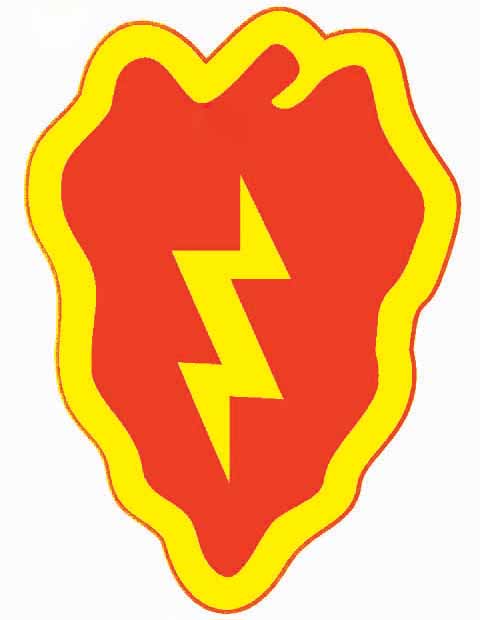

Shoulder patch 25th Inf, Tropic Lightning

Driving through base to the quarters of the commanding general (CG), they could see the area where the ‘grunts’, the combat troopers, were billeted:

                                      the 11-bravos, ‘grunts’
                                      are tented in fetid ‘favelas’
                                      of rotting surplus canvas
                                      from Korea, world war two,
                                      … to endure beyond combat
                                      the heat, the bugs, the rats,
                                      the endless monsoon
                                      and the most inelegant 
                                      mess chow mélange
                                      slung to steel trays

Moving on to their corporate destination – to confer with the divisional CG, the poet came upon a scene barely imaginable in his previous incarnation as a Spec-5, roughly the equivalent of sergeant. His lines reveal the surprising contrast:

                                      in the commanding
                                      general’s mess
                                      nestled in officer country’s
                                      manicured, suburban
                                      emerald otherworld
                                      of putting green lawns
                                      and air conditioned luxury
                                      command staff trailers
                                      privacy fenced and gated,
                                      guarded against the envy
                                      and anger of their own troops

In that inner sanctum of the highly stratified US Army, the poet and his general were invited to lunch – a splendid repast worthy of colonial days in French Indochina – first cocktails, then “lobster, shrimp, filet mignon, prime rib,” washed down with fine wine followed by cigars all around. The poet might well have wondered – Am I still in the same war zone?1

John married in Vietnam, and he and his wife began a family in Saigon. For help with the house and the infant, they hired little Miss Anh. Early one Monday morning, Anh came to work, punctual as always, and began playing with the baby.
But the poet noticed her quietly crying, choking back tears. She managed to say very politely “I need to take a week off/a personal matter/I can be back next week.

John replied, of course, take whatever time you need and gently asked, “is everything okay, are you okay.” Amidst a flood of tears, Anh explained that her brother had just died and she needed to go back to the village in the Mekong Delta to help with his children.

Sympathetically, the poet inquired had her brother been ill or perhaps in an accident? The weeping young woman replied:

                                      he was just a farmer
                                      and he was at home
                                      standing in his doorway
                                      smoking a cigarette
                                      drinking coffee
                                      looking out at his field
                                      watching his children play
                                      and they just came
                                      and killed him
                                      from the helicopter
                                      from the air
                                      with a rocket
                                      and machine guns

Shocked and saddened, John said “I am so sorry … take whatever you need, it’s okay,” but quickly realized “it’s not ‘okay’ at all” as … “tears echo up in my own eyes/and, choked silent/in the cold realization/of shared responsibility.”2

Another poem mourns a company man working at a regimental base up country who had died saving three GIs wounded by a road mine. If not for the poet’s eulogy, the man would have been a hero unsung lost in oblivion:

                                      If he’d been an army man
                                      his name would be carved on the wall
                                      but he was just a civilian,
                                      a blue collar construction guy,
                                      working at Blackhorse, near Xuan Loc
                                      not a very important job
                                      even for an old guy like him,
                                      the oldest man on Blackhorse base3 

Then came Tet ’68, the VC’s coordinated attacks on every major urban center in South Vietnam. Like an angry volcano, the war – long raging in the jungles and mountains – erupted, its lethal flows coursing through cities and towns. Asleep at home in Saigon, John

                                      woke startled
                                      with the neighborhood
                                      to the mortars,
                                      grenades, small arms,
                                      machine gun fire
                                      and, loudest of all,
                                      the eerie haunted
                                      silences echoing
                                      muffled in between
                                      … battle fires
                                      in Saigon’s
                                      bloodiest alley
                                      just barely
                                      a block away

From the rooftop, the poet watched the heavy fighting below “like picnickers/at Bull Run/ … ashamed/ embarrassed/ at our helplessness/ in our raw exposed/impotence/as the city burned/and so, so many died/… just barely/ and more than/those hundred/lost lives away/in this insanity/of war.4                                               
  

 Saigon street fighting, Tet ‘68

The streets and alleys of the capital awash in death, civilians too fell victim as the poet renders the fate of neighbors in verse. An old Vietnamese woman gone mad in protective entombment from the violence outside her door. A priest, fearful of becoming a casualty of the fighting elsewhere, had fled to Saigon where – as in the ancient Persian tale of Samarra -- Death found him after all, in the form of a Katyusha rocket.

In perhaps his finest and most memorable poetic image of the war, John was driving on the road south of Saigon enroute toward the delta, the Mekong River Delta. Stopping at a roadside soup stand near a large, well-tended rice paddy, the poet attracted a small group of peasants, curious to see a lone American in those parts, not to mention one who spoke their language.

In the midst of the war, the countryside seemed like “an ancient watercolor scene/as from a silken scroll” until the crowd suddenly turned away toward the paddy berm, peering at something on the far tree line.

Curious, John looked over and saw “the three/dark shadow elephant-like hulks/approaching fast abreast” – Armored Personnel Carriers, or APCs, churning through the pristine green paddies, ugly scars in their wake.


Rice paddies in South Vietnam

As the villagers watched, muttering angrily, the “amphibian herd” closed the distance, crested the berm, one of them dragging a cargo net. What occurred next the poet found disturbing:

                                      cheering soldiers jump running       
                                      to drop their netted catch
                                      and, as in a play, set up, laughing,
                                      their grim trophy-like display,
                                      eight bodies neatly laid in rows
                                      along the paddy dike
                                      eight dead boys, so young
                                      eight dead teenage boys,
                                      forever teens, forever dead
                                      from today until forever

Mounting up, the soldiers sped away “jeering, laughing, cheering/ …
as though their own still last tomorrows/might not ever come.”

In an epiphany the poet foresaw

                                      that the final victors in this
                                      now all American war
                                      would be not ‘assisted friends’
                                      but comrades, sisters
                                      and blood’s brothers
                                      of these eight dead
                                      these eight so dead
                                      teen guerrilla boys
                                      at rest on the altar berm

But this had not yet been grasped in Saigon “where fantasies of progress/still
sustained the war machine.5

The longer John worked in Vietnam during the war, the more he saw of the dark side of US ‘assistance’ to our ally, the South Vietnamese. In a poem about an orphanage run by Buddhist monks, the poet tells of the huge amount of rice required daily to feed the children.

And as rice boils, it multiplies in volume,

                                      so, too, the orphanage
                                      swells in numbers
                                      of orphaned children
                                      ever since the Americans
                                      came to help their friends
                                      and set the land
                                      so much to fire6
                                                                  
Fast forwarding to the end of the century and beyond to the new one, the last poems in John Buquoi’s fine volume, Snapshots from the Edge of a War, are suffused with sadness – for  the young of Vietnam, “unearned deaths before they even lived;”7 for a buddy, an old soldier, with whom he visited the Wall, “so many so long dead/so many;”8 and for the country his wife Kim left behind, “older now, dazed at so much change/she walked the Saigon of her youth.”9

Vietnam War Memorial, Washington, DC

The poet closes his meditation on the past reflecting on a final trip back to Vietnam, revisiting “again one’s youth/that was so shaped in that far place.” And hence his last lament

                             for those too soon
                             already gone who cannot go
                             or did not leave that never land
                             and, yes, for all those times long lost
                             but to fast fading memory
                             this one last memorial trip
                             on landscapes now but faintly dreamed
                             across those ancient miles of time10


The book is available in e-book, Kindle, and hard copy.

  1. “tropic lightning, cu chi base,” J Buquoi, snapshots from the edge of a war (2015), 60. Quotes from the poems in the text are indicated in bold blue type.
  1. “monday morning, early,” Ibid, 63.
  1. “death and recompense,” Ibid, 69.
  1. “surprise,” Ibid, 74 
  1. “on the chau thanh road,” Ibid, 89.
  1. “mindfulness,” Ibid, 100.
  1. “collateral damage,” Ibid, 117.
  1. “brother ghost,” Ibid, 101.
  1. “quanta of memory,” 115.
  1. “meditation on a trip back,” Ibid, 128.


Wednesday, December 2, 2015

Arise! A Latter-Day Poet of the Vietnam War

The war in Vietnam has long been over, but from time to time new writing still appears illuminating the period in a fresh light. So it is with John Buquoi’s just published book of poetry, Snapshots from the Edge of a War.* Although the eloquently and vividly written poems were written one by one, the collection can be read as a single long narrative poem about a large part of America’s war in Vietnam.

The perspective is John’s – as a Vietnam GI, later as a civilian contractor, he bore witness from the fateful year of ‘63 until the end of his extended time in Vietnam in ’70. From the distance of time and much reflection, the poet looks back nearly half a century; his poems have a retrospective antiwar tilt with a hint of the bittersweet.


John was ASA – the Army Security Agency – a semi-clandestine communications outfit, the military arm of the NSA, or National Security Agency, in Washington DC. After a year of intensive study of Vietnamese at a military language school on the California coast, he was shipped out to Vietnam. It was fall of ’63 as a simmering coup in Saigon was coming to a boil.

South Vietnamese generals were plotting against President Diem with sub rosa support from the Kennedy White House. To be on the safe side though, Washington sent in a small team of Vietnamese linguists (lingys) to secretly monitor the generals’ communications to learn what they were up to outside the earshot of the US Embassy. Jeff Sharlet, my brother, was part of the lead group stationed at a remote listening post outside Saigon, the capital, in August. John Buquoi arrived as a replacement in October.

Early in the narrative poem, the poet is out on the town in Saigon with Jeff and other lingys. They were walking toward the Imperial, a French-Vietnamese café when old waiters at l’Imperial/sprint out from the open air café/racing a pursuing billow/of hot shrapnel steel, smoke and fire/from Mr. Charlie’s tossed grenade. 1 For John it was a violent welcome to the Paris of the Orient from the Viet Cong (VC).


Saigon Street Scene, 1960s

Then came the coup a few weeks later on November 1st as the lingys tapped into conversations/between the general staff/we listened to the chaos/of the bloody coup d’etat. 2 Overnight Diem and his brother, the secret police chief, were out, assassinated, and the generals were in.

The coup over, the linguists returned to their other assignments, but sometimes even those might be interrupted by the more mundane. One day he was on guard duty atop the American school for children of soldiers’ trailing families in Vietnam. Very hot, very bored, John passed the time watching two little Vietnamese ragamuffins spend the afternoon laboriously draining a pond across the road – an arduous job.

The pond finally drained, the kids gathered up a mess/ of tiny gasping fish and crabs/trapped dying on the bottom mud/maybe to take home for dinner/or perhaps to sell at market. Admiring their industry and perseverance, the poet mused, I can’t help myself but wonder/about which side will have the will/to stick it out all the way until/that far off final ‘win’…and why.3

As ’63 came to an end, John again bore witness on Christmas Eve to the ever-present VC. Standing in a bar, he and a friend felt the tremor of a blast. Running out they saw that a massive bomb had devastated a small hotel mainly housing American military advisors. First on the scene before help arrived, the two GIs sprinted toward the destruction.


We made it through the fence/into the Stygian courtyard scene/of burning cars, twisted steel/blasted brick and glass/into a silence beyond death/soundless but for the crackle/of the scattered fires/and the occasional explosion.4

A wounded Vietnamese man stumbled from the wreckage, pointing back where his friends were still trapped. John plunged into the choking smoke, found the two bloodied, deafened guys, and just hoping for no second bomb/we crawled out along the floor.4 Merry Christmas from Victor Charlie.

Sent up to an outpost near the border with North Vietnam in early ’64, John got a call that two of his good buddies back at Saigon base had been killed – while watching a softball game. The VC had planted a bomb under their section of the bleachers – they told me it was all over in a flash of fire/… they told me all they thought there was to tell, except/they didn’t tell me that 50 years on as I remembered them/I would see them so then time young ….5

John was at Phu Bai, ASA’s northernmost listening post where the linguists liaised by radio with South Vietnamese commandos infiltrated across the border. Often as not, the commandos were soon killed or captured by the Communist border troops while watchers just as young as they/listen here, close by, listening/listening, listening, waiting/until their faint transmissions end.6

To unwind the stresses of the latest failed black mission, the guys went off to the base club – a hole in the wall with cheap drinks – where they're greeted by Bill, a great gruff, bluff, comic walrus/philosopher, storyteller/our mustached brother holding court with a bottle of whiskey. Jeff, distracted, tired, slouches down/and Bill, in greeting sloshes out/a double Cutty Sark his way/Jeff downs the shot but craves a beer6

Already deeply disillusioned with the war, Jeff raged:

this place stinks and this war’s bullshit/
we’re not fucking helping ‘em here/
just makin’ some fat white guys rich/
from people dyin’ on all sides/
’just war’, my ass, there’s no such thing/
not here anyway, least of all.6

Hearing the last call for drinks, the gang loaded up and headed out to the base perimeter to continue partying. Peyton joins them, a beat poet/philosopher, weaver of spells/young Kerouac still on the road/the sandbag bunker full of drunks/… until the first dim wash of dawn mists up/pale pinked orange and gold pastels from/over east’s South China Sea, and/beyond those places once called home.6 So went many a night at Phu Bai.

In the midst of the nightmare that would soon engulf their daily lives, the poet showed his affection for the Vietnamese. Sitting in a bar with Jeff down the coast in Danang, they encounter a Tom Sawyer kid called ‘Joe’, all/Vietnamese with a huge smile/and sparkling eyes that made you think/you could probably trust this one/even as you checked your wallet.7


A bus in Danang

Little Joe, maybe all of eight years old, beaming mischievously among the bar girls, made his pitch:

Hey, G.I. guys! I watch your jeep
 make sure it not get stolen here? …
guys, guys, for sure I watch it cheap
only maybe 10-20 p[iastres]
I guarantee you satisfied
nobody else watch jeep like Joe
and I can tell you about these girls.7

John and Jeff laughed, gave him some coins, you couldn’t help but love the kid.7

It’s ’65, the war would soon be in full throat, John was back in Saigon. Tracing favorite images from Graham Greene’s famous novel of Vietnam in the ‘50s, the poet found himself on the street where the author’s heroine lived, perhaps even in the same building. Within this perfect corner/at the razor intersection/ of the fiction and the real/ … we relax … with a magical twilight meal/as we try to ignore the war/thunders across the river.8

Drawing from his memories of the lively Saigon night scene, the poet records snapshots from the past. A GI in from the field celebrating his first firefight, just seventeen, already killed a man/

          No shit, I stood up and he looked at me
          motherfuckin’ zip maybe ‘bout my age
          and right then, man, it was like Dodge City
          I beat him on the draw Matt Dillon style9


But as the Dodge City kid keeps retelling the story, he dissolves to tears, calling his ‘momma’/screaming for Jesus to come take him home.9

At another bar was a lovely girl whose name meant ‘Teardrop’ She day- dreamed of childhood days back in her village, swimming in the cool canals/nights listening to the soft rain/by the light of yellow candles/near to comforting kitchen fires/safe from the thunderstorms of war. All dead now except her mother/she works here just to care for her/in this old taxi dancing club/a hostess to Americans.10

Early spring and the Marines were about to hit the beaches. Like an impending war game, the US was moving its pieces into place. John and a radio operator were dropped on a peak eagle high above the coastal plain/just eastward from bloody Route 1911 – their mission to listen for the enemy’s counter moves to challenge the arrival of the first US combat units.

Exploring their turf, the two GIs found trenches hacked from bedrock/granite defenses all around the hill/hand hewn so deep so long ago.11
From which of Vietnam’s wars from over the decades and even the centuries, they didn’t know. But the silent stone’s message was clear to them,

                   those who hand cut trench terraces
                   from black bedrock had never quit
                   and we knew their heirs, our ‘enemies’,
                   would never give up their father’s land
                   not even to us…Marines or no 11

Just a few days off the hilltop post, the poet finds himself in the cramped cool cocoon/ of a World Airways flight/homeward bound/trying to shake/cold turkey/the adrenaline high/of life and death/in a war zone.12

John’s war was over – or was it? As the next post will show, he would soon be back in Nam, but in a different role, one that afforded him even broader vistas of a society being torn asunder by war.
________________________________________________________________
*http://www.amazon.com/snapshots-edge-war-John-Buquoi-ebook/dp/B017MR461C

The book is available in e-book, Kindle, and hard copy.

“frag racing,” J Buquoi, snapshots from the edge of a war (2015), 10. Quotes from the poems in the text are indicated in bold blue type.

2  “oversight,” Ibid, 8.

3 “hangin’ in,” Ibid, 14.

4 “hangin’ in,” Ibid, 45.

5 “what they told,” Ibid, 16.

6 “phu bai nights,” Ibid, 18.

7 “joe,” Ibid, 34.

8 “maybe,” Ibid, 36.

9 “dodge city kid,”Ibid, 40.

10 “two girls called kieu,” Ibid, 42.

11 “ground truth,”Ibid, 51.

12 “homecoming,” Ibid,53.