Showing posts with label CIA. Show all posts

Wednesday, April 23, 2014

Catching Sight of A Revolution – From Harvard to IU

In the time between the world wars, our father, like so many Americans, had visited Cuba’s exotic capital in the interwar period. He was in Havana in 1930 during the country’s heady Republican Period, but decades later my brother Jeff and I had only passing awareness of revolutionary Cuba of our own time.  We’d both seen the family photo of Irving as a young man – he was 21 – dressed to the nines with a good looking blonde at the bar in Sloppy Joe’s – the famous celebrity hangout on Cuba’s Golden Riviera.


Irving Sharlet (l), our father, in Havana, 1930

Irving had grown up in comfortable circumstances; he had some money and was something of a playboy. At the time, Prohibition reigned as the law of the land in the States. To get a drink without a password in a back alley speakeasy, well-heeled Americans would sail off to Europe or head to the Caribbean to relax with a highball in fashionable public places. Sloppy Joe’s was one of the in-places, just off-shore so to speak, where one might see John Wayne or Clark Gable or even Cuba’s most famous North American visitor, Hemingway, down the bar.

Decades afterward during the postwar period when dramatic changes began happening in Cuba, the island country was on the periphery of our young lives. Jeff in his short life – he died at 27 – had been heavily involved with Vietnam. Serving there early in the growing conflict, he later became an international leader of GI opposition against the war. I became an academic, a specialist on the Soviet Union, where I had studied and visited periodically. I spent most of my adult years teaching and writing about the country.

Still, as the Cuban Revolution emerged in the ‘50s and consolidated in the early ‘60s, quite serendipitously Jeff and I bore witness to some of the salient moments of the island’s transition from a popular Caribbean tourist destination to the epicenter of the global Cold War. Cuba first came to my attention unexpectedly in late fall ’56. In the phrase of the day, I was fulfilling my military obligation in the army.

___________________________________________________________________________

The rebellion in Cuba is over, and students of foreign affairs can now 
give  themselves again to Hungary and the Middle East.
_________________________________________________________

I was fortunate, having been assigned to a congenial posting for a year of study at the Army Language School (ALS) on the sunny California coast. I was being trained in a Slavic language, my only duties six hours a day of class and a little homework. At lunch break, I always had the latest issue of the airmail edition of the British paper, Manchester Guardian, in my back pocket as I waited in the chow line. Reading it was a pleasant respite from the morning’s grammar lessons, pronunciation drills, and vocabulary tests.

One noontime I was glancing through the early December ‘56 issue of the Guardian. Hungary and the Suez Canal were the lead stories. The Soviets had just bloodily crushed the Hungarian Revolution while the Israeli, British, and French forces had defeated the Egyptians, whose nationalization of the Canal had touched off a brief but fierce war.

Perusing the back pages, my eye fell on an unfamiliar story, ‘The battle for Cuba’, with a dismissive opening line, “The rebellion in Cuba is over, and students of foreign affairs can now give themselves again to Hungary and the Middle East.” Reading on, I found a lighthearted account, rife with British irony, of a hapless invasion of the island by a band of Cuban revolutionaries sailing from Mexico.

As I would learn a few years later, the Guardian had some of the key details wrong, but it was right on the end of the affair – the armed forces of the dictator Batista had quickly routed the invaders – killing or capturing most of them on the beach.

The invasion group – 82 of them – had arrived offshore aboard a yacht perilously overloaded with men, weapons, and ammo and leaking to boot. Departing from the Gulf of Mexico, most of them became seasick and were depleted as the boat twice nearly capsized in rough waters. Then, after crossing the Caribbean Sea, they missed their landing spot on the Cuban coast, ran aground in a swamp, and had to wade ashore in chest-high water. Needless to say, the would-be revolutionaries were sitting ducks for the defenders.

The leader of the unlucky band, Fidel Castro, an exiled revolutionary, was reportedly killed, but he actually made it off the beach and into the mountains along with some 20 survivors to fight again another day. But in late ’56, the Guardian wrote the expedition off with the sardonic line that the “invasion fleet” (the yacht) “was badly damaged and might be unfit for charter for the rest of the tourist season.”*

I had reached the mess hall food line, laughed off the Caribbean caper, and gave neither Fidel nor Cuba any further thought. Afternoon classes awaited, and it was back to the Cold War. But to my surprise, Cuba briefly reappeared on my radar just over a year later while I was serving in the forces in West Germany. On an off-duty weekend, I had covered the German Grand Prix – an international Formula 1 car race in the Eifel Mountains – for an American paper.

It was an exciting, closely contested race at staggering speeds – won by the reigning world champion, the Argentine Juan Fangio at the wheel of a Maserati, edging out his British challenger in a Ferrari by a margin of three seconds. I filed my story stateside and it was again back to the Cold War. So much for the glamorous world of F-1 racing.†

But then, El Maestro Fangio, whose name was usually found on the world’s sports pages, turned up as front page news in the Paris Herald Tribune. He had gone to Havana in ‘58 for the Cuban Grand Prix to defend his title and was ‘politely’ kidnapped by the Fidelistas – by then a formidable guerrilla movement with broad support, they constantly tweaked Batista’s forces in classic hit and run encounters.

They held Fangio just a few days to garner maximum international publicity. When released unharmed, the champion spoke favorably of his captors, a propaganda coup for Castro. He had shown he could snatch a world famous figure right off the streets of Havana with impunity, a sure sign the regime was on its last legs.

Later that year I got out of the Army and was back in college, just in time for fall semester at Brandeis University outside Boston. My father had gone bust financially, so I was on my own, on borrowed money for tuition and working nights as a cabbie for Boston Checker. To be closer to my job and because it was a cool place, I rented inexpensive digs on Eliot Street just off Harvard Square, Cambridge.

While I was settling back into the world of books and classes, Castro and his revolutionary army finally defeated Batista. Entering Havana as victors, they took power on New Year’s Day ’59. The old regime had been notorious for its cruelty and corruption, so the Cuban Revolution was greeted warmly by Americans as well as Europeans, not to mention the Communist Bloc and Third World nations.
_________________________________________________________ 
At Harvard I was in the crowd of 10,000 exuberantly welcoming Castro.
_______________________________________________________

Several months after the victory Castro was invited to the States. Landing in Washington – although coolly received by the Eisenhower (Ike) Administration – the charismatic Maximum Leader took the country by storm, making his way up the East Coast city by city in a triumphant tour. Castro looked and acted the hero, and the American public took to him.

Not everyone was happy about his visit though – there were death threats at every stop. As a result, when Castro reached New York, the city organized the greatest security cordon in its history, even more so than for a president. His final stop in the US was Boston where he was scheduled to speak at Harvard. I saw the posters in Harvard Square and decided to go hear him.

It was late April ’59 – actually 55 years ago this week – when Castro  appeared at the Harvard Field House on a warm Saturday evening. After a bomb scare in New York, Boston was taking no chances. The Cuban leader’s train had been met at Back Bay Station by 300 of the city’s finest. As he was driven the several blocks to his hotel, cheering crowds lining the route were held back by a wall of blue.

______________________________________________________________

Cuba’s Ethan Allen leading the Green Mountain boys had taken on and defeated King George III in the guise of Fulgencio Batista.
____________________________________________________________

A few hours later, Castro was accompanied to Harvard by a combined force of Boston cops, Metro police, State Department security, and the FBI. As he walked across the grounds of the field house complex, he was flanked by a phalanx of tall Massachusetts State Troopers in their sky blue jackets, jodhpurs, and black boots.


Castro being escorted by Massachusetts State Troopers, 1959

I drove down Boylston Street to the Charles River, crossed the Eliot Bridge, and walked on up Soldiers Field Road to the field house. There I found myself part of an enormous crowd of some 10,000 students and others exuberantly welcoming the Cuban leader. He took the salute from a speaker’s stand high above the field where we all stood.

Harvard Law School was his host – Fidel was educated as a lawyer – although he was introduced by the Dean of Harvard College, McGeorge Bundy. It turned out that Fidel had applied to the law school as a young man in ‘48, but was turned down. Dean Bundy made light of this, saying that Harvard wanted to make amends and would now accept him.

Cuban and American flags were on display, and Castro was decked out in his trademark olive-green military fatigues and field cap. Standing at the podium above the Harvard crest, he was unobtrusively shielded on both sides by personal bodyguards and Boston security. When he was introduced, the roar of the crowd was deafening – Fidel and the guerrillas were seen through the prism of American legend. Cuba’s Ethan Allen leading the Green Mountain boys had taken on and defeated King George III in the guise of Fulgencio Batista.
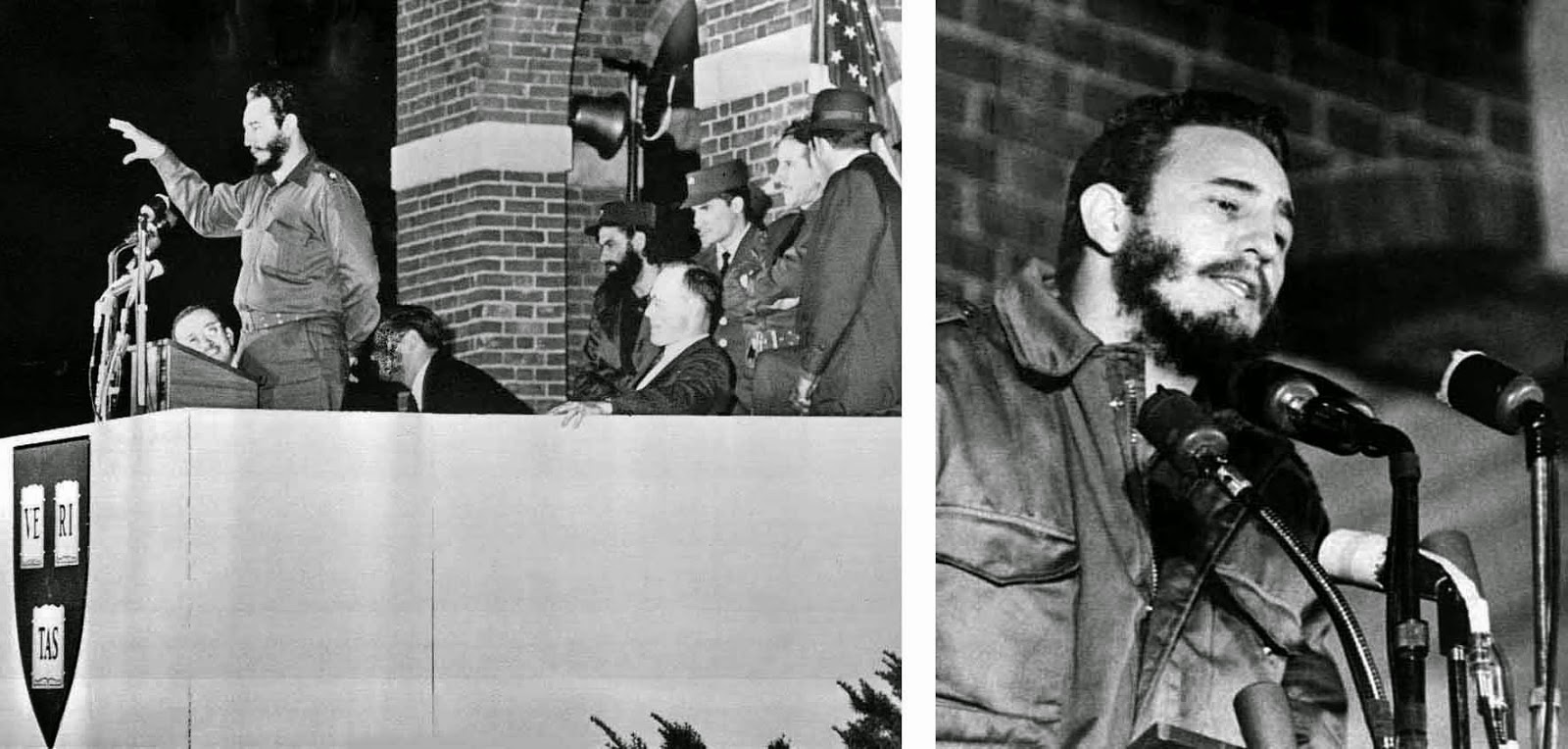

Castro speaking at the Harvard Field House

Fidel was a forceful rather histrionic speaker given to dramatic gestures. His remarks were billed as ‘The Cuban Revolution’, but he didn’t dwell long on past battles. Instead he gave a thoughtful, albeit rambling, speech on the problems of backwardness and underdevelopment plaguing revolutionary Cuba.

From the press, he well understood that Americans, in their enthusiasm for his victory over a dictatorial regime, were expecting democracy and the rule of law to follow, but he patiently explained the more immediate problems facing his government were hunger, mass illiteracy, and a level of unemployment greater in scale than during the American Depression.

Castro went on to say all things would come in due time, but for now elections – absent political parties – would have to be put off at least two years. And he added pointedly that rights of the criminally accused would have to wait until the revolution dealt summarily with the many who had administered the terror and carried out torture under the old regime.

Up to that point, he still had the majority of the audience with him, but then a law student called out a question about a recent criminal case in Havana. A couple of Batista’s pilots had attempted to bomb the presidential palace. They received a stiff prison sentence, but Castro, dissatisfied, ordered a retrial.
Second time around they got the death penalty.

Wasn’t that double jeopardy the questioner persisted? Castro bridled at the challenge, responding aggressively that the second trial was justified by the higher right of the revolution to defend itself. At that, a chorus of boos floated up from below.

Fidel grew visibly angry, and his speech dissolved into a rant as he occasionally slipped from English into Spanish. The crowd’s good will toward him began to ebb. The atmosphere in the field house complex had changed, and the evening ended on a down note for many there.

I went off to grad school a year later. Indiana University (IU) had given me fellowship money to study Soviet Russia. As it happened, brother Jeff also arrived in Bloomington for his Freshman year. I was delighted with the lively, competitive graduate school milieu – in the midst of the Cold War, Soviet Studies was the hottest field around.

Jeff, however, was unhappy at the university. He had graduated from a small Eastern prep school and felt lost on the vast campus, a virtual small city in itself. He had hoped to go to an Ivy League school where all his friends were, but Pop’s business reversal precluded a costly private college.

One of my friends in the Russian Institute was George Shriver. Like me, he had come out to IU from the East – from Harvard where he’d majored in Russian. While I was in the Political Science PhD program, George’s focus was Russian language and literature. Although I didn’t realize it at the time, George was also a left political activist.

At IU that fall he had quietly organized a campus chapter of the Young Socialist Alliance (YSA), the youth affiliate of the Trotskyist Socialist Workers Party (SWP). Then, from the small band of campus Trotskyists, George also spun off a local branch of the national Fair Play for Cuba Committee (FPCC) in support of the Cuban Revolution.


George Shriver speaking at an YSA meeting, Indiana University

As fall term ‘60 was coming to an end, George, as FPCC chair, was organizing a trip to Cuba over Christmas break. Jeff got wind of the trip and put his name down, but even though the cost was modest, he didn’t have the money. He wrote home for funds. While our parents were apolitical, they were wary of anything controversial when it came to their sons, so Jeff had to make a persuasive pitch since the US government considered Cuba leaning toward Communism.
____________________________________________________________________________________

Yet to come, the ill-fated Bay of Pigs invasion was an open secret in Miami émigré circles, and Castro’s forces were more than ready for them.
__________________________________________________________

In his letter, he explained that the trip was sponsored by FPCC, a national organization dedicated to offsetting critical media coverage of Cuba and giving the revolution a fair shake. He added:

   The Cuban government wants Americans to come there and judge the situation and the results of the revolution for themselves. There is nothing political involved. It’s just to have a good time and get informed on the real situation in Cuba.

Jeff asked me to add an endorsement to his letter, which I was happy to do. I knew he was drifting at IU and was glad to see him finally taking an interest in something.

Apparently the parents were persuaded, but in the end Jeff never made it to revolutionary Cuba. There weren’t enough takers, so the trip was called off. Not long after he dropped out of school and a year later found himself in my old military outfit. However, instead of sailing off to Europe as I did, he was taught Vietnamese and landed in Southeast Asia in the middle of a small war.

But I’m getting ahead of the story. By that spring of ’61 Cuba was back in the headlines. The time was JFK’s first 100 days, and he had adopted Ike’s animus toward Castro and, worse, his predecessor’s misbegotten plan to remove him from power – another hamhanded invasion of the island by Cuban exiles – although this time not a revolutionary vanguard, but a brigade of CIA-trained anti-Castro ‘patriots’.

Once again McGeorge Bundy, by then JFK’s National Security Advisor, was out front – serving as White House liaison to the Agency’s invasion planners. The ensuing Bay of Pigs fiasco is well-known – the whole ill-fated enterprise had become an open secret in Miami’s Cuban émigré circles, and Castro’s forces were more than ready for them.
         
The operation was a personal tragedy not just for the hundreds of brigadistas who survived, languishing in harsh Cuban prison camps for nearly two years – it was also a political disaster for America’s new young president. However, the image of his administration as a bunch of bunglers and himself personally as lacking in resolve only steeled JFK’s determination to get Castro. One of the President’s favorite maxims was ‘Don’t get mad, get even’.
         
After purging senior CIA people responsible for the debacle, JFK tasked the Agency to covertly eliminate Fidel – in a word, assassinate him. The hit plan, code-named ‘Operation Mongoose’, enlisted Cuban émigrés again, but this time the American Mafia as well – the very guys whose Havana casinos had been seized by the Castro regime in ’59.  

By summer ’62 the bizarre plotting to decapitate Communist Cuba was well underway.  Some of the looney ideas the plotters came up with included a lethal exploding cigar, exposing Castro to a fountain pen treated with poison, and, perhaps looniest of all, slipping a chemical into his shoes to cause his signature beard to fall out – that wouldn’t have worked anyway.

Unbeknownst to the US, that very summer Khrushchev was planning clandestine operations to carry out regime change in Guatemala, Honduras, and El Salvador, Latin American dictatorships firmly in the Western camp.

However, sensing that Kennedy might attempt another attack on Cuba, Khrushchev changed his mind and decided instead to secretly reinforce his new Caribbean client state, a move which would erupt in the coming months into the Cuban Missile Crisis – arguably the most dangerous moment of the long Cold War – but that’s a story for another post.
____________________________________________
*Manchester Guardian (December 4, 1956).


Wednesday, December 5, 2012

Antiwarriors Mobilize – Brothers Divergent

Brother Jeff and I returned to the States in the late spring of ’64, he from the Vietnam War still in its infancy, and I from the Soviet Union. I had just finished a year’s study of Marxist legal theory at Moscow University Law School. While I had been studying Communism, Jeff had been fighting it in Southeast Asia. How our experiences shaped us couldn’t have been more different.

We met again that summer at our parents’ place in Coral Gables outside Miami. It was an all too brief reunion – Jeff and I both had to get on with our stateside lives. I headed north to Washington to finish up research on my doctoral dissertation at the Library of Congress. Jeff went west, back to Indiana University (IU) – where I was taking my PhD – to complete his undergraduate education.†

Back from Vietnam – Jeff in Florida, Summer ‘64

A half year later Jeff and I were again off on our different trajectories, I starting my academic career at the University of Missouri (Mizzou), Jeff beginning spring term at IU. I was teaching introductory courses on politics and international relations along with an upperclass course on Soviet politics with no prior classroom experience.
 
Jeff was taking a full course load, including US and comparative politics, American intellectual history, a course on the novel, and a course on totalitarian political patterns—totalitarianism at the time was very much in vogue as a descriptor of Soviet Bloc and Asian communist regimes. Colleagues and I would later successfully challenge the concept, but that’s another story.
 
Meanwhile back in South Vietnam (SVN), the low-key war had been steadily heating up. The South Vietnamese army (ARVN), assisted by some 15,000 US military advisers, was fighting a communist guerrilla insurgency against the Viet Cong (VC) supported by North Vietnam (NVN). The war was not going well for SVN, which had persuaded the late President Kennedy (JFK) to accede to the South Vietnamese generals’ coup against President Diem in November ’63.
 
Unfortunately, the situation in Saigon had only grown worse following the coup. A junta of generals, divided among themselves, could not effectively govern. Political instability combined with military ineptitude weighed down the floundering regime. A second coup toppled the junta a few months later.  Then followed a series of coups and attempted coups throughout ‘64. None of this confusion was lost on the VC, nor on their military mentors in the North. By early ’65, the VC had achieved de facto control of large parts of the country.
 
All this produced alarm among the Washington policy makers. The CIA had forecast that the time was near when the VC could triumph. The US guarantee of the independence of a non-communist SVN was at stake. More and more, the emboldened VC were infiltrating the cities and populated areas specifically to attack US military facilities and places where American personnel gathered for recreation.
 
On January 20, 1965, President Johnson (LBJ) was inaugurated, and just two days at a confidential briefing of the congressional leadership he broadly intimated that he was about to begin bombing North Vietnam. All he needed was a pretext; the VC obliged in early February with a destructive attack on the American base at Pleiku in the Central Highlands, and LBJ responded with air strikes against NVN. A few days later, a concerned Jeff wrote me, “I could get recalled very easily (Ready Reserves, Vietnamese linguist, Intelligence experience).”
 
It was soon evident that the retaliatory strikes had been pre-planned dress rehearsals for a full-scale bombing campaign, code-named Rolling Thunder, that was launched in March. Marine combat battalions soon followed to secure the air bases from which strikes against the North were being flown. By those two abrupt moves, LBJ had dramatically escalated the war. The sudden exponential increase in American involvement in the civil war of a country most people couldn’t find on a map, in turn elicited a sharp negative reaction among faculty and students at a number of major universities.

♫We'll smash down your doors, we don't bother to knock
We've done it before, so why all the shock
We're the biggest and the toughest kids on the block
And we're the Cops of the World, boys
We're the Cops of the World
††

The University of Michigan at Ann Arbor quickly became the focal point of opposition to the escalation. A number of UM students were veteran activists of the civil rights movement in the South, and the campus had a strong chapter of SDS, Students for a Democratic Society, a national organization formed there in the early ‘60s. Michigan was also home to a sizeable number of politically active professors. These forces came together to organize what became the first ‘Teach-In’ on Vietnam, an initial step toward what would eventually become a nationwide antiwar movement.
 
As a political and moral response to Washington, a group of Michigan faculty planned a one-day teaching strike. The strikers would refuse to teach their regular classes and instead spend the time introducing interested students to the critical issues of America’s war in Vietnam. Nearly 50 professors signed up, but Governor George Romney and the university president opposed the strike. At the 11th hour, a compromise was reached: instead of cancelling classes, concerned faculty would teach their courses, but continue teaching through the night; thus was born the idea of a teach-in as a forum for informed protest.


Ann Arbor Teach-In Poster
 
The first teach-in began at 8 PM on Wednesday, March 24th and went on through the night until daybreak the 25th. The dorm curfew for women was suspended, greatly swelling the turnout to over 3,000 students; along with 200 faculty, it was the largest demonstration in the university’s history.
 
The main speakers were two academics with field experience in Vietnam who knew the country well, an economist from the East, and a Michigan State anthropologist. One speaker recited Vietnam’s long history of fending off invaders, while the other simply pronounced the war unwinnable.


University of Michigan Teach-In, March 24-25, 1965

At other colleges and universities, small groups of activists gathered to listen in to the Michigan speakers via telephone hook-ups. At IU, Jeff was undoubtedly one of the best informed on the subject, judging by the discussion of Vietnam in his letters from that period.


Activist Leaders at Indiana – Bernella & David Satterfield, ‘64

Thanks to national media coverage of the Michigan event, the teach-in format was soon replicated at over 100 other campuses, including the University of Missouri. At Mizzou, however, the organizers decided to stage a teach-in as a balanced debate between pro- and anti-Administration speakers. In contrast to brother Jeff’s growing opposition to US policy, I along with an American historian was the lead debater on the pro side of the question. We were opposed by two scholars of South Asia, one a political scientist, the other a historian.
 
For nearly five hours, the four of us debated US policy in Vietnam before an audience of 500+ students crammed into an auditorium in the Business School. The South Asian specialists both viewed the Vietnam conflict in historical and regional contexts, emphasizing the need for a negotiated settlement before the US got in too deeply. At the time as a JFK liberal internationalist, I looked at the problem within the framework of the bi-polar Soviet-American Cold War conflict.
 
The Cold War was then at an uncertain point. Khrushchev, a reformer, had been ousted from power in Moscow by a coalition of former Stalinists just six months earlier. Although he’d been aggressive in the international sphere (witness the Cuban Missile Crisis of ’62), the following year he’d agreed to JFK’s proposed treaty banning nuclear tests in the atmosphere – a very important step in the effort to slow down the dangerous arms race. By the spring of ’65 when I spoke at Mizzou, the full foreign policy intentions of Khrushchev’s successors, especially in the former colonial world now called the Third World, were by no means yet clear.
 
Hence, I saw Vietnam as a surrogate war between NVN, a Soviet and Chinese Communist ally, and SVN, a US ally. In those years, the US had put in place a policy of global ‘containment’ by means of an encircling network of bases and military alliances. The idea was to keep the Soviet empire and, by then, its rival Chinese sphere of influence, in check, i.e., not permit either the Soviets or the Chinese to extend the authoritarian communist model beyond their borders.
 
The US was particularly concerned about the Third World, which was undergoing rapid decolonialization that left power vacuums in its wake. South Vietnam was, of course, a Third World country; from a Cold War angle of vision, both the USSR and China were probing, via their proxy NVN and its agent, the VC, to expand the international communist domain to the South. No one, not even the ‘doves’ had any illusions that the North could carry the fight to the South without massive military and economic aid from the two giants of the Communist world.
 
After the debaters presented, the Mizzou audience was invited to pose questions or make short statements from the floor. In retrospect, the most prescient remark of that long afternoon was made by Professor William Allen, a noted young historian of Germany. He vigorously opposed US policy and advocated complete withdrawal from Vietnam. Of course, he was right.

♫It's written in the ashes of the village towns we burn
It's written in the empty bed of the fathers unreturned
And the chocolate in the children's eyes will never understand
When you're white boots marching in a yellow land†††
 
At the end of the debate, the moderator asked the audience to signal by applause which set of arguments they found most persuasive. While both sides found support, by dint of applause, the pro-Administration position seemed to prevail.
 
Most notable of the post-Michigan teach-ins were the national teach-in in mid-May and the ‘mother’ of all teach-ins that season, the huge one at Berkeley toward the end of the month. At the national event in Washington, broadcast live on radio and television throughout the country, two leading specialists on Vietnam, Kahin of Cornell and Scalapino of Berkeley, duked it out.
 
The Berkeley affair attracted an aggregate of 30,000 participants from the San Francisco Bay area listening to nearly 50 speakers over a period of 36 hours, by far the longest and the largest teach-in that spring. Although not intended as a balanced debate, at least one pro-Administration speaker was included. He and the lead-off presenter ended up as polar opposites in the spectrum of comments at the teach-in – one wildly idealistic, the other darkly dystopian.
 
A historian from Yale opened the teach-in, proposing civil disobedience so massive and persistent that LBJ and his war cabinet “will forthwith resign.”* At the other end of the spectrum, a Berkeley political scientist foresaw – absent continued US resistance – SVN as “Communist totalitarian regime” with a regimented population wakened in the mornings to the sound of bugles and forced to work long days in pursuit of the regime’s goals.**
 
That first turbulent spring of the newly escalated American war in Vietnam came to an end with what would become legions of ‘antiwarriors’*** mobilizing on the nation’s campuses. As for Jeff and me, our respective academic business finished for the summer, we continued our separate ways – he off to Mexico to hang out with friends; I to Washington to advise on US-USSR arms control. Brothers divergent.
 
*L Menashe, ed, Berkeley Teach-In: Vietnam (1966), 3

**Ibid

***The term is from Melvin Small, Antiwarriors: The Vietnam War and the Battle for America’s Hearts and Minds (2002)† 


††† White Boots Marching in a Yellow Land:  http://www.youtube.com/watch?v=Fq42reX_MPA

Wednesday, October 24, 2012

Death in Saigon, Camelot in Disarray

The story began on a steamy day in Foggy Bottom, late August, Washington, ’63, and played out with all the elements of a fictional spy thriller. Thanks to the passage of time and declassification, we can now eavesdrop on the highly secret daily moves within the US government (USG) that led to the coup in Saigon. A year earlier, JFK had installed a taping system, and recently the audio tapes and follow-on memoranda as well as a lengthy, detailed Central Intelligence Agency (CIA) history of events have all been made public.

Foggy Bottom was a local name for the State Department complex along the Potomac River. Everyone of importance was out of town, Jack Kennedy (JFK) up on Cape Cod at the family compound, the Secretary of State at the United Nations (UN) in New York, the CIA chief at his California get-away, the Defense Secretary and others out of reach on that end-of-summer weekend.

Three senior diplomats remaining in the capital kept an eye on US-South Vietnam (SVN) policy. Recent news had not been good, and cables from Saigon indicated conditions in SVN were getting much worse. President Diem’s brother Nhu, the de facto secret police chief, had just sent squads of Special Forces and combat police into three major Buddhist pagodas, and over a thousand priests and nuns had been roughed up and arrested. Reportedly, several hundred were killed.

Since spring, the predominantly Catholic government of Diem had been in sharp conflict with the Buddhist religious establishment, which represented the predominantly Buddhist population. It had started on a minor note to which the regime had reacted violently, killing nine unarmed civilians. In reaction, saffron-robed Buddhist monks called bonzes had begun martyring themselves in public squares – gasoline and a match – creating shocking photos on the front pages of the world press and embarrassing the regime’s patron, the United States.

The US, present when SVN was established and Diem installed in the mid-‘50s, by then had much political capital invested. The escalating Buddhist crisis was distracting attention from the government’s flagging fight against Communist North Vietnam’s insurgency, and Washington became concerned. Things weren’t going well with the US client state anyway – endemic corruption and resistance to reforms to engender popular support had become the norm.

On July 4th 1963, the US Embassy in Saigon threw its annual Independence Day party. A number of senior South Vietnamese Army (ARVN) generals, including General Tran Van Don, ran into an ex-comrade in arms, Lou Conein. French by birth, American by citizenship, a long serving hand in the Saigon CIA Station. Conein had first arrived in Vietnam in ‘45 as a WWII OSS* operative, and had fought alongside some of officers now generals in driving the Japanese occupation forces out of Indochina. His old friends invited him to join them for drinks at the nightclub at the Hotel Caravelle where they revealed they were planning a coup against Diem, and asked Conein to find out what Washington’s attitude would be.


General Don, coup plotters’ contact with Conein for US Embassy

Conein reported back to them that the US was non-committal, but would not stand in the way – what the conspirators hoped to hear. Planning began, then on August 21st the raid on the pagodas occurred, and Nhu falsely implicated the generals. They were furious, it was the final straw.

The next day, they sent word to the American Embassy asking the USG for a signal. It was the very day the new ambassador, Henry Cabot Lodge, arrived. He’d been briefed earlier and was disposed toward regime change. He cabled State for instructions and ordered Conein to liaise with the cabal. In addition, a team of Army Security Agency (ASA) linguists (lingys), including brother Jeff Sharlet, were quickly flown into Saigon from Clark Air Base in the Philippines (PI). Set up at an out of the way base, their classified mission was to tap into the conspirators’ communications.† 

Lodge’s urgent cable reached Washington that humid Saturday morning, instantly setting in motion a flurry of activity. Since spring the President himself and most of his senior advisers had become disenchanted with Diem’s leadership, especially his brother’s actions. It had become clear that the war against the insurgents would not be won without a regime change.

The ambassador needed immediate guidance, so the key officer, Assistant Secretary of State for the Far East Hilsman, and his superior, the Deputy Secretary of State, began urgently drafting strong, unambiguous instructions for regime change in Saigon – at the very least, the removal of Nhu.

Protocol required that the communication be approved by the Under Secretary of State who was in town, but at the golf course. With the cable in hand, the draftsmen rushed out to Burning Tree Golf Course where they caught up with Secretary Ball at the ninth hole. Ball insisted on calling JFK at his Hyannisport retreat. The President suggested circulating the draft for more approvals.

By Saturday evening, Rusk had been reached at the UN, as well as the acting chiefs at the Pentagon and CIA, and the Joint Chiefs of Staff. Shortly after 9 PM, JFK’s White House Vietnam adviser telephoned him at the Cape and secured final approval. At 9:36 PM, the cable that would irreversibly transform America’s commitment in Southeast Asia went off.

Marked ‘Top Secret’ and ‘Eyes Only – Ambassador Lodge’, the text was as direct as diplomatic language permitted. The ambassador was to see Diem forthwith to say that the USG could no longer tolerate Nhu, but if Lodge’s efforts were to no avail, then, in the delicate phrasing of high diplomacy, “we must face the possibility that Diem himself cannot be preserved.” The key generals were to be told that if Diem proved obdurate about his brother, then the USG is “prepared to accept the obvious implication that we can no longer support Diem” himself. The ambassador was assured that Washington would back him “to the hilt.” As history has recorded, a ‘green light’ had been given.


Ambassador Lodge and President Diem

On Monday, August 26th, with all the foreign policy principals back in town, there was alarm that the cable had been too strong, even incendiary. The President’s advisers were divided – McNamara at the Pentagon, McCone of CIA, and General Taylor of the Chiefs all felt that Hilsman, Harriman, and Ball had gone too far. Concerned over the divide among his inner circle, JFK quickly convened the National Security Council.

At that first of many meetings, the President served as moderator, generally questioning rather than expressing his views. However, at the outset when several inner circle people proposed withdrawing the cable, JFK rejected that course of action.

Despite the concern over the tone of the cable, Hilsman led off the initial session, expressing the broad consensus that Nhu had to go. He added that the two key generals who had sent word to Lodge told their US contacts “you have got to make up your mind.” From where the generals stood, things had reached a critical point, and the USG could no longer sit on the fence. JFK called another meeting for Tuesday and asked that Ambassador Nolting, the outgoing Saigon envoy be present. McNamara suggested designating the policy group an Executive Committee or ExComm.

As the ExComm went through a series of meetings that last week of August, no clear agreement on what to do about the situation in Saigon had been reached, and the President was beset by indecision.

On August 28th, domestic politics momentarily intruded on the ExComm deliberations. That was the day of the great march on Washington, 250,000 strong, culminating in Martin Luther King’s (MLK) iconic ‘I Have a Dream’ speech at the Lincoln Memorial.  JFK broke off a late afternoon session to receive MLK and a delegation from the historic event.

 
MLK (l) leading a delegation to meet with JFK (r), August 28, 1963

Although JFK was deeply skeptical about its likelihood of success, he decided at the next day’s ExComm on one more attempt to get Diem to oust Nhu. If it failed, the ambassador was to learn of the generals’ plans, but without committing the USG. Ruefully, JFK observed that America was “hip-deep in mud in Vietnam” and if he let the country go “down the drain,” Congress would be madder than hell.

JFK remained distressed that his closest advisers disagreed, not only in Washington, but at the Saigon embassy where Lodge was an enthusiastic coup proponent while the general commanding the military advisors, essentially a career staff officer an old cavalry officer with no knowledge of guerrilla warfare, was doubtful and the CIA station chief less than keen. However, as the leading authority on the secret history of the Vietnam War has concluded: “In effect the President rejected an immediate coup, but accepted that one would eventually take place.”**

By the end of that hectic week in August, JFK directed a cable be sent leaving the initial green light signal on the table, but expressing his second thoughts. No doubt divining Washington’s hesitation and ambivalence, the generals, who were risking their lives and feared possible betrayal either by one of their own or even the Embassy, abruptly suspended planning for a near-term coup. The diplomatic reason given – they didn’t feel ready.

The pressure was off at the embassy, but Jeff and the ASA team continued their covert assignment on a 24/7 basis, recording and translating the intercepted communications of the target generals, and no doubt highlighting key words that turned up. Their ‘product’, destined for the National Security Agency, was so politically sensitive that it was rigged to explode should the guards be stopped enroute to the airport for the flight to Washington by South Vietnamese police or military personnel.

Decades later Jeff’s buddy, the late Ed Smith††, told me that at the time they had no idea why they were listening in on US allies. Despite their top secret and cryptographic security clearances, the ‘big picture’ was well above their pay grade. Jeff and the intercept team did not have ‘Need to Know’, a concept I understood well from my own ASA experience in Cold War Europe where  the translator working next to me and I were not permitted to discuss our respective work – compartmentalization was the name of the game.

September arrived, and nothing had changed in Saigon. The bumbling Diem remained blissfully unaware of the real state of affairs in the country, having long encouraged overly optimistic reports. Even his brother Nhu privately referred to the regime as ‘mandarin’ and ‘feudal’. Washington’s dilemma was that while the war was unwinnable with Diem in power, they foresaw political instability and a lost cause in the long run without him.

Meanwhile, Saigon was awash in rumors; an observer commented that the “city seemed as taut as a piano wire.”***  The senior conspirator of the summer plotters, General Minh, known as ‘Big Minh’, asked the CIA contacts to keep the lines of communication open, so Conein, under orders from the ambassador, listened and reported through channels.

Lodge himself remained committed, but like JFK in Washington, he presided over a divided house. By all reliable accounts, things were not going well in South Vietnam, but his CIA chief, Jocko Richardson, tended to minimize the political crisis while his military adviser, General Harkins, written off by history as a “compelling mediocrity,”**** kept unrealistically insisting the war was going well. To reduce the dissonance, the ambassador engineered Richardson’s recall to Washington while JFK, anxious to gain more clarity, dispatched General Taylor and State’s Walt Rostow to Saigon on a fact-finding mission.


JFK,  Gen Taylor, and Sec McNamara conferring, September 24,1963

Then in early October, the USG learned the Saigon generals had resumed coup-planning. All indications were that they were in earnest. General Don, now liaison for the plotters, ran into Agent Conein and invited him to his office to learn the latest developments. Don passed on that Big Minh wanted to meet with Conein; they met for an hour, and Minh expressly asked Washington’s stance on a coup. He stressed that they were not seeking assistance, just assurance that the USG would recognize the post-coup government.

That promise came back quickly from JFK who directed the Embassy not to encourage a coup, but not to discourage one either. Essentially it was a repetition of the ambiguous signal of August, but satisfactory to the generals. They just wanted to be sure as they proceeded that the Americans would not betray them to Diem and Nhu.
 
Washington now became uneasy relying on Conein as its sole conduit to the conspirators. More a man of action than reflection, he wasn’t the ideal person to convey and negotiate USG positions. For the generals, however, there was no question of any other liaison – they knew Conein well and trusted him. So he remained Washington’s ‘man in the middle’. To throw off any possible surveillance by Nhu’s people, Conein and Don would meet seemingly by chance in nightclubs, at the airport, and even at the dentist they coincidentally shared, or use cut-outs, intermediaries, since both men were well-known around Saigon.

Conversely, from their side the generals wanted to be certain Conein was speaking with authority. An unobtrusive meeting was arranged at the airport between General Don and Ambassador Lodge as the ambassador awaited a flight. Don asked him in French for whom Conein spoke. Lodge replied unequivocally, “Il parle pour moi. Il me représente." (He speaks for me. He is my representative.)

Unexpectedly a ‘monkey wrench’ was thrown into the works when Harkins, a protégé of General Taylor, who opposed a coup, on his own initiative told General Don to cease and desist the plotting. Alarmed that the Americans had changed their collective position, the generals sought clarification. Conein told Don that the general had been out of line, and the ambassador, although an old Boston friend of Harkins, quickly set him straight. Meanwhile covering all bets back in Washington, the CIA director assured JFK that if the coup went awry, the Agency would disavow Conein as a rogue agent.
 
By mid-October, Jeff, Ed Smith, Fred Baumann, and their team finished their stint and headed back to the PI, but the surveillance mission continued with another group of lingys sent out from Clark Air Base. Meanwhile, Conein was instructed to ask Big Minh and the generals for their operational plans so the USG could evaluate the odds of success, but the plotters dithered and promised only to give the embassy 48-hour advance warning. Back in Washington, confidence in the outcome waxed and waned as the ExComm constantly reviewed the order of battle of rebel and loyalist forces.


The President, already quite uneasy, was getting mixed messages from his people. Ambassador Lodge came on strong while General Harkins via a backchannel was feeding Taylor dissent. Near the end of October, JFK signaled Lodge to slow things down, but the ambassador cabled back it was too late. The US was implicated, and at that point events in Saigon were beyond its influence.

 
On November 1st 1963, the conspirators’ promise of two days’ warning dissolved into four hours when they summoned Conein. Arranging for a Green Beret team to guard his family should the coup fail, Conein rushed off with a radio and his sidearm to coup headquarters from where he radioed the embassy a stream of reports for the next 18 hours.
 
The generals had planned well; loyalist forces were neutralized, but Diem and Nhu remained at large. Finally promised safe passage out of the country, the brothers surrendered, but soon after were assassinated by a special unit loyal to General Minh.
 
The unexpected news of the killings shocked official Washington. It was front page news around the world – I read about it in Izvestiia in Moscow†††. When the President received the news, he turned ashen, jumped up, and rushed out of the room. His close adviser, Arthur Schlesinger, later said he had never seen JFK so distraught since the Bay of Pigs fiasco in ’61.
 
Whatever his intentions for Vietnam might have been, JFK was too shrewd not to instantly grasp that the United States was complicit in the death of a head of state, and, absent a successor to ensure political stability, America would be stuck in Vietnam.
 
Camelot, the aura of style, grace, and, above all, effectiveness in the world at large, was in disarray. Then a mere three weeks later with the assassination of the young president, the Camelot on the Potomac passed into history as a brief moment of unbridled optimism, the romance of great power, and, yes, unchecked hubris.
________________________________________________
 
*The Office of Strategic Services or OSS was the United States’ clandestine military arm during WWII, and precursor of the CIA established in 1947.

**J Prados, Kennedy Considered Supporting Coup in South Vietnam, August 1963, National Security Archive Electronic Briefing Book No. 302 (2009), 15. http://www.gwu.edu/~nsarchiv/NSAEBB/NSAEBB302/index.htm

***R Phillips, Why Vietnam Matters (2008), 200.

****D Halberstam, The Best and the Brightest (1972), 183.

† http://jeffsharletandvietnamgi.blogspot.com/2011/06/conein-lawrence-of-vietnam.html

††† http://jeffsharletandvietnamgi.blogspot.com/2011/10/surveilling-and-surveilled.html


Wednesday, September 12, 2012

The Mountains of Laos

From the entrance of the squad tent, Jeff could see the mountains of Laos. Brother Jeff Sharlet was in the narrowest, most northern part of South Vietnam serving at an American base near the small ville of Phu Bai in 1964. From where he stood, the South China Sea was to his left; to his right was the rugged Annamite Range as far away as Laos, maybe 50 miles as the crow flies.
 
Jeff was an American ‘military advisor’, one of 16,000 sent mostly by President Kennedy to help South Vietnam (SVN) quell a guerrilla insurgency guided from Communist North Vietnam (NVN).  At that point it wasn’t much of a war, what political scientists called a low-intensity conflict with hard fighting between the SVN Army (ARVN) and the insurgents in the far south in the Mekong Delta as well as occasional hit and run skirmishes in the Central Highlands, but relative quiet around Phu Bai not far below the DMZ and the border with NVN. From Hanoi’s strategic perspective, the action was in the more populous southern part of the country in and around Saigon, the capital.
 
Phu Bai was a very small  outpost relative to regular military bases. Jeff’s outfit was called Detachment J, a subunit of the 3rd Radio Research Unit (RRU), the euphemism for the intelligence-gathering facility tucked away behind barbed wire at Saigon’s Tan Son Nhut Airport. The 3rd RRU and Det J were part of the Army Security Agency (ASA), an independent communications intel agency nominally within the Army, but actually under aegis of the National Security Agency (NSA) in Washington. In effect, Phu Bai was NSA’s listening post in closest proximity to NVN.
 
It was an ASA installation, but the base also accommodated a much smaller Marine unit doing much the same thing. ASA intercepted NVN military land communications while the Marines’ beat was the small coastal NVN Navy’s ship to shore and ship to ship communications. Both units were made up of Vietnamese linguists like Jeff, Morse code operators, cryptographers, security guards. and the usual logistical personnel.
 
Marine corporal Dave Reinhardt was in the first Vietnamese class at Army Language School in Monterey CA; he’d been assigned to Phu Bai with the 1st Composite Radio Company, a unit attached to the 3rd RRU, the year before Jeff arrived. Phu Bai was not far from the ‘street without joy’, a stretch of highway named by the French who had been frequently ambushed there during the First Indochina War (1946-54).* Dave described the area as peaceful in 1963, with little evidence of the insurgent Viet Cong (VC) – except for road mines. The terrain was mostly flat with little vegetation. Right across from the base was an old French airstrip, the control tower abandoned, but with a long enough runway in good condition for large US military aircraft to land.
 
A year later in ’64, the Pentagon (DOD) began taking a greater interest in remote Phu Bai. Up to that point, the Central Intelligence Agency (CIA) had been responsible for running ‘black ops’, clandestine operations, against NVN, although most of its efforts had ended in failure. Defense Secretary McNamara decided DOD could do a better job and lobbied the White House. In mid-January President Johnson (LBJ) authorized OPLAN 34A, a comprehensive plan described as “a wide variety of sabotage and psychological operations [psy ops] against North Vietnam.”** The centerpiece would be to continue cross-border commando infiltrations, which DOD took over from the CIA on February 1st.
 
Coincidentally, that was the day after General Khanh carried out a coup against the military junta that had overthrown President Diem several months earlier. As soon as the US got an inkling the coup was underway, Jeff and a contingent of linguists were sent back to Saigon from their home base in the Philippines, but since the coup was quick, bloodless, and successful there was nothing for them to do. However, DOD needed to rapidly strengthen the small ASA detachment at Phu Bai, which would be tasked as communication liaison with SVN commandos infiltrated into NVN as well as for psy ops, so orders were cut for Jeff and a dozen other ASA personnel to report to Det J.
 
Arriving at Phu Bai, Jeff found a ramshackle jumble of low buildings, high antennas, communication vans, large squad tents, a truck park, and construction sites in various stages of completion. The whole assemblage was surrounded by barbed wire with a single gate manned by a couple of ASA security guards armed with .45s. The topography was pretty barren except for a small hill of just under 600’ used for additional antennas. Outside the wire was an old, overgrown Vietnamese cemetery, most likely the graveyard for the nearby ville of about 7,000 inhabitants.


Construction at Phu Bai base, 1964
 
The nondescript buildings housed the communications and intercept equipment as well as the work areas for the lingys, crypts, and ditty boppers, as the ASA guys called their specialties. Most of them were billeted in the large tents set on wooden platforms with space for eight cots with mosquito netting and footlockers. Wooden walkways linked the tents to other parts of the base. Given the heat, humidity, and flying insects of Southeast Asia, at night the side flaps were usually up and mosquito nets down. Jeff and his bunkmates posted a sign out front reading:

CANVAS CASTLE MOTEL – 3
·         Air conditioning
·         Wall to wall plan
·         Scenic view
·         Floor show nightly
NO VACANCY
 
Amenities were minimal. There was an enlisted men’s club with cheap booze and a jukebox; a small PX, or military store that sold liquor, beer, and toothpaste; a one-chair barber shop in a wooden hut, a tent with some workout equipment; and the mail room. The touchdown of the C-123 Caribou mail plane was a daily event. Less welcome were the nearby ARVN heavy artillery unit firing randomly and thunderously day & night and the constant hum of powerful diesel generators powering the base’s equipment—both of which took some getting used to, as Jeff wrote home.

The classified work required attention, but otherwise formal military duties were at a minimum. Given the steamy climate, the standard uniform would barely qualify as military-informal. Occasionally the men were trucked outside the compound to a rifle range to practice firing their carbines. When someone asked why the truck bed was covered with sandbags, the answer was, ‘road mines’. Otherwise, no ammo was handed out, probably as a safety measure, since few if any ASA troopers had weapons experience.

Jeff worked alongside a congenial group of young college guys like himself—Ralph Adams, John Buquoi, Bill Jernigan, Peyton Bryan among others. Ralph Adams was the best linguist and served as the base commander’s (CO) interpreter for administrative business with local Vietnamese. Later Ralph would make a career with the NSA, rising to executive director before retirement.

 
Ralph Adams off duty talking to a Vietnamese boy

As the CO’s aide, Ralph had use of a jeep he’d occasionally loan to Jeff and his buddies. Off duty they’d don civvies and roam the countryside – north to nearby Hue on the coast, south over the picturesque Hai Van (Sea Cloud) Pass to Danang, and occasional afternoons at white sand beaches on the South China Sea.

By late May ’64, Jeff finished his Vietnam tour and headed back to the States, to ‘the world’ as GIs would later say. Not long afterward, a major event in what became the American war in Vietnam occurred. A US destroyer on an electronic surveillance mission in the Gulf of Tonkin cruised close to the NVN coast well within the 12-mile international waters limit, drawing the attention of NVN torpedo boats. A brief sea skirmish occurred.

The destroyer escaped unscathed thanks to warnings from the Phu Bai Marines who intercepted the attackers’ communications, but a furor ensued in Washington. On the basis of bad information and worse advice, LBJ used the incident as a pretext to launch a heretofore secret air strike against NVN. Planes from the carriers Ticonderoga and Constellation carried out 64 attacks on NVN naval facilities ashore. Far more consequential, LBJ used the patriotic fervor whipped up by ‘Operation Pierce Arrow’ to push through an almost unanimous Congress a loosely worded resolution that he, and later President Nixon, would use to provide political cover for our subsequent long involvement in Vietnam’s civil war.

Security began to tighten at the ASA base after the Tonkin crisis. Everyone pulled night guard duty once or twice a week using parachute flares that cast spooky shadows to illuminate the area. The man assigned to guard the sandbagged radio direction finder outside the perimeter at the air strip was given a couple of grenades and the reassuring company of a guard dog in addition to his weapon and ammo. One of the GIs, noting all the on-base construction and the new runway being added across the road, figured something was afoot.  He was right.

As we learned much later from the leaked Pentagon Papers, LBJ was secretly laying the groundwork for a planned escalation of US involvement. A usable justification arrived just over six months later in February ’65 at Pleiku in the Central Highlands. The VC carried out a devastating attack on US military advisors’ barracks, so the President commenced a systematic bombing campaign, Rolling Thunder, against NVN and sent in the first combat units. As National Security Advisor McGeorge Bundy subsequently explained, “Pleikus are like streetcars;” in effect, it was a convenient vehicle for the planned escalation.***

A Marine battalion (bttn) was assigned to defend Danang airbase; another was sent north to provide security for the top secret operations at Phu Bai. Because ASA guys had minimal military training, the unit commander strengthened the bunker network, added more wire to the base perimeter, and stepped up weapons practice to include light machine guns and bazookas.

As the war increased in intensity with hundreds of thousands of American troops in-country, the heretofore distant base at Phu Bai was no longer a backwater immune from armed clashes and casualties. By the late ‘60s, Phu Bai personnel had increased from a few hundred in Jeff’s day to several thousand to become the largest ASA unit world-wide. By then, the Agency no longer had the place to itself.

With VC bttns and North Vietnamese Army regulars maneuvering in the operational area that the US Saigon command called I Corps, the 1st Marine Division took up residence followed by the Army’s elite 101st Airborne (ABN). Phu Bai and its environs became a vast military camp, home to tens of thousands of combat troops and their command headquarters. The once largely empty terrain had become quite congested with barracks and facilities for large fighting formations.


Phu Bai in the late ‘60s: Marine Hq and an Address board for 101st ABN units

In ’69, Phu Bai, an otherwise obscure dot on military maps, acquired sudden visibility in the world press and the halls of Congress (publicity unwanted by the principals involved, as it turned out). In early May, General Zais, CO of the 101st ABN, ordered elements of the division with Marine support to assault and take an enemy-held peak with in the Annamite Range abutting Vietnam’s border with Laos. Their assignment – to attack and destroy, or ‘attrit’ in the parlance of the US mission in Vietnam, the opposition.

As not infrequently happened, US intelligence underestimated the NVA’s strength, so the force sent to do battle was inadequate. Although the elevation was just over 3000’, it was a steep climb through bamboo thickets, waist-high elephant grass, and triple canopy jungle. The opening attack went badly; friendly fire killed two paratroopers and wounded 35, the first of five such incidents in the course of the battle. Subsequent assaults went little better against a battle-hardened NVA regiment firing downhill from well concealed, heavily fortified bunkers, trench lines, and fighting holes.

US air power was not effective in the visually impenetrable terrain, and the 101st began taking significant casualties. In fact, the enemy was so disdainful of air attack that their cooking fires were openly visible. In spite of mounting losses and an incredibly challenging battlefield complicated by weather and mud, command kept sending the survivors back up the hill for 10 days of brutal fighting when the summit was finally reached. After a massive bombardment by 150,000 pounds of napalm, 20,000 artillery shells, and 1,000,000 pounds of bombs, all they found was a small rear guard, the main force off to fight another day. Finding a piece of cardboard, a GI scrawled on it in large letters ‘Hamburger Hill’ and attached it to what remained of a tree. Another paratrooper added the words, “Was it worth it?”

In the midst of the fighting, a US wire reporter interviewed commanders as well as bloodied troops, many of whom were enraged at the high death toll, and wrote a scathing article, calling the engagement a ‘meatgrinder’. The public was shocked, and members of Congress led by Senator Ted Kennedy attacked the operation using words like ‘savagery’, ‘senseless slaughter’, and ‘madness’. General Zais and other senior commanders received sharp criticism. Back in barracks at Phu Bai, the hat was reportedly being passed to raise a $10,000 bounty for taking out the general.

In the long American war of attrition, holding ground was never a tactical objective, so US troops left the mountain, which the NVA predictably reoccupied soon after.  As a kind of epitaph, a Vietnam veteran and military historian has written that the Battle of Hamburger Hill became “an enduring symbol of the overall futility of America’s war in Vietnam.”****

*B Fall, Street Without Joy (1961)

**J Prados, Keepers of the Keys: A History of the National Security Council from Truman to Bush (1991), 201

***D Halberstam, The Best and the Brightest, (1972, 1973), 646

****J H Willbanks, “Hell on Hamburger Hill,” Vietnam (June, 2009), 24