In
the time between the world wars, our father, like so many Americans, had visited
Cuba’s exotic capital in the interwar period. He was in Havana in 1930 during
the country’s heady Republican Period, but decades later my brother Jeff and I
had only passing awareness of revolutionary Cuba of our own time. We’d both seen the family photo of Irving as a
young man – he was 21 – dressed to the nines with a good looking blonde at the
bar in Sloppy Joe’s – the famous celebrity hangout on Cuba’s Golden Riviera.

Irving Sharlet
(l), our father, in Havana, 1930
Irving
had grown up in comfortable circumstances; he had some money and was something
of a playboy. At the time, Prohibition reigned as the law of the land in the
States. To get a drink without a password in a back alley speakeasy,
well-heeled Americans would sail off to Europe or head to the Caribbean to
relax with a highball in fashionable public places. Sloppy Joe’s was one of the
in-places, just off-shore so to speak, where one might see John Wayne or Clark
Gable or even Cuba’s most famous North American visitor, Hemingway, down the
bar.
Decades
afterward during the postwar period when dramatic changes began happening in
Cuba, the island country was on the periphery of our young lives. Jeff in his
short life – he died at 27 – had been heavily involved with Vietnam. Serving
there early in the growing conflict, he later became an international leader of
GI opposition against the war. I became an academic, a specialist on the Soviet
Union, where I had studied and visited periodically. I spent most of my adult
years teaching and writing about the country.
Still,
as the Cuban Revolution emerged in the ‘50s and consolidated in the early ‘60s,
quite serendipitously Jeff and I bore witness to some of the salient moments of
the island’s transition from a popular Caribbean tourist destination to the
epicenter of the global Cold War. Cuba first came to my attention unexpectedly in
late fall ’56. In the phrase of the day, I was fulfilling my military
obligation in the army.
___________________________________________________________________________
The rebellion in Cuba is over, and students of foreign affairs can now
give themselves again to Hungary and the Middle East.
_________________________________________________________
I
was fortunate, having been assigned to a congenial posting for a year of study
at the Army Language School (ALS) on the sunny California coast. I was being
trained in a Slavic language, my only duties six hours a day of class and a
little homework. At lunch break, I always had the latest issue of the airmail
edition of the British paper, Manchester
Guardian, in my back pocket as I waited in the chow line. Reading it was a pleasant
respite from the morning’s grammar lessons, pronunciation drills, and
vocabulary tests.
One
noontime I was glancing through the early December ‘56 issue of the Guardian. Hungary and the Suez Canal
were the lead stories. The Soviets had just bloodily crushed the Hungarian
Revolution while the Israeli, British, and French forces had defeated the Egyptians, whose nationalization of the Canal had touched off a brief but fierce war.
Perusing
the back pages, my eye fell on an unfamiliar story, ‘The battle for Cuba’, with
a dismissive opening line, “The rebellion in Cuba is over, and students of
foreign affairs can now give themselves again to Hungary and the Middle East.”
Reading on, I found a lighthearted account, rife with British irony, of a
hapless invasion of the island by a band of Cuban revolutionaries sailing from
Mexico.
As
I would learn a few years later, the Guardian
had some of the key details wrong, but it was right on the end of the affair –
the armed forces of the dictator Batista had quickly routed the invaders –
killing or capturing most of them on the beach.
The
invasion group – 82 of them – had arrived offshore aboard a yacht perilously
overloaded with men, weapons, and ammo and leaking to boot. Departing from the
Gulf of Mexico, most of them became seasick and were depleted as the boat twice
nearly capsized in rough waters. Then, after crossing the Caribbean Sea, they
missed their landing spot on the Cuban coast, ran aground in a swamp, and had
to wade ashore in chest-high water. Needless to say, the would-be
revolutionaries were sitting ducks for the defenders.
The
leader of the unlucky band, Fidel Castro, an exiled revolutionary, was reportedly
killed, but he actually made it off the beach and into the mountains along with
some 20 survivors to fight again another day. But in late ’56, the Guardian wrote the expedition off with
the sardonic line that the “invasion fleet” (the yacht) “was badly damaged and
might be unfit for charter for the rest of the tourist season.”*
I
had reached the mess hall food line, laughed off the Caribbean caper, and gave
neither Fidel nor Cuba any further thought. Afternoon classes awaited, and it
was back to the Cold War. But to my surprise, Cuba briefly reappeared on my
radar just over a year later while I was serving in the forces in West Germany.
On an off-duty weekend, I had covered the German Grand Prix – an international
Formula 1 car race in the Eifel Mountains – for an American paper.
It
was an exciting, closely contested race at staggering speeds – won by the
reigning world champion, the Argentine Juan Fangio at the wheel of a Maserati,
edging out his British challenger in a Ferrari by a margin of three seconds. I
filed my story stateside and it was again back to the Cold War. So much for the
glamorous world of F-1 racing.†
But
then, El Maestro Fangio, whose name was usually found on the world’s sports
pages, turned up as front page news in the Paris
Herald Tribune. He had gone to Havana in ‘58 for the Cuban Grand Prix to
defend his title and was ‘politely’ kidnapped by the Fidelistas – by then a
formidable guerrilla movement with broad support, they constantly tweaked
Batista’s forces in classic hit and run encounters.
They
held Fangio just a few days to garner maximum international publicity. When
released unharmed, the champion spoke favorably of his captors, a propaganda
coup for Castro. He had shown he could snatch a world famous figure right off
the streets of Havana with impunity, a sure sign the regime was on its last
legs.
Later
that year I got out of the Army and was back in college, just in time for fall
semester at Brandeis University outside Boston. My father had gone bust
financially, so I was on my own, on borrowed money for tuition and working
nights as a cabbie for Boston Checker. To be closer to my job and because it was
a cool place, I rented inexpensive digs on Eliot Street just off Harvard
Square, Cambridge.
While
I was settling back into the world of books and classes, Castro and his
revolutionary army finally defeated Batista. Entering Havana as victors, they
took power on New Year’s Day ’59. The old regime had been notorious for its
cruelty and corruption, so the Cuban Revolution was greeted warmly by Americans
as well as Europeans, not to mention the Communist Bloc and Third World
nations.
_________________________________________________________
At
Harvard I was in the crowd of 10,000 exuberantly welcoming Castro.
_______________________________________________________
Several
months after the victory Castro was invited to the States. Landing in
Washington – although coolly received by the Eisenhower (Ike) Administration –
the charismatic Maximum Leader took the country by storm, making his way up the
East Coast city by city in a triumphant tour. Castro looked and acted the hero,
and the American public took to him.
Not
everyone was happy about his visit though – there were death threats at every
stop. As a result, when Castro reached New York, the city organized the
greatest security cordon in its history, even more so than for a president. His
final stop in the US was Boston where he was scheduled to speak at Harvard. I saw the posters in Harvard Square and
decided to go hear him.
It
was late April ’59 – actually 55 years ago this week – when Castro appeared at the Harvard Field House on a warm
Saturday evening. After a bomb scare in New York, Boston was taking no chances.
The Cuban leader’s train had been met at Back Bay Station by 300 of the city’s
finest. As he was driven the several blocks to his hotel, cheering crowds
lining the route were held back by a wall of blue.
______________________________________________________________
Cuba’s Ethan Allen leading the Green Mountain boys had taken on and defeated King George III in the guise of Fulgencio Batista.
Cuba’s Ethan Allen leading the Green Mountain boys had taken on and defeated King George III in the guise of Fulgencio Batista.
____________________________________________________________
A
few hours later, Castro was accompanied to Harvard by a combined force of
Boston cops, Metro police, State Department security, and the FBI. As he walked
across the grounds of the field house complex, he was flanked by a phalanx of
tall Massachusetts State Troopers in their sky blue jackets, jodhpurs, and
black boots.

Castro being
escorted by Massachusetts State Troopers, 1959
I
drove down Boylston Street to the Charles River, crossed the Eliot Bridge, and
walked on up Soldiers Field Road to the field house. There I found myself part
of an enormous crowd of some 10,000 students and others exuberantly welcoming the
Cuban leader. He took the salute from a speaker’s stand high above the field
where we all stood.
Harvard
Law School was his host – Fidel was educated as a lawyer – although he was
introduced by the Dean of Harvard College, McGeorge Bundy. It turned out that
Fidel had applied to the law school as a young man in ‘48, but was turned down.
Dean Bundy made light of this, saying that Harvard wanted to make amends and
would now accept him.
Cuban
and American flags were on display, and Castro was decked out in his trademark
olive-green military fatigues and field cap. Standing at the podium above the
Harvard crest, he was unobtrusively shielded on both sides by personal
bodyguards and Boston security. When he was introduced, the roar of the crowd
was deafening – Fidel and the guerrillas were seen through the prism of
American legend. Cuba’s Ethan Allen leading the Green Mountain boys had taken
on and defeated King George III in the guise of Fulgencio Batista.
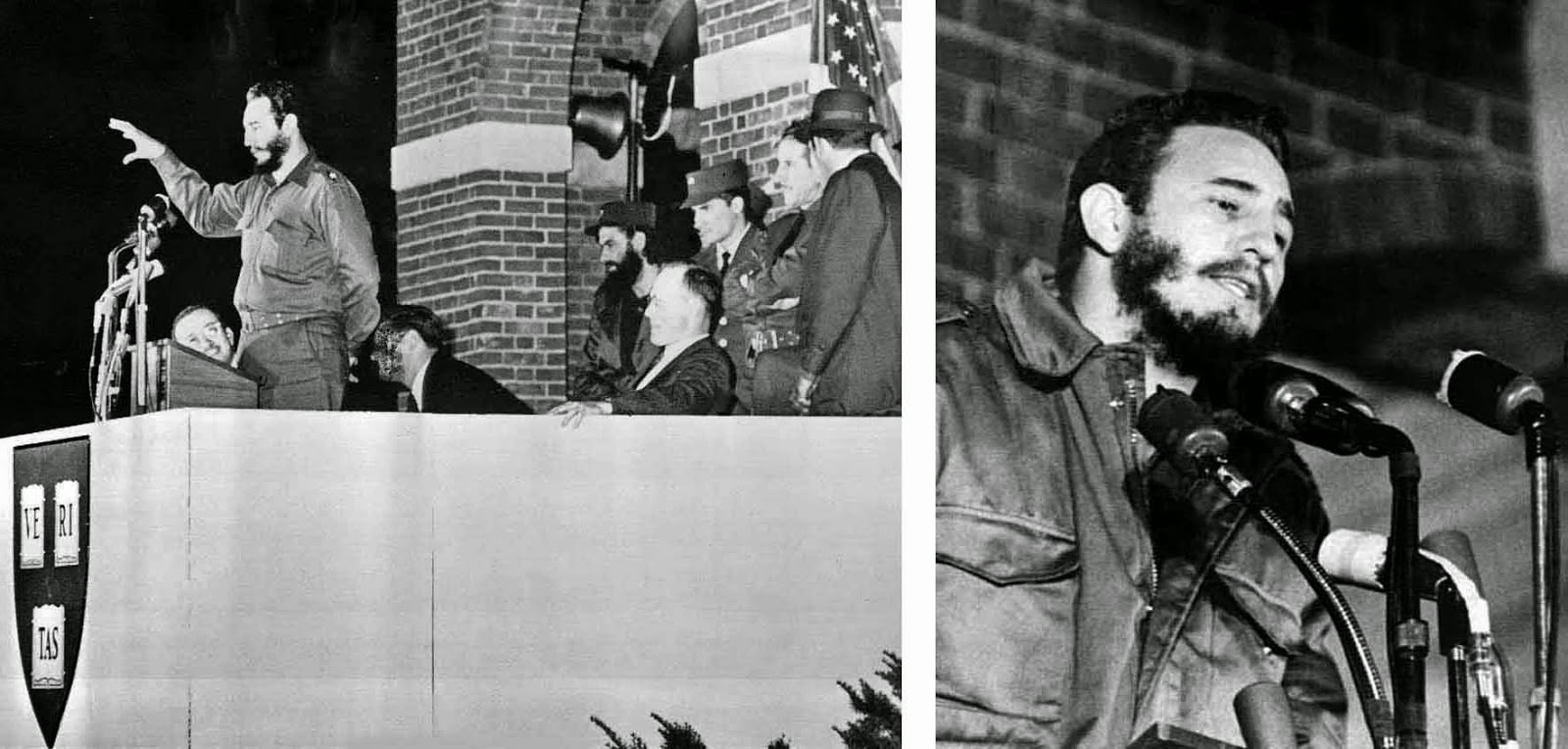
Castro speaking
at the Harvard Field House
Fidel
was a forceful rather histrionic speaker given to dramatic gestures. His
remarks were billed as ‘The Cuban Revolution’, but he didn’t dwell long on past
battles. Instead he gave a thoughtful, albeit rambling, speech on the problems
of backwardness and underdevelopment plaguing revolutionary Cuba.
From
the press, he well understood that Americans, in their enthusiasm for his victory
over a dictatorial regime, were expecting democracy and the rule of law to
follow, but he patiently explained the more immediate problems facing his
government were hunger, mass illiteracy, and a level of unemployment greater in
scale than during the American Depression.
Castro
went on to say all things would come in due time, but for now elections –
absent political parties – would have to be put off at least two years. And he
added pointedly that rights of the criminally accused would have to wait until
the revolution dealt summarily with the many who had administered the terror
and carried out torture under the old regime.
Up
to that point, he still had the majority of the audience with him, but then a
law student called out a question about a recent criminal case in Havana. A
couple of Batista’s pilots had attempted to bomb the presidential palace. They
received a stiff prison sentence, but Castro, dissatisfied, ordered a retrial.
Second
time around they got the death penalty.
Wasn’t
that double jeopardy the questioner persisted? Castro bridled at the challenge,
responding aggressively that the second trial was justified by the higher right
of the revolution to defend itself. At that, a chorus of boos floated up from
below.
Fidel
grew visibly angry, and his speech dissolved into a rant as he occasionally
slipped from English into Spanish. The crowd’s good will toward him began to
ebb. The atmosphere in the field house complex had changed, and the evening
ended on a down note for many there.
I
went off to grad school a year later. Indiana University (IU) had given me
fellowship money to study Soviet Russia. As it happened, brother Jeff also
arrived in Bloomington for his Freshman year. I was delighted with the lively,
competitive graduate school milieu – in the midst of the Cold War, Soviet
Studies was the hottest field around.
Jeff,
however, was unhappy at the university. He had graduated from a small Eastern
prep school and felt lost on the vast campus, a virtual small city in itself.
He had hoped to go to an Ivy League school where all his friends were, but
Pop’s business reversal precluded a costly private college.
One
of my friends in the Russian Institute was George Shriver. Like me, he had come
out to IU from the East – from Harvard where he’d majored in Russian. While I
was in the Political Science PhD program, George’s focus was Russian language
and literature. Although I didn’t realize it at the time, George was also a
left political activist.
At
IU that fall he had quietly organized a campus chapter of the Young Socialist
Alliance (YSA), the youth affiliate of the Trotskyist Socialist Workers Party
(SWP). Then, from the small band of campus Trotskyists, George also spun off a
local branch of the national Fair Play for Cuba Committee (FPCC) in support of
the Cuban Revolution.

George Shriver
speaking at an YSA meeting, Indiana University
As
fall term ‘60 was coming to an end, George, as FPCC chair, was organizing a trip
to Cuba over Christmas break. Jeff got wind of the trip and put his name down,
but even though the cost was modest, he didn’t have the money. He wrote home
for funds. While our parents were apolitical, they were wary of anything
controversial when it came to their sons, so Jeff had to make a persuasive
pitch since the US government considered Cuba leaning toward Communism.
Yet to come, the ill-fated Bay of Pigs invasion was an open secret in Miami émigré circles, and Castro’s forces were more than ready for them.
____________________________________________________________________________________
Yet to come, the ill-fated Bay of Pigs invasion was an open secret in Miami émigré circles, and Castro’s forces were more than ready for them.
__________________________________________________________
In
his letter, he explained that the trip was sponsored by FPCC, a national
organization dedicated to offsetting critical media coverage of Cuba and giving
the revolution a fair shake. He added:
The Cuban government wants Americans to come there and judge the situation and the results of the revolution for themselves. There is nothing political involved. It’s just to have a good time and get informed on the real situation in Cuba.
Jeff
asked me to add an endorsement to his letter, which I was happy to do. I knew
he was drifting at IU and was glad to see him finally taking an interest in
something.
Apparently
the parents were persuaded, but in the end Jeff never made it to revolutionary
Cuba. There weren’t enough takers, so the trip was called off. Not long after he
dropped out of school and a year later found himself in my old military outfit.
However, instead of sailing off to Europe as I did, he was taught Vietnamese
and landed in Southeast Asia in the middle of a small war.
But
I’m getting ahead of the story. By that spring of ’61 Cuba was back in the
headlines. The time was JFK’s first 100 days, and he had adopted Ike’s animus
toward Castro and, worse, his predecessor’s misbegotten plan to remove him from
power – another hamhanded invasion of the island by Cuban exiles – although this
time not a revolutionary vanguard, but a brigade of CIA-trained anti-Castro
‘patriots’.
Once
again McGeorge Bundy, by then JFK’s National Security Advisor, was out front –
serving as White House liaison to the Agency’s invasion planners. The ensuing
Bay of Pigs fiasco is well-known – the whole ill-fated enterprise had become an
open secret in Miami’s Cuban émigré circles, and Castro’s forces were more than
ready for them.
The
operation was a personal tragedy not just for the hundreds of brigadistas who
survived, languishing in harsh Cuban prison camps for nearly two years – it was also a political disaster for America’s new young
president. However, the image of his administration as a bunch of bunglers and
himself personally as lacking in resolve only steeled JFK’s determination to
get Castro. One of the President’s favorite maxims was ‘Don’t get mad, get
even’.
After
purging senior CIA people responsible for the debacle, JFK tasked the Agency to
covertly eliminate Fidel – in a word, assassinate him. The hit plan, code-named
‘Operation Mongoose’, enlisted Cuban émigrés again, but this time the American
Mafia as well – the very guys whose Havana casinos had been seized by the
Castro regime in ’59.
By
summer ’62 the bizarre plotting to decapitate Communist Cuba was well
underway. Some of the looney ideas the plotters
came up with included a lethal exploding cigar, exposing Castro to a fountain
pen treated with poison, and, perhaps looniest of all, slipping a chemical into
his shoes to cause his signature beard to fall out – that wouldn’t have worked
anyway.
Unbeknownst
to the US, that very summer Khrushchev was planning clandestine operations to
carry out regime change in Guatemala, Honduras, and El Salvador, Latin American
dictatorships firmly in the Western camp.
However,
sensing that Kennedy might attempt another attack on Cuba, Khrushchev changed
his mind and decided instead to secretly reinforce his new Caribbean client state,
a move which would erupt in the coming months into the Cuban Missile Crisis –
arguably the most dangerous moment of the long Cold War – but that’s a story
for another post.
____________________________________________
*Manchester Guardian (December 4, 1956).


