Showing posts with label George Shriver. Show all posts

Wednesday, March 4, 2015

Characters in Search of Jeff - I


When I began a memoir on my late brother Jeff Sharlet, I never imagined the fascinating journey that would ensue, a journey of discovery not only about my brother but myself as well. Along the way I’ve encountered many interesting people – well over 150 – who inhabited Jeff’s life and times during his last decade.

Jeff was a Vietnam GI before the war came up on the public’s radar, later a founding leader of the GI antiwar movement. He died young in ’69. I’ve been mightily assisted in the ‘search’ for my brother by Karen Grote Ferb, a very close friend of Jeff’s during his college days.

Four years ago we launched this blog, which I’ve used to put together a preliminary draft of the book underway. In the next several posts, I’d like to introduce and in some instances re-introduce, through a gallery of photos and brief descriptions, a number of the individuals I’ve met “Searching for Jeff.”
                                                                                          
                                                                                                       Bob Sharlet


Lucien Conein, ‘Lawrence of Vietnam’


Captain Lucien Conein, 1945

Though they both played roles in a clandestine operation in Saigon now part of history, my brother Jeff never met Lou Conein. Neither did I much later – Conein died in ’98, but my college roommate knew the man in Vietnam, both were CIA. The closest I’ve got to Conein was his legend. Born in Paris, raised in Kansas, he was a swashbuckling soldier of two wars. In Europe he served as a commando behind German lines, then moved on to Asia where he fought alongside the French and Vietnamese as they drove the Japanese from Indochina.
          Fast forward to 1963, Conein’s back in Vietnam, the embassy’s secret liaison to the South Vietnamese generals planning a coup. As the plot thickened, Conein and his general staff contact rendezvoused as unobtrusively as possible. One time it was at the dentist both men shared, Conein was in the chair ostensibly waiting for the drill when General Don slipped in the side entrance. Behind closed doors in Washington, Conein became known as “a kind of T.E. Lawrence.”
          What was the connection to my kid brother Jeff Sharlet? A Vietnamese-speaking GI, Jeff and fellow linguists played a supporting role to Colonel Conein in the successful coup of November 1st – by wiretapping the generals. The White House wanted to know what was being said when Conein wasn’t around.


George Shriver, founder of the campus left


Young Socialist Alliance meeting, Indiana University,
George Shriver presiding, 1962

          A stalwart of the Left, Jeff and I met George at Indiana University (IU) in the fall, 1960. I was there in the PhD program, Jeff a freshman. George was my fellow grad student in Russian studies. Though I thought I knew the guy pretty well, obviously I missed the main story. Sure, George was studying for a PhD in Russian lit, but he was also quietly working as a skilled political organizer on campus as I only learned many years later. He had come out to IU from Harvard where he’d been a member of  the Young Socialist Alliance (YSA), junior affiliate of the Trotskyist Socialist Workers Party.
Before George dropped out for a career in radical politics, he set up a YSA chapter at the university as well as a branch of the national Fair Play for Cuba Committee (FPCC), created in the wake of the Bay of Pigs fiasco. Though overlapping and very small, the groups were focused and highly dedicated. In effect, George Shriver was the link between the Old Left and emerging New Left at conservative Indiana University.
During Christmas break at the end of fall term ’60, George was organizing a trip to revolutionary Cuba. My brother signed up to go, but it turned out there weren’t enough takers, so Jeff never made it to Havana


Ditty Bopper at Phu Bai


Phu Bai, the mountains of Laos to the west, 1964

          At the beginning of this memoir project, Karen and I were trying to locate ex-GIs who’d been based at Phu Bai, a small intelligence outpost just below the border of Communist North Vietnam. Jeff had served there, but we knew little about the place. We turned up an ex-Vietnam GI who had been posted at Phu Bai. He had been a Morse code operator, ‘ditty bopper’ for short, and, like Jeff, was doing secret work. Ditty Bopper gave us a lot of helpful information.
          Then one day he asked Karen about the memoir project. He knew Jeff had preceded him to Phu Bai, but not that he subsequently became a founder of GI protest against the war back home. We had nothing to hide, but that was too much for Ditty Bopper. A ‘lifer’, or career soldier, he was proud of his Vietnam service and wanted no traffic with criticism of the war, even decades later.
          He cut us off, no more emails, but we had learned a great deal and were grateful. He would shudder to see his name in this blog.


Larry Heinemann, ex-soldier-writer


A lifetime Chicago boy and an ex-Vietnam GI, the author, late ‘70s

          After the Vietnam War ended in ’75, I decided to teach a course on the conflict – as a kind of memorial to my brother. Since I was a Soviet specialist and knew about the war only from the New York Times and nightly television news, it was to be a learning experience. That’s when I came across the name of Larry Heinemann, an ex-Vietnam GI. I had the students read his first novel, Close Quarters, a gritty story of close-combat, much of it drawn from his experience.
          Many years later when I got into this memoir, I sought out the author. By then he had won the National Book Award for a later novel. I asked if he by chance  had known my brother back in the late ‘60s when Jeff was editing Vietnam GI (VGI). A lifelong Chicago boy, Larry replied, “Among those ex-GIs around Chicago, Jeff was, well, famous.”


Matt Rinaldi, antiwar chronicler


Matt Rinaldi’s ground-breaking essay on GI protest, 1972

A young man of the left and an antiwar activist, Matt Rinaldi and Jeff met at a GI coffee house near Fort Leonard Wood, Missouri.  As VGI editor, Jeff went  on the road from time to time, touring training camps as well as nearby coffee houses run by activist friends. He was trawling for combat GIs to interview and other Nam stories for his next issue.
Decades later when I was spoke with Matt, he was still chuckling about something Jeff had told him. My brother had recently telephoned his parents, and our apolitical father asked his youngest son, “Jeff, are you still with those anti-groups?” Not long after Jeff’s early death, Matt Rinaldi published one the first accounts of GI protest against the war:

Vietnam GI was created by Jeff Sharlet, a vet who had served in Vietnam in the early years of the war.  He came back to the States fairly disillusioned. ... VGI was widely circulated and well received. ... It represented a significant breakthrough when it first appeared and helped play a catalytic role throughout the services.

Destiny Handelman, campus SDS leader


Destiny at rest, Bloomington, 1966

          Coming home from Vietnam in ‘64, Jeff headed back to Bloomington, to Indiana University (IU) to finish his education. By the following year the country was edging toward full-blown war in Southeast Asia. When LBJ escalated in March ‘65, protest against the war came alive throughout academe.  At IU every Friday afternoon, a small band of protestors rallied in Dunn Meadow.
          Jeff was also opposed the war and as the rare Vietnam vet on campus, was drawn into protest circles. The group became the nucleus of an SDS, or Students for Democratic Society, chapter at IU. Hostile to hierarchy, the chapter evolved a rotating 4-person leadership team.
          Bernella Satterfield, Jim Wallihan, Destiny Handelman (nee Kinal), and Jeff took turns chairing the group. Under Jeff’s aegis, demonstrations were mounted against pro-war speakers who came to campus – General Maxwell Taylor, former US Ambassador to South Vietnam; and General Lewis Hershey, Director of the Selective Service System, aka the draft.
          Eventually the four moved on – Bernella to professional social activist; Jim to academe, a specialist on labor relations; Destiny, to environmental activism, later a novelist; and Jeff to his place in history as founding leader of the emerging GI antiwar movement.


Vachel Worthington, gung-ho linguist


101st Airborne on patrol, Vietnam, late ‘60s

 Jeff came back from Vietnam with a troubling secret. Something he couldn’t talk about. I only learned about it decades later when Karen told me. What had he done, what had he witnessed? I sought out GI buddies,  but they had no idea. Except Vachel Worthington. 
At the Army Language School (ALS), Jeff and Vachel shared a room in the Vietnamese language barracks. Most of their classmates were fairly casual about military life, something to put up with. Vachel was the exception, a gung-ho trooper, reveling in the military culture.
We located Vachel in Florida. He had a notion of what Jeff had been doing that troubled him. Vachel told me he’ been doing the same thing. As the only linguist in Jeff’s cohort to re-up – re-enlist – gung-ho Vachel was attached to the 101st Airborne, the ‘Screaming Eagles’ of WWII fame. Specifically, he soldiered with the Pathfinders, a deep recon unit operating in the Central Highlands.
The Pathfinders’ assignment – locate Viet Cong (VC) radio transmitters and call in air strikes or artillery missions to take them out. Because VC units were often near villages, inevitably the rain of bombs and shells caused considerable collateral damage – the death of civilians. Vachel took it in stride – the fog of war.
He believed Jeff had worked with the Marines in I Corps earlier in the war on similar long range recon patrols.
          The Marines’ modus operandi was to call in naval fire missions from warships off shore with unintended consequences quite familiar to Vachel – more collateral damage. He speculated that Jeff felt guilty about his complicity in the killing of innocent civilians.
Maybe, but we’ll never know. Jeff died young, taking his secret to the grave.


Keith Willis, friend to the end


Cadet Captain Willis, Albany Academy, 1958

I’ve interviewed many people from Jeff’s life and times, but just one had known him through that final decade of his short but interesting life. Keith Willis and Jeff had gone to the same military prep, Keith two years older and an officer in the school battalion. Jeff was in his company. Both were jocks, Jeff – football  and track, Keith lettering in three Varsity sports.
Taking a degree from Penn, Keith enlisted in ASA, the Army Security Agency, to avoid the draft and possibly the infantry. He followed Jeff to ALS in the same Vietnamese program. The two of them bought a used motorcycle and on weekends cruised the beautiful California coast – up to San Francisco, down to Big Sur. Jeff and Keith both deployed and were stationed with the 9th ASA in the Philippines; later Jeff was sent over to Vietnam.
After his Vietnam tour, Jeff went back to college, Keith into the corporate world, but the two guys landed in Chicago and kept in touch. Later, in spring ’69 Jeff fell terminally ill, but remained hopeful. It was Keith he contacted to help him draft an appeal to the government for a disability pension. The letter went off to Washington, but the reply came too late – Jeff was already gone. It didn’t matter anyway, it was a rejection letter. Keith Willis though, friend to the end.


Wednesday, April 23, 2014

Catching Sight of A Revolution – From Harvard to IU

In the time between the world wars, our father, like so many Americans, had visited Cuba’s exotic capital in the interwar period. He was in Havana in 1930 during the country’s heady Republican Period, but decades later my brother Jeff and I had only passing awareness of revolutionary Cuba of our own time.  We’d both seen the family photo of Irving as a young man – he was 21 – dressed to the nines with a good looking blonde at the bar in Sloppy Joe’s – the famous celebrity hangout on Cuba’s Golden Riviera.


Irving Sharlet (l), our father, in Havana, 1930

Irving had grown up in comfortable circumstances; he had some money and was something of a playboy. At the time, Prohibition reigned as the law of the land in the States. To get a drink without a password in a back alley speakeasy, well-heeled Americans would sail off to Europe or head to the Caribbean to relax with a highball in fashionable public places. Sloppy Joe’s was one of the in-places, just off-shore so to speak, where one might see John Wayne or Clark Gable or even Cuba’s most famous North American visitor, Hemingway, down the bar.

Decades afterward during the postwar period when dramatic changes began happening in Cuba, the island country was on the periphery of our young lives. Jeff in his short life – he died at 27 – had been heavily involved with Vietnam. Serving there early in the growing conflict, he later became an international leader of GI opposition against the war. I became an academic, a specialist on the Soviet Union, where I had studied and visited periodically. I spent most of my adult years teaching and writing about the country.

Still, as the Cuban Revolution emerged in the ‘50s and consolidated in the early ‘60s, quite serendipitously Jeff and I bore witness to some of the salient moments of the island’s transition from a popular Caribbean tourist destination to the epicenter of the global Cold War. Cuba first came to my attention unexpectedly in late fall ’56. In the phrase of the day, I was fulfilling my military obligation in the army.

___________________________________________________________________________

The rebellion in Cuba is over, and students of foreign affairs can now 
give  themselves again to Hungary and the Middle East.
_________________________________________________________

I was fortunate, having been assigned to a congenial posting for a year of study at the Army Language School (ALS) on the sunny California coast. I was being trained in a Slavic language, my only duties six hours a day of class and a little homework. At lunch break, I always had the latest issue of the airmail edition of the British paper, Manchester Guardian, in my back pocket as I waited in the chow line. Reading it was a pleasant respite from the morning’s grammar lessons, pronunciation drills, and vocabulary tests.

One noontime I was glancing through the early December ‘56 issue of the Guardian. Hungary and the Suez Canal were the lead stories. The Soviets had just bloodily crushed the Hungarian Revolution while the Israeli, British, and French forces had defeated the Egyptians, whose nationalization of the Canal had touched off a brief but fierce war.

Perusing the back pages, my eye fell on an unfamiliar story, ‘The battle for Cuba’, with a dismissive opening line, “The rebellion in Cuba is over, and students of foreign affairs can now give themselves again to Hungary and the Middle East.” Reading on, I found a lighthearted account, rife with British irony, of a hapless invasion of the island by a band of Cuban revolutionaries sailing from Mexico.

As I would learn a few years later, the Guardian had some of the key details wrong, but it was right on the end of the affair – the armed forces of the dictator Batista had quickly routed the invaders – killing or capturing most of them on the beach.

The invasion group – 82 of them – had arrived offshore aboard a yacht perilously overloaded with men, weapons, and ammo and leaking to boot. Departing from the Gulf of Mexico, most of them became seasick and were depleted as the boat twice nearly capsized in rough waters. Then, after crossing the Caribbean Sea, they missed their landing spot on the Cuban coast, ran aground in a swamp, and had to wade ashore in chest-high water. Needless to say, the would-be revolutionaries were sitting ducks for the defenders.

The leader of the unlucky band, Fidel Castro, an exiled revolutionary, was reportedly killed, but he actually made it off the beach and into the mountains along with some 20 survivors to fight again another day. But in late ’56, the Guardian wrote the expedition off with the sardonic line that the “invasion fleet” (the yacht) “was badly damaged and might be unfit for charter for the rest of the tourist season.”*

I had reached the mess hall food line, laughed off the Caribbean caper, and gave neither Fidel nor Cuba any further thought. Afternoon classes awaited, and it was back to the Cold War. But to my surprise, Cuba briefly reappeared on my radar just over a year later while I was serving in the forces in West Germany. On an off-duty weekend, I had covered the German Grand Prix – an international Formula 1 car race in the Eifel Mountains – for an American paper.

It was an exciting, closely contested race at staggering speeds – won by the reigning world champion, the Argentine Juan Fangio at the wheel of a Maserati, edging out his British challenger in a Ferrari by a margin of three seconds. I filed my story stateside and it was again back to the Cold War. So much for the glamorous world of F-1 racing.†

But then, El Maestro Fangio, whose name was usually found on the world’s sports pages, turned up as front page news in the Paris Herald Tribune. He had gone to Havana in ‘58 for the Cuban Grand Prix to defend his title and was ‘politely’ kidnapped by the Fidelistas – by then a formidable guerrilla movement with broad support, they constantly tweaked Batista’s forces in classic hit and run encounters.

They held Fangio just a few days to garner maximum international publicity. When released unharmed, the champion spoke favorably of his captors, a propaganda coup for Castro. He had shown he could snatch a world famous figure right off the streets of Havana with impunity, a sure sign the regime was on its last legs.

Later that year I got out of the Army and was back in college, just in time for fall semester at Brandeis University outside Boston. My father had gone bust financially, so I was on my own, on borrowed money for tuition and working nights as a cabbie for Boston Checker. To be closer to my job and because it was a cool place, I rented inexpensive digs on Eliot Street just off Harvard Square, Cambridge.

While I was settling back into the world of books and classes, Castro and his revolutionary army finally defeated Batista. Entering Havana as victors, they took power on New Year’s Day ’59. The old regime had been notorious for its cruelty and corruption, so the Cuban Revolution was greeted warmly by Americans as well as Europeans, not to mention the Communist Bloc and Third World nations.
_________________________________________________________ 
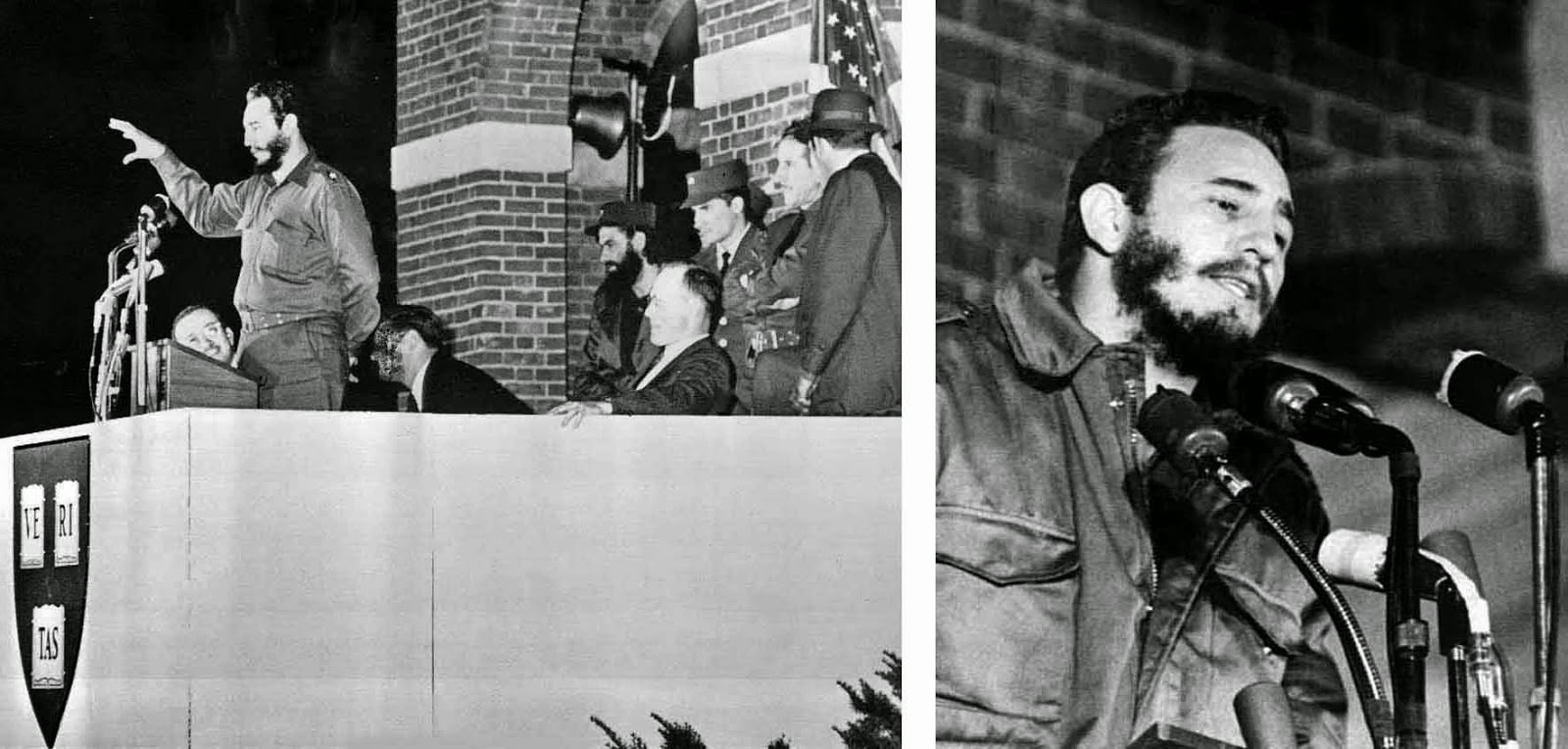
At Harvard I was in the crowd of 10,000 exuberantly welcoming Castro.
_______________________________________________________

Several months after the victory Castro was invited to the States. Landing in Washington – although coolly received by the Eisenhower (Ike) Administration – the charismatic Maximum Leader took the country by storm, making his way up the East Coast city by city in a triumphant tour. Castro looked and acted the hero, and the American public took to him.

Not everyone was happy about his visit though – there were death threats at every stop. As a result, when Castro reached New York, the city organized the greatest security cordon in its history, even more so than for a president. His final stop in the US was Boston where he was scheduled to speak at Harvard. I saw the posters in Harvard Square and decided to go hear him.

It was late April ’59 – actually 55 years ago this week – when Castro  appeared at the Harvard Field House on a warm Saturday evening. After a bomb scare in New York, Boston was taking no chances. The Cuban leader’s train had been met at Back Bay Station by 300 of the city’s finest. As he was driven the several blocks to his hotel, cheering crowds lining the route were held back by a wall of blue.

______________________________________________________________

Cuba’s Ethan Allen leading the Green Mountain boys had taken on and defeated King George III in the guise of Fulgencio Batista.
____________________________________________________________

A few hours later, Castro was accompanied to Harvard by a combined force of Boston cops, Metro police, State Department security, and the FBI. As he walked across the grounds of the field house complex, he was flanked by a phalanx of tall Massachusetts State Troopers in their sky blue jackets, jodhpurs, and black boots.


Castro being escorted by Massachusetts State Troopers, 1959

I drove down Boylston Street to the Charles River, crossed the Eliot Bridge, and walked on up Soldiers Field Road to the field house. There I found myself part of an enormous crowd of some 10,000 students and others exuberantly welcoming the Cuban leader. He took the salute from a speaker’s stand high above the field where we all stood.

Harvard Law School was his host – Fidel was educated as a lawyer – although he was introduced by the Dean of Harvard College, McGeorge Bundy. It turned out that Fidel had applied to the law school as a young man in ‘48, but was turned down. Dean Bundy made light of this, saying that Harvard wanted to make amends and would now accept him.

Cuban and American flags were on display, and Castro was decked out in his trademark olive-green military fatigues and field cap. Standing at the podium above the Harvard crest, he was unobtrusively shielded on both sides by personal bodyguards and Boston security. When he was introduced, the roar of the crowd was deafening – Fidel and the guerrillas were seen through the prism of American legend. Cuba’s Ethan Allen leading the Green Mountain boys had taken on and defeated King George III in the guise of Fulgencio Batista.


Castro speaking at the Harvard Field House

Fidel was a forceful rather histrionic speaker given to dramatic gestures. His remarks were billed as ‘The Cuban Revolution’, but he didn’t dwell long on past battles. Instead he gave a thoughtful, albeit rambling, speech on the problems of backwardness and underdevelopment plaguing revolutionary Cuba.

From the press, he well understood that Americans, in their enthusiasm for his victory over a dictatorial regime, were expecting democracy and the rule of law to follow, but he patiently explained the more immediate problems facing his government were hunger, mass illiteracy, and a level of unemployment greater in scale than during the American Depression.

Castro went on to say all things would come in due time, but for now elections – absent political parties – would have to be put off at least two years. And he added pointedly that rights of the criminally accused would have to wait until the revolution dealt summarily with the many who had administered the terror and carried out torture under the old regime.

Up to that point, he still had the majority of the audience with him, but then a law student called out a question about a recent criminal case in Havana. A couple of Batista’s pilots had attempted to bomb the presidential palace. They received a stiff prison sentence, but Castro, dissatisfied, ordered a retrial.
Second time around they got the death penalty.

Wasn’t that double jeopardy the questioner persisted? Castro bridled at the challenge, responding aggressively that the second trial was justified by the higher right of the revolution to defend itself. At that, a chorus of boos floated up from below.

Fidel grew visibly angry, and his speech dissolved into a rant as he occasionally slipped from English into Spanish. The crowd’s good will toward him began to ebb. The atmosphere in the field house complex had changed, and the evening ended on a down note for many there.

I went off to grad school a year later. Indiana University (IU) had given me fellowship money to study Soviet Russia. As it happened, brother Jeff also arrived in Bloomington for his Freshman year. I was delighted with the lively, competitive graduate school milieu – in the midst of the Cold War, Soviet Studies was the hottest field around.

Jeff, however, was unhappy at the university. He had graduated from a small Eastern prep school and felt lost on the vast campus, a virtual small city in itself. He had hoped to go to an Ivy League school where all his friends were, but Pop’s business reversal precluded a costly private college.

One of my friends in the Russian Institute was George Shriver. Like me, he had come out to IU from the East – from Harvard where he’d majored in Russian. While I was in the Political Science PhD program, George’s focus was Russian language and literature. Although I didn’t realize it at the time, George was also a left political activist.

At IU that fall he had quietly organized a campus chapter of the Young Socialist Alliance (YSA), the youth affiliate of the Trotskyist Socialist Workers Party (SWP). Then, from the small band of campus Trotskyists, George also spun off a local branch of the national Fair Play for Cuba Committee (FPCC) in support of the Cuban Revolution.


George Shriver speaking at an YSA meeting, Indiana University

As fall term ‘60 was coming to an end, George, as FPCC chair, was organizing a trip to Cuba over Christmas break. Jeff got wind of the trip and put his name down, but even though the cost was modest, he didn’t have the money. He wrote home for funds. While our parents were apolitical, they were wary of anything controversial when it came to their sons, so Jeff had to make a persuasive pitch since the US government considered Cuba leaning toward Communism.
____________________________________________________________________________________

Yet to come, the ill-fated Bay of Pigs invasion was an open secret in Miami émigré circles, and Castro’s forces were more than ready for them.
__________________________________________________________

In his letter, he explained that the trip was sponsored by FPCC, a national organization dedicated to offsetting critical media coverage of Cuba and giving the revolution a fair shake. He added:

   The Cuban government wants Americans to come there and judge the situation and the results of the revolution for themselves. There is nothing political involved. It’s just to have a good time and get informed on the real situation in Cuba.

Jeff asked me to add an endorsement to his letter, which I was happy to do. I knew he was drifting at IU and was glad to see him finally taking an interest in something.

Apparently the parents were persuaded, but in the end Jeff never made it to revolutionary Cuba. There weren’t enough takers, so the trip was called off. Not long after he dropped out of school and a year later found himself in my old military outfit. However, instead of sailing off to Europe as I did, he was taught Vietnamese and landed in Southeast Asia in the middle of a small war.

But I’m getting ahead of the story. By that spring of ’61 Cuba was back in the headlines. The time was JFK’s first 100 days, and he had adopted Ike’s animus toward Castro and, worse, his predecessor’s misbegotten plan to remove him from power – another hamhanded invasion of the island by Cuban exiles – although this time not a revolutionary vanguard, but a brigade of CIA-trained anti-Castro ‘patriots’.

Once again McGeorge Bundy, by then JFK’s National Security Advisor, was out front – serving as White House liaison to the Agency’s invasion planners. The ensuing Bay of Pigs fiasco is well-known – the whole ill-fated enterprise had become an open secret in Miami’s Cuban émigré circles, and Castro’s forces were more than ready for them.
         
The operation was a personal tragedy not just for the hundreds of brigadistas who survived, languishing in harsh Cuban prison camps for nearly two years – it was also a political disaster for America’s new young president. However, the image of his administration as a bunch of bunglers and himself personally as lacking in resolve only steeled JFK’s determination to get Castro. One of the President’s favorite maxims was ‘Don’t get mad, get even’.
         
After purging senior CIA people responsible for the debacle, JFK tasked the Agency to covertly eliminate Fidel – in a word, assassinate him. The hit plan, code-named ‘Operation Mongoose’, enlisted Cuban émigrés again, but this time the American Mafia as well – the very guys whose Havana casinos had been seized by the Castro regime in ’59.  

By summer ’62 the bizarre plotting to decapitate Communist Cuba was well underway.  Some of the looney ideas the plotters came up with included a lethal exploding cigar, exposing Castro to a fountain pen treated with poison, and, perhaps looniest of all, slipping a chemical into his shoes to cause his signature beard to fall out – that wouldn’t have worked anyway.

Unbeknownst to the US, that very summer Khrushchev was planning clandestine operations to carry out regime change in Guatemala, Honduras, and El Salvador, Latin American dictatorships firmly in the Western camp.

However, sensing that Kennedy might attempt another attack on Cuba, Khrushchev changed his mind and decided instead to secretly reinforce his new Caribbean client state, a move which would erupt in the coming months into the Cuban Missile Crisis – arguably the most dangerous moment of the long Cold War – but that’s a story for another post.
____________________________________________
*Manchester Guardian (December 4, 1956).


Wednesday, January 15, 2014

Long March from Bloomington – Lives of the New Left V

Most of us went to college, followed our youthful enthusiasms, and later moved on to grad school and career tracks, but not the New Left activists of Indiana University (IU) during the ‘60s. Many of them had arrived on campus politically aware, while the others were soon politicized and radicalized by the inescapable crisis of those years, the Vietnam War.

For the New Left, the war seemed emblematic of the ills of American society – thus, opposing the war while supporting the Civil Rights Movement and other ‘freedom’ movements and causes became the order of the day.
         
The New Leftists at IU were never numerous – essentially a small minority of students on a large campus – but they were a tightly knit band of brothers and sisters determined to stop a war and change society. I’d been aware of the IU New Left for some time in the course of researching a memoir on my brother Jeff Sharlet, IU ’67. He was part of the group, one of the few ex-Vietnam GIs on the campus left at that time. He became a campus leader of the SDS chapter, the Students for a Democratic Society.

Jeff’s activism didn’t end with graduation. Winner of a prestigious Woodrow Wilson National Fellowship, he went on to the University of Chicago, but soon withdrew to continue the struggle against the Vietnam War. Until his early death in ’69, he was a founding leader of the emerging GI opposition to the war. †

During summer of 2013 I had the opportunity to get better acquainted with my brother’s old IU comrades. They had gathered for a grand reunion of the New Left back in Bloomington where it all began for them. One of the kick-off events was an informal assembly called a ‘Town Hall’ at which a couple of dozen rose to speak about their activist days as students and their lives beyond Indiana University.

Sure, they graduated, left town, and moved on, although the activists took away not only parchment diplomas, but the political commitment that had marked their university experience as well.  In effect, Bloomington for them was the point of departure for a ‘long march’ down through the years. And although the war in Vietnam is long over, new as well as extant old domestic issues still preoccupy most of the IU New Left who are carrying on the struggle to this day.

The profiles at hand are of two of those ‘long marchers’, Marilyn Vogt-Downey and Sandi Sherman. Their early experiences at Indiana with the Young Socialist Alliance (YSA) and other left groups have informed and shaped their life choices. For both, their initial political commitments have guided their respective paths from Bloomington through many years ‘on the road’, so to speak, as they continued the pursuit of social justice.

As committed Trotskyists and, for a long period of time, members of the Socialist Workers Party (SWP), their journeys have taken them far and wide, Sandi throughout the States while Marilyn has also traveled extensively abroad. Each is a paragon of the activist life on the left.

Marilyn Vogt-Downey arrived at Indiana University as a grad student. Since leaving Bloomington, she has had a notable career as a long-time revolutionary, a scholar, translator, union activist, and secondary school teacher. Her work has taken her to New York, Paris, Moscow, the former Leningrad, and Tallinn, capital of Estonia.

Along the way, she has made many valuable translations from Russian, contributed to a number of books, and, during the ‘90s, published two books of her own – The USSR 1987-1991: Marxist Perspectives (1993) of which a reviewer wrote that “serious historians of the Soviet Union would ignore at their peril;” and Notebooks for the Grandchildren: Recollections of a Trotskyist Who Survived the Stalin Terror (1995) with Mikhail Baitalsky.


Marilyn also made presentations at a number of conferences on Trotsky’s legacy,  both here and abroad, and has championed numerous causes, including the posthumous rehabilitation of victims of Stalin’s purge trials of the ‘30s, opposition to NATO’s Balkan bombing campaign, a statement against the war in Afghanistan, petitions on behalf of various individuals prosecuted by the US government, and most recently, support for the post-9/11 Muslim hunger strikers at the Guantanamo Bay detention camp in the Caribbean.


 Marilyn Vogt-Downey at the ‘Town Hall’, Bloomington IN, 2013

With verve, she described her life and times at the New Left reunion of August ’13:

I am Marilyn Vogt, actually Marilyn Vogt-Downey, and I came here from Bloomington, Illinois [with a BA degree]. We had had a committee … and when I got here we set up the Committee to End the War in Vietnam [CEWV]. Was anybody here in that?

So, yeah, and then pretty soon the [national office of the] YSA figured out we were here, and Russell Block* and I, Randy Green and Dennis and one other woman reconstituted the [IU] YSA. How many of you knew Russell Block? I think almost everybody knew Russell Block. Yeah, so we reconstituted the YSA [chapter] that had been disbanded earlier on. Then we were involved in all the things everybody here has been talking about, all the antiwar work and everything that was going on here in the ‘60s.

Professor Russell Block, Munich, Germany

Then I left here, I was married, and we went to Albany [NY]. The women’s movement kind of really hit in the ‘70s, and I left my husband, went to New York City and joined the Socialist Workers Party [SWP]. They hired me to work at Pathfinder Press [SWP’s publication arm] so I got to work on translating Trotsky’s [books] for the writing series. That was exciting until they had no more money in ’75 and laid us off.

I worked [at Pathfinder] with George Saunders, rather George Shriver [his actual name], and we put out the samizdat stuff. We started translating all this stuff that was coming out of the Soviet Union, all the underground literature. We started translating it and getting it into ‘Intercontinental Press [a Trotskyist international weekly] and to the International Socialists and others.

SWP made the ‘turn to industry’, and I ended up becoming a pipe fitter. [However,] unfortunately I got caught with a sailor smoking pot and got expelled [from the party] (laughter). I didn’t actually smoke, but it was a time when the party was having trouble with COINTELPRO,** and they were going to trial. Suddenly it occurred to us that Larry the sailor might have been a cop, so we thought it was a good idea to get me out of there. So SWP expelled me, they were very hostile.

Then I went to Paris and worked with Gerry Foley *** [an IU alumnus] who was an international editor on ‘International Viewpoint’. I was a typesetter for that. When I came back, I remarried. I married a Welshman, a lovely Welshman named Nicholas Downey. Unfortunately, he died just about a year and three months ago.

Anyway [on return from Paris] I had decided to become a high school teacher. I taught Trotskyism. Yes! I taught socialism and the workers and the US rogue state. I taught that for about 12 years and then I retired.

I was in the UFT [United Federation of Teachers] and fought the horrible leadership, the so-called leadership – the Unity Caucus of UFT, horrible people … those bastards, those sell-out creeps. I had also been in other groups that worked on the [US] Labor Party.

In defense of Marxism, I got out a couple of books that you can’t afford to buy because they’re too expensive. Lastly, I want to say that lately I’ve been working on Lynne Stewart’s case and on behalf of Bradley Manning.**** I’m going to his court-martial in Washington [where] I’m going to support the Gitmo [Guantanamo] hunger strikers as well.

All these causes are very important, but I’m not in a party so I’m running around like a chicken with its head cut off, trying to make things work. You can’t do it that way, it doesn’t work that way. Lynne Stewart should be released from prison, she’s dying from cancer. How many of you have heard about her case? All right, how many of you have done something about it? Okay, this is really serious, so if you want more details we’ll talk about it later.

For the other speaker, Sandi Sherman, opposition to the Vietnam War while at Indiana became seminal for a lifetime on the left. As a student it took her awhile to find her political direction, but soon she was active on the emerging issues of the late ‘60s/early ‘70s – abortion rights and women’s liberation. She received her BA degree in ’73, left Bloomington, and joined the Socialist Workers Party, spending nearly the next two decades as a party activist in various parts of the country.

During the past several years, Sandi has focused primarily on labor issues at the University of Minnesota (MN) where she is a ‘program/project specialist’ at the university’s cancer research center. As a member the American Federation of State, County and Municipal Employees (AFSCME), she was a major activist, playing a significant role in two strikes against the university system over wage issues.
         
Most recently, in June 2013, Sandi testified on behalf of her union local before the Board of Regents, speaking in opposition to the university’s plan to shift more health insurance costs to the clerical staff, the lowest paid stratum of the MN community. Like the deeply committed person of the left she has long been, for Sandi the issue was not just a local matter. As she wrote, “Our fight is a fight for all working people.”


 Sandi Sherman testifying, University of Minnesota, 2013

From the IU Town Hall assembly, here’s Sandi Sherman telling of her long march in her own words:

I’m Sandi Sherman. I was here from ’69 to ’73. I grew up in Indianapolis and was born in Maryland. My parents were Democrats, my father a liberal Democrat. I came to college with a kind of – well, I wasn’t a Republican, but I was very naïve.

I remember going to the ’69 moratorium event [to hear a speaker] and I was completely turned off. I thought he was a jerk so I went right back to my dorm room and said, “This is not for me.”

So it took me a little while to get active. But through Ike [Nahem]†† and David and Barbara Webster, I became active in the Abortion Rights Movement. I was also very active in the Gay Liberation Front. I had a lot of gay friends, so I was very active in that.

[Those issues] helped radicalize me and then of course, the war in Vietnam, I would say much more than Bloomington was the seminal influence on my life. It changed my life, it made me see that we live under imperialism, and I was opposed to that.

I wanted to fight to change the world and joined the Young Socialist Alliance. After graduation I left Bloomington with Barbara Webster in my little VW packed to the gills. We drove out to San Francisco and broke down in the Wasatch Mountains (laughter) ….

From there I joined the Socialist Workers Party and was very active for the next 19 years. I lived in San Francisco, San Jose, Kansas City, New York – where I met my husband Bill – Milwaukee, Pittsburgh, and now we’re in the Twin Cities, Minneapolis, Minnesota. I’m a clerical worker at the University of Minnesota and an activist in the American Federation of State, County and Municipal Employees. We were on strike twice in 2003 and 2007. I was an organizer – I was a picket – I organized all the picket squads in 2007.

Now if you want higher wages let me tell you what to do
You got to build you a union, got to make it strong,
...
It ain't quite this simple, so I better explain
Just why you got to ride on the union train.
'Cause if you wait for the boss to raise your pay,
We'll all be a-waitin' 'til Judgment Day.†††

Right now, I have to go back tomorrow because on Monday we’re having a big rally at the President’s office in opposition to some really big take-backs in our healthcare coverage that they’re planning to blame on Obamacare. I’m still a supporter of SWP; I organized volunteers to get ‘The Militant [SWP’s newspaper] online weekly, but I’m not as active as I was.

I don’t have the energy, but still have the heart. I still believe in this fight.

So for Marilyn Vogt-Downey and Sandi Sherman, veterans of the left, the long march from Bloomington continues – the fight goes on.

___________________________

† Jeff Sharlet created 'Vietnam GI' in 1968 as the first GI-edited underground antiwar paper addressed to Vietnam GIs, see http://jeffsharletandvietnamgi.blogspot.com/2011/06/vietnam-gis-mission.html


*Russell Block, a friend of Jeff Sharlet’s at IU, arrived at the university in 1965 where he earned an MA in Linguistics in ’67. He subsequently studied at the University of Washington, Heidelberg University, and the University of Hamburg where he took his PhD in English and German. He currently teaches at Hochschule München (Munich University of Applied Sciences). While at IU, Russell was affiliated with the New Left as a member of YSA and a leader of CEWV. He was nominated by the IU Revolutionary Student Party to run for student body president. At the University of Washington, he continued his involvement with YSA.

**COINTELPRO or ‘Counter Intelligence Program’ was created by the FBI during the ‘50s to sow disinformation,  carry out illegal break-ins, and perpetrate other ‘dirty tricks’ against dissidents of various persuasions, especially those on the left. The program’s secret existence was exposed in the early ‘70s when a group of anti-Vietnam War activists broke into a regional FBI office and hauled off thousands of classified documents which they sent to the media. For the story of the break-in, see Betty Medsger, The Burglary: The Discovery of J Edgar Hoover’s Secret FBI (2014).

***The late Gerry Foley, American socialist, prolific journalist, and master linguist – he reportedly read 60 languages and spoke 12 fluently – was a full-time revolutionary who supported the causes of oppressed and persecuted people at home and abroad. Gerry attended grad school at IU where he met George and Ellen Shriver, founders of the campus YSA, and became part of the group during his time at the university. After he left IU, Gerry participated in the national defense of the ‘Bloomington Three’ while attending the University of Wisconsin-Madison where he was active in the campus YSA and Fair Play for Cuba Committee.

****Progressive defense attorney Lynne Stewart represented defendants in the terrorism case following the 1993 bombing of the New York World Trade Center. She in turn was charged with and convicted of aiding and abetting terrorism and other charges as a result of her work as defense counsel in the case. Disbarred and dying of cancer in prison, she applied for compassionate release under federal law which provides for sentence reduction under extraordinary circumstances, foremost of which being life-threatening illness. She was granted a release on December 31, 2013. Bradley Manning, now known as Chelsea Manning, was diagnosed with gender identity disorder while serving as a US Army intelligence analyst. In 2013 he was convicted of espionage, among other offenses, for leaking thousands of classified documents into the public domain. Dishonorably discharged and sentenced to 35 years in prison, there have been mixed reactions to his punishment. Many felt his actions were traitorous, but some saw the leaked material as a positive catalyst for the ‘Arab Spring’, while others simply believed the sentence was overly harsh.