Showing posts with label Washington. Show all posts

Wednesday, April 24, 2013

Under an Azure Sky, Death Awaited

Peering over the side of a landing craft, young Marines about to go into battle in the South Pacific must have experienced a momentary disconnect. There ahead lay a beautiful tropical beach fringed with palm trees swaying gently in the breeze, all framed under a bright, cloudless sky. Yet all their training had taught them that in minutes when the front hatch went down, they’d be hitting that beach, and just beyond, hidden in the dense jungle, Japanese defenders awaited.

Two decades later in the ‘60s many American troops arriving in South Vietnam experienced the same initial sensation. My brother Jeff Sharlet, who was in-country 1963-64, extolled the natural beauty of the country in letters home – the white sand beaches sparkling on the South China Sea and the dense green jungle undulating across the Central Highlands were especially stunning from the air.


Along the South China Sea

America’s Vietnam War was then still young and casualties light, but subsequent waves of troops would soon learn there was a price to be paid for the eye’s pleasure in such a striking landscape. Beneath the azure sky under the jungle canopy death awaited tens of thousands of Americans as well as countless Vietnamese on both sides.

Hollywood set out to capture the perverse dichotomy of stark beauty and hidden terror in a second wave of Vietnam War films. Having successfully tested the public’s tolerance for revisiting the war with three releases during 1978†, the film industry was ready for more ambitious projects, none more so than Apocalypse Now (1979).

With Francis Ford Coppola of Godfather fame directing; Brando, Duvall, and Martin Sheen co-starring; and Michael Herr of Dispatches as voice-over, Apocalypse garnered numerous nominations and awards from Cannes to tinseltown. The story line is simple – Kurtz, a maverick Special Forces colonel (Brando) goes rogue and out of control.  Captain Willard (Sheen), a special ops assassin, is dispatched upriver to “terminate with extreme prejudice.”

Before the two men come face to face in the wilderness, Willard travels by Navy gunboat up the fictional Nung River deep into Cambodia, a picaresque journey in the company of a bizarre crew. The setting is one of great heat and humidity, tropical jungle to water’s edge, and exotic birdsong – all creating an atmosphere of anticipatory anxiety for the well-armed and trigger-happy young boat crew. Occasionally fired upon from the riverbank by the enemy or natives with spears and arrows, the gunners respond with fusillades of heavy machine gun fire, but never see their adversaries.

The riparian vistas are scenic enough for a tourist excursion, but death lurks along those riverbanks. Still, during quiet passage the journey resembles a lark – one crew member sports a peace symbol, another gets high on drugs. At those moments the war appears as just another ‘trip’ with surreal sights of a GI surfboarding as enemy mortar rounds fall around him and even a light show as the gunboat glides beneath a bridge brightly lit up like a Christmas tree in the dark night.

When the real war does interrupt the crew’s reveries, the action sometimes anticipates a contemporary video game – an enemy soldier pops up, gets off a few rounds, and the high strung bow gunner answers with a curtain of fire temporarily silencing the cries and calls of jungle creatures.

Adventures occur en route, most memorably when Willard’s crew encounters a swashbuckling air cavalry commander, Lt Colonel Kilgore (Duvall). 

The colonel takes a sailor along on a helicopter assault on a Viet Cong village – complete with the whoosh of outgoing rockets accompanied by psyops loudspeakers on the command chopper blasting Wagner's 'Ride of the Valkyries'. Then, on the ground and while watching a bombing run along the tree line, Kilgore utters the movie’s signature line, “I love the smell of napalm in the morning.”


Kilgore and ‘napalm in the morning’

Overshadowing Willard’s mission and adding measurably to the tension is the sense of the crew having left civilization behind as they close on Kurtz’s camp, heading into a Conradian ‘heart of darkness’. And the great Brando does not disappoint in his essentially cameo role, stealing the show as he did in Godfather. The viewer comes away from seeing Apocalypse as if, in GI argot, returning from Southeast Asia’s cauldron of death and destruction back to ‘the world’.

Fast forwarding a decade past some better known Vietnam War flicks, we come to 84 Charlie MoPic, a small gem of a film which couldn’t have depicted the war more differently than Apocalypse Now. It is a relatively short (95 mins), low-budget film shot by a director better known for television work compared to the very long (2.5+ hrs in the original version), big budget film directed by a seasoned Academy Award winner.

While Coppola assembled a large distinguished cast of stars as well as upcoming lesser knowns, 84 Charlie was made with just seven actors, of whom a prominent reviewer wrote. “commanding performances by cast of unknowns.”* Predictably, while Apocalypse made tens of millions at the box office and has become a classic on the war, 84 Charlie, despite winning the coveted Sundance Festival Grand Prize, earned just over $150,000 and regrettably has slipped into filmic oblivion.

I say ‘regrettably’ because what the director may have lacked at that point in big screen experience, he more than made up for as an ex-Vietnam GI who knew the war from the inside. The structure of the film is highly unusual – a two-man 82nd Airborne film crew making a training film on a Long Range Reconnaissance Patrol, known by its acronym LRRP, while accompanying an actual patrol.

Six klicks is a mighty short walk
When you march behind the band
But six klicks can seem like a hundred miles
When you’re walking in Charlie’s land†† 

The enforced silences of patrol in hostile terrain as well as the sharp disjunctions between boredom and terror in the combat zone are masterfully handled. The overall effect is of a documentary film, one that could be used in an Advanced Infantry Training course. The result is probably one of the most ‘realistic’ films made about the Vietnam War.

In effect, it takes one down trail in the Central Highlands on a familiar wartime tactical maneuver – to search out and gather intelligence on enemy positions without engaging unless necessary, the idea being to get back with the information. With little or no music compared to the soaring soundtrack of Apocalypse Now, the viewer accompanies the patrol and its embedded film crew step by cautious step, the point man several well out front looking to his left, looking to his right.


Every step you take
Death is holding your hand
     Walking in Charlie’s land†† 

As OD, Cracker, Pretty Boy, Hammer, and Pvt Easy penetrate deeper and deeper into what they dub ‘Indian country’, what began as a routine patrol goes awry. For the most part, their elusive adversary is unseen – mostly a potential threat, rarely a presence – until the patrol spots a large enemy encampment and beats a hasty retreat in the face of a superior pursuing force. Men are hit, people die. In general, although 84 Charlie is also a ‘journey’ film, it takes place within a small cinematic universe, a slice of jungle and underbrush that the GIs traverse at greater and greater risk. 

Some of our boys learned too late 
Just who owns this real estate  
This is Charlie's land†† 

84 Charlie represents the war as an unglamorous affair – methodical, wearying, and largely bereft of the vivid scenes of Apocalypse Now. Instead, the film has a plausible experiential dimension with which an average person could empathize, if not identify. Like Go Tell the Spartans (1978) starring Burt Lancaster, which came out in the same year with two other major Vietnam War films, 84 Charlie MoPic never found a significant audience.

America is a long, long way from closure on its catastrophic involvement in Vietnam, but one film offered a view of the finality of the war for at least a select group of those who fell: Gardens of Stone, Coppola’s elegy to Arlington National Cemetery, the nation’s most hallowed burial ground, where the precisely choreographed ceremony of death was performed with ever greater frequency during the Vietnam War.

Coppola's film goes neither upriver nor down trail, but is largely confined to the sacred acreage on a hillside across the river from Washington; it takes place in the thick of the Vietnam War. Many Americans probably know the ceremony, having seen either film or photos of the funeral of JFK in ’63 with the President’s body borne on a horse-drawn caisson followed by a riderless horse.

Not quite a decade earlier on a hot summer day, a writer, as he stood at the Arlington burial of his grandfather, who had served with the cavalry on the Montana and Wyoming frontier in the 1880s, looked out across the rows of markers and described the view from Arlington, “heat currents rise from the Potomac River to distort the classic lines of the Lincoln Memorial. The geometric panorama of Washington wavers like a quilt on a laundry line.”**

In Gardens, the non-coms, senior sergeants who’ve served and survived Vietnam (James Earl Jones, James Caan), are in a safe billet. A young private is assigned to the ceremonial platoon. In the Korean War, his father had been the non-coms’ comrade in arms. They take his son under their wing. The boy proves to be a model soldier in a unit distinguished by high standards. The war rages on as the Arlington Honor Guard performs the daily ritual of interring the dead from the battlefields of Ia Drang, Dak To, Khe Sanh, and other less well-known combat sites hallowed in Vietnam War memory. 

However, the young man is not satisfied to sit the war out in his spotless dress uniform. The legacy of a soldier-father, admiration for his Arlington mentors, and youth’s eternal attraction to adventure, to challenge, draws him to Officer Candidate School and then to volunteer for combat.††† The older men, knowing the war as a killing field, try to dissuade him, but to no avail.

The age-old quest to prove manhood proves too strong; the new lieutenant is determined to serve in battle. The young officer inevitably returns to Arlington for his final journey on a horse-drawn caisson and is laid to rest to the mournful sounds of Taps under an azure sky.


Burial procession, Arlington National Cemetery©

What have we learned from these three fine films – that misbegotten war becomes madness, that the deadly trail must be traversed to the end, and that the only certitude about war is the finality of death.

*L Maltin, Movie and Video Guide: 2000 Edition (1999), 399.
**H Masters, Last Stands: Notes from Memory (2004), 3.

©Leo Touchet, 1999. Photo is of the 1998 funeral procession for Lucien Conein, WWII hero and the legendary ‘Lawrence of Vietnam’. See http://jeffsharletandvietnamgi.blogspot.com/2011/06/conein-lawrence-of-vietnam.html


Wednesday, November 21, 2012

Fixin' To Die Rag

It was 1964, the year Beatlemania, that frenzy of screaming, hysterical girls, swept the States.  The Beatles, aka the Fab Four, was a group of working class young men from England who led the so-called ‘British Invasion’, arrived on these shores, and quickly conquered America with their innovative music and distinctive style. By August a film had even been released, A Hard Day’s Night:

♫It's been a hard day's night
And I've been working like a dog
It's been a hard day's night
I should be sleeping like a log

Later in the year Jeff Sharlet came home from Vietnam, not long before the Gulf of Tonkin incident in the South China Sea, destined to become a turning point in the Vietnam War. After North Vietnamese fast boats attacked a US destroyer, President Johnson (LBJ) ordered a retaliatory air strike, the country rallied around the flag, and Congress passed the Gulf of Tonkin Resolution, non-binding political rhetoric that both LBJ and his successor Richard Nixon would subsequently use as the basis for waging full-scale war in Southeast Asia.

Jeff had seen that war first hand and was returning to Indiana University (IU) to study politics. His letters home had indicated serious reservations about the US mission in Vietnam and our deepening involvement there. As a trained Vietnamese linguist and serving in the top secret Army Security Agency (ASA), he’d been in a position to see and hear more of what became America’s quagmire. ASA, whose motto was “We weren’t there,” wryly described itself with the saying “In God we trust, all others we monitor.”
Listen, do you want to know a secret
Do you promise not to tell?
 
America in ’64 was alive with protest. The Civil Rights Movement was at its peak and scored a great legislative victory with the Civil Rights Act of 1964. Anti-nuke groups such as SANE from the ‘50s began taking note of the growing conflict in South Vietnam. At the University of California-Berkeley (Berkeley), major student activism emerged with the ‘Free Speech Movement’ (FSM). At Ann Arbor in the upper Midwest, a fledgling activist group founded earlier, Students for a Democratic Society (SDS), began to flourish as the war in Southeast Asia heated up.  Marches and demonstrations everywhere rang with the familiar strains of We Shall Overcome:

We are not afraid, we are not afraid,
We are not afraid today;
Oh, deep in my heart, I do believe,
We are not afraid today.


Berkeley Students used a police car with arrestee inside as a podium
 
Basically conservative IU was still quiet but for a fair amount of griping about curfews for women.  A campaign against compulsory ROTC, the military's Reserve Officer Training Corps, would prove successful in the spring of '65. Students of the right age or in possession of a fake or borrowed ID were more likely to be singing along with Roger Miller's country hit Chug-a-lug (downing an entire alcoholic drink without stopping) than with Bob Dylan's With God on Our Side:


Jukebox and sawdust floor
Somthin' like i've never seen
Heck I'm just going on 15,
But with the help of my fanaglein' uncle
I get snuk in for my first taste of sin
I said let me have a big old sip
bbbb i done a double back flip
 
In contrast, Bob Dylan’s poetry set to music was still a little ahead of the curve for IU where fraternity and sorority life and college sports were the main events:
 
Oh my name it is nothin’
My age it means less
The country I come from
Is called the Midwest
I’s taught and brought up there
The laws to abide
And that the land that I live in
Has God on its side
 
LBJ escalated the war in early ‘65. Draft calls were up, the Marines had landed, and US fighter-bombers began systematically pounding North Vietnam. Troop strength rose rapidly, soon reaching 50,000. We were seriously at war. Students and faculty at Berkeley, Michigan, University of Wisconsin, as well as at IU and elsewhere felt betrayed. The previous fall in the wake of the Tonkin crisis, LBJ had run for election against Senator Goldwater, a hawk on Vietnam, promising “We … seek no wider war.” Behind the scenes, as later revealed, the President had already ordered the Pentagon to begin contingency planning for escalation in Vietnam. As Tom Paxton explained it:

Lyndon Johnson told the nation,
"Have no fear of escalation.
I am trying everyone to please.
Though it isn't really war,
We're sending fifty thousand more,
To help save Vietnam from Vietnamese."
 
 
 Lyndon Johnson and Tom Paxton

At the University of Michigan, a ‘teach-in’ was organized to inform the campus community on the war and to protest it; about 3500 attended the all-night sessions, and women's hours were even suspended.  Lectures and debates, heard via telephone links at Indiana and many other campuses, were the core of the event, which also included films and musical events at the Ann Arbor end.  The fledgling New Left at IU, mostly politically active grad students, coalesced around the Michigan Teach-in relay and joined the SDS-sponsored March on Washington on April 17, 1965.

 
IU Students March on Washington, 1965
 
By this time protest music was well-established. Now-famous Joan Baez along with Phil Ochs and the Freedom Singers, were on hand to perform. The ever-voracious draft was prompting more draft card burning, and many young men were fleeing to Canada. Satirist Phil Ochs, a critical opponent of the war policy, penned Draft Dodger Rag as US involvement in the war grew:

Oh, I'm just a typical American boy from a typical American town
I believe in God and Senator Dodd and a-keepin' old Castro down
And when it came my time to serve I knew "better dead than red"
But when I got to my old draft board, buddy, this is what I said:

Sarge, I'm only eighteen, I got a ruptured spleen
And I always carry a purse...

...Besides, I ain't no fool, I'm a-goin' to school
And I'm working in a DE-fense plant
 
It was around this time that Jim Wallihan arrived at IU, already pretty radicalized by his participation in the FSM at Berkeley. Jim immediately became part of the group looking to establish an SDS chapter at the university. Jeff and Jim became close friends, and Jim persuaded Jeff to lend his authority as an ex-Vietnam GI to SDS. Jeff had felt student protest wouldn’t have sufficient impact on the administration’s war policy, but agreed to give it a try.

The marches, teach-ins, and protests continued to spread. The Vietnam Day Committee at Berkeley mobilized vast student audiences in the San Francisco Bay Area. IU students summering in Bloomington in August ‘65 staged a Hiroshima Day march against the war. A month later a national SDS meeting was held at a state park not far from campus, and that fall the IU SDS chapter was formally launched.
 
In 40 American cities and foreign capitals large crowds of concerned people participated in the International Days of Protest against American Military Intervention. In Berkeley and across the bay in Oakland, upwards of 15,000 participated in the two-day program. The singers Country Joe McDonald and Tom Paxton;  Ken Kesey, author of One Flew Over the Cuckoo’s Nest; beat poets Allen Ginsberg and Lawrence Ferlinghetti; the radical commentator I.F. Stone, and others spoke, sang, read poetry, and marched – ironically to Ochs' I Ain't Marchin' Any More, among other tunes.
 
♫Call it "Peace" or call it "Treason,"
Call it "Love" or call it "Reason,"
But I ain't marchin' any more,
No I ain't marchin' any more
 
Vietnam veteran Country Joe, in charge of organizing the music for the program, had just recorded The I Feel Like I'm Fixin' to Die Rag, which became an anthem of the antiwar movement:
Well, come on all of you, big strong men,
Uncle Sam needs your help again.
He's got himself in a terrible jam
Way down yonder in Vietnam...

And it's one, two, three,
What are we fighting for ?
Don't ask me, I don't give a damn,
Next stop is Vietnam
 
 
Country Joe McDonald
 
IU students joined a coalition of over 30,000 antiwar protestors in Washington DC on November 27th, ten days after a deadly engagement in the Ia Drang Valley in Vietnam, the first major battle between US troops and North Vietnamese units. Both sides claimed victory, but the US 7th Cavalry had clearly taken a mauling. Some victory. By the end of ‘65, monthly draft calls had risen to 35,000; troop strength in Vietnam topped 200,000; and for the antiwar movement America was on the Eve of Destruction:

You're old enough to kill, but not for votin'
You don't believe in war, but what's that gun you're totin'
 
By ’66 IU, the 11th largest university in the country, still could muster only a couple hundred protestors at a time. That spring Jeff and other SDS activists mounted demonstrations against two high level Washington visitors to campus. Both spoke in support of the war, reflecting Cold War fears of communism and the specter of American defeat in Asia as exemplified by the Fugs' Kill for Peace:

If you don't want America
To play second fiddle,
Kill, kill, kill for peace...
...If you let them live
They might support the Russians
Summer was usually a placid time on the IU campus, but activists joined a planned protest on the occasion of LBJ's Midwestern swing with a stop in Indianapolis. The result – 28 IU protesters preemptively arrested. Public assembly permit in hand, the activists arrived at the site of the President’s address early that morning only to be met by police ordering them away.  They refused, whereupon Secret Service men arrived, followed shortly by paddy wagons that herded them off and out of sight of the media.† Meanwhile to the north in Madison at Wisconsin the first of two major protests against corporate recruiters from Dow Chemical, the manufacturer of napalm, roiled that highly active campus. Legal and campus disciplinary proceedings against IU and Wisconsin students involved in protest actions dragged on, as did the Vietnam War:
Let me tell you the story of a soldier named Dan.
Went out to fight the good fight in South Vietnam...
…And the war drags on.
Found himself involved in a sea of blood and bones
Millions without faces, without hope and without homes...
At IU in a major address at the end of ‘66, the university president demonized the campus New Left. Jeff, Robin Hunter, and Bob Tennyson took issue with him and pushed back in public exchanges.† In Ann Arbor tensions were rising between activists and the Michigan administration over the university’s involvement in military research, while at Wisconsin the Dow recruiters returned to campus and were met this time by a huge determined opposition. Tear gas hung over the campus green as cops and protestors alike were bloodied in what became the first campus antiwar protest to turn violent. America was increasingly divided, as its campuses began falling prey to violence and discord:
There's battle lines being drawn
          Nobody's right if everybody's wrong
        Young people speakin' their minds
       Gettin' so much resistance from behind
I think it's time we stop, hey, what's that sound? Everybody look what's going down


Links to music videos

A Hard Day’s Night:  https://www.youtube.com/watch?v=Eepw7LCa2SQ

Do You Want to Know a Secret:  https://www.youtube.com/watch?v=bVVvpW_5vgw
 
Chug-a-Lug:  https://www.youtube.com/watch?v=G2OTSw6eZ08
 
With God on Our Side:  https://www.youtube.com/watch?v=cAgAvnvXF9U&feature=related
 
Lyndon Johnson Told the Nation:  https://www.youtube.com/watch?v=qTyqoV1d2Ys
 
Draft Dodger Rag:  https://www.youtube.com/watch?v=ZV0TIGOqia0&feature=fvsr
 
I Ain’t Marching Any More:   http://www.youtube.com/watch?v=L5pgrKSwFJE
 
The I Feel Like I’m Fixin’ to Die Rag:  http://www.youtube.com/watch?v=3W7-ngmO_p8
 
Eve of Destruction:  http://www.youtube.com/watch?v=eCrnpJTJiuU
 
Kill for Peace: http://www.youtube.com/watch?v=-uEB8K3yffY
 
The War Drags On:  https://www.youtube.com/watch?v=XrOE2s_ldlQ
 
For What It’s Worth:  https://www.youtube.com/watch?v=gp5JCrSXkJY


Wednesday, November 7, 2012

Shadow Highway – "They Just Keep a-Coming"

It was a low-tech engineering marvel with a lethal purpose. North Vietnam’s (NVN) shadow highway to the south steadily and stealthily delivered men and materiel to the battlefields of South Vietnam (SVN). Its immense success was reflected in admiring nicknames coined by Americans tasked to shut it down. Because of Ambassador Harriman’s illusion of a neutral Laos through which the shadow highway passed, US Saigon Embassy personnel cynically referred to the Ho Chi Minh Trail (the Trail) as the “Averell Harriman Memorial Highway.” A Marine general called it the “Ho Chi Minh Autobahn,” while a Green Beret who had reconnoitered the route said that at times it was “like the Long Island Expressway – at rush hour.”
 
What Washington dubbed the Ho Chi Minh Trail (actually its official name was the Trường Sơn Strategic Supply Route) had ancient origins in the Annamite Mountains and jungles of Southeast Asia along the western border of what became SVN after the defeat of the French colonialists in 1954. It had long been a loosely connected network of primitive paths and trails through the wilderness trod only by aboriginal tribes inhabiting that sparsely populated, inhospitable area. Only in the late ‘40s during the long Vietnamese war for independence against the French did the network take on some semblance of a logistical trail system. The Viet Minh, the communist-nationalist guerrilla army created by Ho Chi Minh, used the system of trails as a clandestine route for moving fighters from the northern area of France’s Indochina colony to the Mekong Delta in the south below Saigon.
 
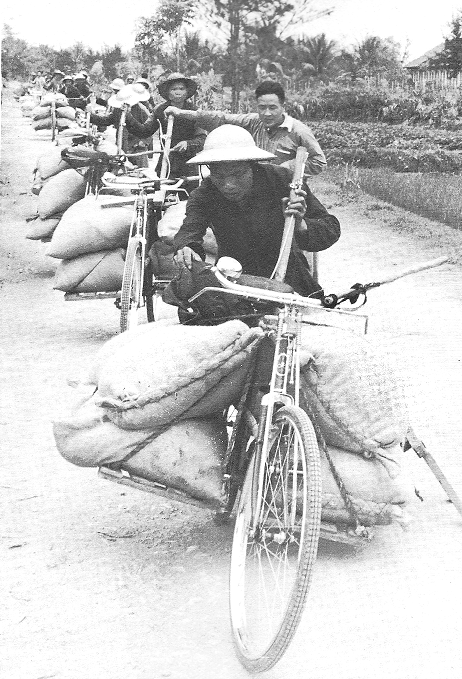
After ’54, the system fell into disuse, temporarily as it turned out. In ’59 the Communist Party of NVN decided to significantly support the ongoing low-level guerrilla insurgency against the government of SVN, and the Trail again saw military traffic. Because the early Trail involved climbing steep, heavily forested mountains and traversing rough jungle terrain, elephants were initially used to carry the heavy supplies. Eventually the preferred vehicle for transporting larger-caliber weapons, ammo, and foodstuffs became specially reinforced bicycles pushed, not ridden, by porters. Frames were strengthened, handlebars fixed with a long steering stick, and a pole for stabilizing the bike arose from the seat. Fully loaded, the bikes carried several hundred pounds.
 
 
Bike porters on the Ho Chi Minh Trail
 
After ’65 when the war escalated on both sides, the Trail was widened, and heavy duty Chinese army trucks replaced bikes. A truck-relay system was developed with designated individual sections of the Trail responsible for keeping their own fleets on the road. An underground pipeline was laid to provide fuel to the way stations along the Trail. Early on, Pentagon planners calculated that only as few as 20 truckloads of cargo a day, a fraction of the truck traffic on the Trail at any one time, had to get through for the NVN to meet its supply requirements in the south. By then the Trail had become a dual system – roads safe only at night for the trucks, while troops marched off-road by day, often having to cut trail as they went.
 
Throughout the Trail’s active service from ’59 to the fall of Saigon in ’75, North Vietnamese Army (NVA) troops moved along the route with heavy packs weighing as much as 85 lbs that contained food, clothes, and ammo for both the long journey and, ultimately, the SVN battlefields. To reach the Saigon-Mekong Delta region in ’64 by foot took five months.* Even later, after the system was considerably engineered and improved, the full trek still lasted as long as six weeks. To say that NVN’s ‘long march’ was arduous and tested the limits of human endurance would not be an exaggeration.
 
 
On the Trail through the mountains
 
Not all the NVA troops that moved as units were destined for the Mekong theater of operations. The Trail, which paralleled SVN’s border through Laos and Cambodia, had various ‘exits’, much like an American superhighway. The first exit was just below the Demilitarized Zone (DMZ) separating North and South Vietnam for units assigned to the Hue-Phu Bai sector, the area where brother Jeff Sharlet served in ’64. Although trail time was shorter for troops headed for that sector, they still had to climb over a rugged mountain range in northeast Laos to reach their destination.
 
While the Trail was NVN’s conduit for matching US troop levels in the south with NVA combat regiments and battalions, it was maintained by a separate command consisting of tens of thousands of engineering troops, anti-aircraft units, infantry for ground security, and huge numbers of young women volunteers assigned to roadwork – a highly dedicated and efficient combat support force stationed along the myriad byways and alternate routes of the 8000-mile road system.
 
 
The Trail and its ‘exits’
 
For the NVA troops trekking down trail, the terrain, predators, disease, and weather added to the ordeal. The foot trails were stony, rest areas rough-hewn, and the rainforests through which they passed either suffocatingly hot and humid or rain-drenched, perpetually damp, and steamy during monsoon season. Insects and jungle creatures plagued the transiting soldiers. Mosquitos swarmed in clouds; leeches abounded, whether in water crossings or dropping from trees; and poisonous snakes were ever a danger – everyone carried anti-snake venom, which had to be self-administered within three minutes of a bite. Many soldiers died enroute from disease – malaria, typhoid fever, amoebic dysentery, and many other infectious diseases, even plague, were endemic.
 
However, in terms of sheer ferocity and a staggering death toll, nothing along the Trail matched the US Air Force’s bombing and strafing campaign. When ‘Rolling Thunder’ was launched during spring ’65, Washington believed a relentless bombing campaign of NVN would ‘persuade’ the Communist regime to sue for peace or at least cause them to cease and desist stoking the southern insurgency with streams of men and supplies down the Trail. As the fighting intensified and US illusions about NVN’s commitment and steadfastness began to fall away, the strategic objective shifted to shutting down the pipeline feeding the Viet Cong’s (VC) insurgency against the SVN regime. In military-speak, the objective became ‘interdiction’ to prevent cross-border infiltration from NVN via Laos and Cambodia.
 
For this purpose, the hi-tech might of the world’s greatest military power was brought to bear on the Trail. The battle in the air against the enemy became a veritable separate, secret war apart from the ground war in SVN where GIs and Marines were going head to head with the VC and NVA battalions from the DMZ to the Mekong Delta. The air war was concealed from Congress as well as the American public because a large percentage of the thousands of air strikes were against the Trail in nominally neutral Laos and Cambodia.
 
At the outset prop-driven Douglas trainers were deployed to bomb and strafe enemy formations spotted along the shadowy trail. As the flow from the North increased, the air war escalated when Phantom jets armed with rockets and napalm entered the fray. B-52 bombers from Guam, designed for Cold War intercontinental warfare with the Soviets, were added to the order of battle. Carrying enormous bomb loads, the bombers cruised unseen seven miles up from where their deadly cargoes of 750 lb bombs were dropped from map coordinates.
 
 
B-52s over the Trail
 
As part of the Pentagon’s evolving electronic warfare, a device was created for detecting the presence of humans invisible in the impenetrable jungle below from the air. Colloquially known as ‘people sniffers’, the device was slung under a helicopter which reconnoitered suspected Trail areas, picking up the scent of urine. Coordinates would be transmitted, and perhaps the most destructive air weapon of all would be called in – a converted C-130 cargo plane nicknamed ‘Spooky’ because, being slow and flying at low altitude, it operated at night.  Bristling with automatic rapid-fire Gatling-type guns, Spooky would fly over the identified area, sometimes at only 1500’, and literally shower the jungle below with lead at the rate of 15,000 rounds a minute, eerily lighting up the night with red tracers.
 
One might think such overwhelming power would prevail, would have defeated NVN’s effort to sustain the war in the south. On the contrary, through surprising feats of Engineering 101 and often simple, even primitive countermeasures, the Trail remained a busy military thoroughfare as the vital route to the ground war in the south and ultimate victory in ’75. To counter relentless air attacks, the NVA positioned anti-aircraft guns at critical chokepoints on the Trail, ensuring that US bomb runs were not cost-free. Later, batteries of Soviet surface-to air missiles (SAM) were added, greatly increasing Air Force fixed-wing losses. In the course of the separate war over the Trail thousands of NVA trucks were destroyed and heavy casualties sustained, while the US lost 500 planes with their air crews.
 
Air attacks on the Trail were most effective against bridges over the many rivers that had to be crossed. Engineering crews could put pontoon bridges in place relatively quickly, but they too would be knocked out the next day by prowling Phantoms. For this special challenge to Trail traffic, combat engineers came up with a couple of workable, low-tech solutions. The first was a cable bridge, but one without a roadway. Two strong cables would be strung across a river invisible from the air at water level a truck-width apart. When a truck convoy arrived at a crossing, the tires were removed, the rims aligned on the cables, and the trucks driven across, and refitted with tires on the opposite bank.
 
This bridging technique worked well, but was time-consuming, so another equally simple but even more amazing solution found. A pontoon structure called a ‘peek-a-boo’ bridge was rigged out of the inner tubes of truck tires, and powerful pneumatic pumps were hidden on each side of a waterway. When not in use, the bridge would be concealed by deflating the tubes and letting the structure sink and float beneath the water’s surface. Upon arrival of the trucks, the pneumatic pump would inflate the tubes, the bridge would emerge from the depths, and the convoy would pass over it.
 
Road repair from bomb damage, a constant, was essentially a no-tech job. Without the availability of bulldozers, the largely female road crews posted along the Trail filled bomb craters overnight with just picks and shovels. Occasionally, when a stretch of trail was being repeatedly targeted, the engineers would cut an alternate route below the triple canopy jungle, thus hiding it from the air. Often this involved cutting down trees and clearing brush, but when the NVA realized that their hi-tech adversary had airborne means for detecting foliage decay, they changed tactics. Trees and bushes were instead carefully dug up and transplanted elsewhere, an elementary gardening procedure.
 
However, the NVA’s most primitive but effective countermeasure – and a devilishly clever and amusing one too – was its diversionary response to the vaunted airborne people sniffers. Pots of buffalo urine were hung in the trees in areas away from the Trail causing the planes to release their munitions harmlessly on empty stretches of jungle. Still, the relentless air attacks never ceased.
 
After the Communist Tet Offensive of ’68, Creighton Abrams replaced General Westmoreland (Westy) as overall US commander and inherited not only a grinding ground war, but also the shadowy, hotly contested air war over the Trail. The interdiction campaign remained his major preoccupation right up to the final days of active US involvement in the Vietnam War late ’72. Transcripts from Abrams’ regular briefings clearly indicate that in spite of the best efforts of a superpower, interdiction had remained a frustrating and elusive objective. In late ’70, his deputy commander for air operations conceded that the scope and effectiveness of the Trail had increased:
 
          Over the past year we’ve seen a continual increase
          in the road network, the trails, the alternate route
          structure … which gave the enemy many options
          in terms of moving his equipment and supplies ….


          [The NVA’s dispersal of their trucks] has been
          accomplished beautifully, they move at night, they
          move at regular predetermined times, they move to
          one place, stay and hide, unload, pick up another
          truck and move on down, hiding in the [jungle]
          canopy, it’s just an extremely difficult problem.**
 
As American involvement in the war was winding down 18 months later in ‘72, it was evident that NVA infiltration had trumped US interdiction. As a frustrated General Abrams exclaimed to his staff: “it’s a more or less continuous thing – you know, they just keep a-coming.”***
 
Years after in post-mortems on the war, a senior North Vietnamese officer conceded that US air attacks, especially Spooky’s saturation strafing, had hurt them badly, while Westy’s deputy stated flatly in an interview that the fact that the  “Ho Chi Minh Trail was never closed” was a major factor in the failure of the US mission in Southeast Asia.****
 
*J Zumwalt, Bare Feet, Iron Will (2010), 232
**L Sorley, ed, Vietnam Chronicles: The Abrams Tapes, 1968-1972 (2004), 495
***Ibid, 818
****Quoted in R McNamara, In Retrospect (1995), 212