It
was a low-tech engineering marvel with a lethal purpose. North Vietnam’s (NVN)
shadow highway to the south steadily and stealthily delivered men and materiel
to the battlefields of South Vietnam (SVN). Its immense success was reflected
in admiring nicknames coined by Americans tasked to shut it down. Because of
Ambassador Harriman’s illusion of a neutral Laos through which the shadow
highway passed, US Saigon Embassy personnel cynically referred to the Ho Chi
Minh Trail (the Trail) as the “Averell Harriman Memorial Highway.” A Marine
general called it the “Ho Chi Minh Autobahn,” while a Green Beret who had
reconnoitered the route said that at times it was “like the Long Island
Expressway – at rush hour.”
What
Washington dubbed the Ho Chi Minh Trail (actually its official name was the Trường
Sơn Strategic Supply Route) had ancient origins in the Annamite Mountains and
jungles of Southeast Asia along the western border of what became SVN after the
defeat of the French colonialists in 1954. It had long been a loosely connected
network of primitive paths and trails through the wilderness trod only by
aboriginal tribes inhabiting that sparsely populated, inhospitable area. Only
in the late ‘40s during the long Vietnamese war for independence against the
French did the network take on some semblance of a logistical trail system. The
Viet Minh, the communist-nationalist guerrilla army created by Ho Chi Minh,
used the system of trails as a clandestine route for moving fighters from the
northern area of France’s Indochina colony to the Mekong Delta in the south
below Saigon.
After
’54, the system fell into disuse, temporarily as it turned out. In ’59 the
Communist Party of NVN decided to significantly support the ongoing low-level
guerrilla insurgency against the government of SVN, and the Trail again saw
military traffic. Because the early Trail involved climbing steep, heavily
forested mountains and traversing rough jungle terrain, elephants were
initially used to carry the heavy supplies. Eventually the preferred vehicle
for transporting larger-caliber weapons, ammo, and foodstuffs became specially
reinforced bicycles pushed, not ridden, by porters. Frames were strengthened,
handlebars fixed with a long steering stick, and a pole for stabilizing the
bike arose from the seat. Fully loaded, the bikes carried several hundred
pounds.
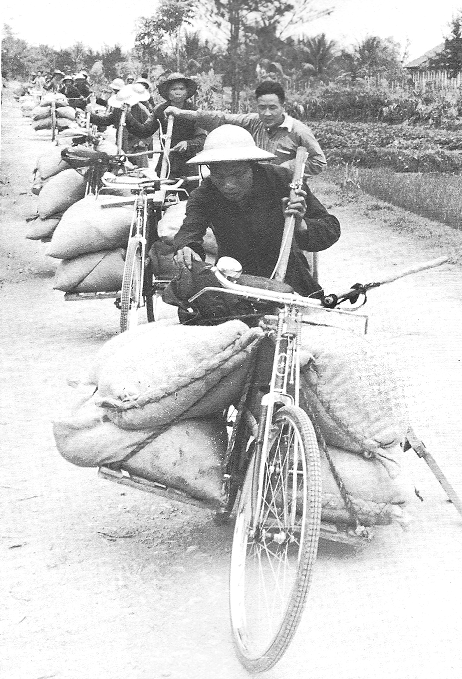
Bike
porters on the Ho Chi Minh Trail
After
’65 when the war escalated on both sides, the Trail was widened, and heavy duty
Chinese army trucks replaced bikes. A truck-relay system was developed with
designated individual sections of the Trail responsible for keeping their own
fleets on the road. An underground pipeline was laid to provide fuel to the way
stations along the Trail. Early on, Pentagon planners calculated that only as
few as 20 truckloads of cargo a day, a fraction of the truck traffic on the
Trail at any one time, had to get through for the NVN to meet its supply
requirements in the south. By then the Trail had become a dual system – roads
safe only at night for the trucks, while troops marched off-road by day, often
having to cut trail as they went.
Throughout
the Trail’s active service from ’59 to the fall of Saigon in ’75, North
Vietnamese Army (NVA) troops moved along the route with heavy packs weighing as
much as 85 lbs that contained food, clothes, and ammo for both the long journey
and, ultimately, the SVN battlefields. To reach the Saigon-Mekong Delta region
in ’64 by foot took five months.* Even later, after the system was considerably
engineered and improved, the full trek still lasted as long as six weeks. To
say that NVN’s ‘long march’ was arduous and tested the limits of human
endurance would not be an exaggeration.

On
the Trail through the mountains
Not
all the NVA troops that moved as units were destined for the Mekong theater of
operations. The Trail, which paralleled SVN’s border through Laos and Cambodia,
had various ‘exits’, much like an American superhighway. The first exit was
just below the Demilitarized Zone (DMZ) separating North and South Vietnam for
units assigned to the Hue-Phu Bai sector, the area where brother Jeff Sharlet
served in ’64. Although trail time was shorter for troops headed for that
sector, they still had to climb over a rugged mountain range in northeast Laos
to reach their destination.
While
the Trail was NVN’s conduit for matching US troop levels in the south with NVA
combat regiments and battalions, it was maintained by a separate command
consisting of tens of thousands of engineering troops, anti-aircraft units,
infantry for ground security, and huge numbers of young women volunteers
assigned to roadwork – a highly dedicated and efficient combat support force
stationed along the myriad byways and alternate routes of the 8000-mile road
system.

The
Trail and its ‘exits’
For
the NVA troops trekking down trail, the terrain, predators, disease, and
weather added to the ordeal. The foot trails were stony, rest areas rough-hewn,
and the rainforests through which they passed either suffocatingly hot and
humid or rain-drenched, perpetually damp, and steamy during monsoon season.
Insects and jungle creatures plagued the transiting soldiers. Mosquitos swarmed
in clouds; leeches abounded, whether in water crossings or dropping from trees;
and poisonous snakes were ever a danger – everyone carried anti-snake venom,
which had to be self-administered within three minutes of a bite. Many soldiers
died enroute from disease – malaria, typhoid fever, amoebic dysentery, and many
other infectious diseases, even plague, were endemic.
However,
in terms of sheer ferocity and a staggering death toll, nothing along the Trail
matched the US Air Force’s bombing and strafing campaign. When ‘Rolling
Thunder’ was launched during spring ’65, Washington believed a relentless
bombing campaign of NVN would ‘persuade’ the Communist regime to sue for peace
or at least cause them to cease and desist stoking the southern insurgency with
streams of men and supplies down the Trail. As the fighting intensified and US
illusions about NVN’s commitment and steadfastness began to fall away, the
strategic objective shifted to shutting down the pipeline feeding the Viet
Cong’s (VC) insurgency against the SVN regime. In military-speak, the objective
became ‘interdiction’ to prevent cross-border infiltration from NVN via Laos
and Cambodia.
For
this purpose, the hi-tech might of the world’s greatest military power was
brought to bear on the Trail. The battle in the air against the enemy became a
veritable separate, secret war apart from the ground war in SVN where GIs and
Marines were going head to head with the VC and NVA battalions from the DMZ to
the Mekong Delta. The air war was concealed from Congress as well as the
American public because a large percentage of the thousands of air strikes were
against the Trail in nominally neutral Laos and Cambodia.
At
the outset prop-driven Douglas trainers were deployed to bomb and strafe enemy
formations spotted along the shadowy trail. As the flow from the North
increased, the air war escalated when Phantom jets armed with rockets and
napalm entered the fray. B-52 bombers from Guam, designed for Cold War
intercontinental warfare with the Soviets, were added to the order of battle.
Carrying enormous bomb loads, the bombers cruised unseen seven miles up from
where their deadly cargoes of 750 lb bombs were dropped from map coordinates.

B-52s
over the Trail
As
part of the Pentagon’s evolving electronic warfare, a device was created for
detecting the presence of humans invisible in the impenetrable jungle below
from the air. Colloquially known as ‘people sniffers’, the device was slung
under a helicopter which reconnoitered suspected Trail areas, picking up the
scent of urine. Coordinates would be transmitted, and perhaps the most
destructive air weapon of all would be called in – a converted C-130 cargo
plane nicknamed ‘Spooky’ because, being slow and flying at low altitude, it
operated at night. Bristling with
automatic rapid-fire Gatling-type guns, Spooky would fly over the identified
area, sometimes at only 1500’, and literally shower the jungle below with lead
at the rate of 15,000 rounds a minute, eerily lighting up the night with red
tracers.
One
might think such overwhelming power would prevail, would have defeated NVN’s
effort to sustain the war in the south. On the contrary, through surprising
feats of Engineering 101 and often simple, even primitive countermeasures, the
Trail remained a busy military thoroughfare as the vital route to the ground
war in the south and ultimate victory in ’75. To counter relentless air
attacks, the NVA positioned anti-aircraft guns at critical chokepoints on the
Trail, ensuring that US bomb runs were not cost-free. Later, batteries of
Soviet surface-to air missiles (SAM) were added, greatly increasing Air Force
fixed-wing losses. In the course of the separate war over the Trail thousands
of NVA trucks were destroyed and heavy casualties sustained, while the US lost
500 planes with their air crews.
Air
attacks on the Trail were most effective against bridges over the many rivers
that had to be crossed. Engineering crews could put pontoon bridges in place
relatively quickly, but they too would be knocked out the next day by prowling
Phantoms. For this special challenge to Trail traffic, combat engineers came up
with a couple of workable, low-tech solutions. The first was a cable bridge,
but one without a roadway. Two strong cables would be strung across a river
invisible from the air at water level a truck-width apart. When a truck convoy
arrived at a crossing, the tires were removed, the rims aligned on the cables,
and the trucks driven across, and refitted with tires on the opposite bank.
This
bridging technique worked well, but was time-consuming, so another equally
simple but even more amazing solution found. A pontoon structure called a
‘peek-a-boo’ bridge was rigged out of the inner tubes of truck tires, and
powerful pneumatic pumps were hidden on each side of a waterway. When not in
use, the bridge would be concealed by deflating the tubes and letting the
structure sink and float beneath the water’s surface. Upon arrival of the
trucks, the pneumatic pump would inflate the tubes, the bridge would emerge
from the depths, and the convoy would pass over it.
Road
repair from bomb damage, a constant, was essentially a no-tech job. Without the
availability of bulldozers, the largely female road crews posted along the
Trail filled bomb craters overnight with just picks and shovels. Occasionally,
when a stretch of trail was being repeatedly targeted, the engineers would cut
an alternate route below the triple canopy jungle, thus hiding it from the air.
Often this involved cutting down trees and clearing brush, but when the NVA
realized that their hi-tech adversary had airborne means for detecting foliage
decay, they changed tactics. Trees and bushes were instead carefully dug up and
transplanted elsewhere, an elementary gardening procedure.
However,
the NVA’s most primitive but effective countermeasure – and a devilishly clever
and amusing one too – was its diversionary response to the vaunted airborne
people sniffers. Pots of buffalo urine were hung in the trees in areas away
from the Trail causing the planes to release their munitions harmlessly on
empty stretches of jungle. Still, the relentless air attacks never ceased.
After
the Communist Tet Offensive of ’68, Creighton Abrams replaced General Westmoreland
(Westy) as overall US commander and inherited not only a grinding ground war,
but also the shadowy, hotly contested air war over the Trail. The interdiction
campaign remained his major preoccupation right up to the final days of active
US involvement in the Vietnam War late ’72. Transcripts from Abrams’ regular
briefings clearly indicate that in spite of the best efforts of a superpower,
interdiction had remained a frustrating and elusive objective. In late ’70, his
deputy commander for air operations conceded that the scope and effectiveness
of the Trail had increased:
Over
the past year we’ve seen a continual increase
in the road network,
the trails, the alternate route
structure … which gave the
enemy many options
in terms of moving his equipment and supplies
….
[The
NVA’s dispersal of their trucks] has been
accomplished
beautifully, they move at night, they
move at regular
predetermined times, they move to
one place, stay and
hide, unload, pick up another
truck and move on down, hiding
in the [jungle]
canopy, it’s just an extremely difficult
problem.**
As
American involvement in the war was winding down 18 months later in ‘72, it was
evident that NVA infiltration had trumped US interdiction. As a frustrated
General Abrams exclaimed to his staff: “it’s a more or less continuous thing –
you know, they just keep a-coming.”***
Years
after in post-mortems on the war, a senior North Vietnamese officer conceded
that US air attacks, especially Spooky’s saturation strafing, had hurt them
badly, while Westy’s deputy stated flatly in an interview that the fact that
the “Ho Chi Minh Trail was never closed”
was a major factor in the failure of the US mission in Southeast Asia.****
*J
Zumwalt, Bare Feet, Iron Will (2010), 232
**L
Sorley, ed, Vietnam Chronicles: The Abrams Tapes, 1968-1972 (2004), 495
***Ibid,
818
****Quoted
in R McNamara, In Retrospect (1995), 212


