A year later Joe Carey left Nam and
returned stateside to Chicago. He heard that Jeff Sharlet, another ex-Vietnam
GI he knew from Indiana University, was in town. Jeff had founded the first
underground antiwar paper addressed to GIs, Vietnam GI (VGI).
It had quickly taken off and found a large and growing readership in Vietnam as
well as stateside base camps.
Joe passed the unpublished headless print on to Jeff who realized it was dynamite, the first atrocity photo to surface in the war. Believing that it needed much broader public exposure, Jeff offered the dramatic photo to various national media. One by one they turned it down. Why you might ask. One compelling reason was that the Johnson White House would ‘punish’ any media outlet which blindsided and embarrassed the administration – a paper’s White House correspondent might be excluded from backgrounders or dropped from a presidential trip roster at the last minute.
With no takers, Jeff ran the photo in his May ’68 issue of VGI. Predictably, it created a small sensation in the coast to coast world of underground media. Several civilian papers reprinted the picture for their own large audiences. Not too long after, a European wire service and a Soviet newspaper picked up the photo. By then it had come to the Pentagon’s attention, an unwanted distraction in prosecuting the war.
Because of the adverse publicity, the Army tracked down the GIs who had posed as great white hunters and court-martialed them. Joe Carey was called to testify. Was justice meted out? As the title of a book of that time suggested, “Military justice is to justice as military music is to music.” The three younger men, privates and PFC’s, were acquitted – just following a superior’s orders. The sergeant was reduced one grade – he merely lost a stripe. End of story.
At the time the photo appeared in VGI, I wondered if the shocking scene represented an aberration – several bad apples had killed two Viet Cong (VC) and then took it a step further, decapitating the dead – or was the photo a rare glimpse into the sub rosa nature of the war, a reality that somehow got missed in the extensive media coverage. In the vast literature on the war by ex-GIs over subsequent decades – memoirs, oral histories, autobio’s cum fiction – there were scattered hints, but as a good county district attorney would probably say, all you’ve got is circumstantial evidence, no smoking gun.
Let’s take a retrospective look at some of that fragmentary evidence. In A Rumor of War, one of the first and still one of the best combat memoirs, the author, a Marine lieutenant, admitted to ordering the death of two South Vietnamese villagers he suspected as VC only to learn they were innocent civilians.
A combat rifleman, later a distinguished poet of the war, paraphrased the ‘rules of engagement’ as, if a man’s running, he’s VC. He shot a figure in traditional black peasant garb and conical hat running across a rice paddy. Coming upon the body, he saw it was an old woman, probably frightened at sight of the troops. To no one in particular, the Marine uttered the standard throw-away line, ‘Sorry ‘bout that’, and moved on.
After the war, three widely read oral histories of the GI experience appeared. Two were compiled by a former trooper who interviewed fellow GIs. Due either to self-censorship or the editor’s pen, the interviews were relatively sanitized so that even a guy’s mother could read the book without blushing. The third volume, however, was different. Written by a journalist who gave his respondents anonymity. Called Nam, it was a much rawer account of what went on in the same combat areas when, for instance, they took hostile fire from a ville supposedly free of VC.
The book included boasting stories of what X soldier did to Y civilian encountered in an ambiguous situation, some of the accounts so out of character with the growing memoir literature that I speculated at the time that the tellers were exaggerating, spinning tall tales.
Earlier, ‘71, the ‘Winter Soldier Investigation’ was held at which dissident combat veterans testified in a confessional manner to far more hair-raising tales of war crimes in graphic detail. The horrors related, however, received limited media attention and never gained traction in public consciousness. At that point in time, the public was war weary and just wanted the Vietnam conflict to go away.
Joe passed the unpublished headless print on to Jeff who realized it was dynamite, the first atrocity photo to surface in the war. Believing that it needed much broader public exposure, Jeff offered the dramatic photo to various national media. One by one they turned it down. Why you might ask. One compelling reason was that the Johnson White House would ‘punish’ any media outlet which blindsided and embarrassed the administration – a paper’s White House correspondent might be excluded from backgrounders or dropped from a presidential trip roster at the last minute.
With no takers, Jeff ran the photo in his May ’68 issue of VGI. Predictably, it created a small sensation in the coast to coast world of underground media. Several civilian papers reprinted the picture for their own large audiences. Not too long after, a European wire service and a Soviet newspaper picked up the photo. By then it had come to the Pentagon’s attention, an unwanted distraction in prosecuting the war.
Because of the adverse publicity, the Army tracked down the GIs who had posed as great white hunters and court-martialed them. Joe Carey was called to testify. Was justice meted out? As the title of a book of that time suggested, “Military justice is to justice as military music is to music.” The three younger men, privates and PFC’s, were acquitted – just following a superior’s orders. The sergeant was reduced one grade – he merely lost a stripe. End of story.
At the time the photo appeared in VGI, I wondered if the shocking scene represented an aberration – several bad apples had killed two Viet Cong (VC) and then took it a step further, decapitating the dead – or was the photo a rare glimpse into the sub rosa nature of the war, a reality that somehow got missed in the extensive media coverage. In the vast literature on the war by ex-GIs over subsequent decades – memoirs, oral histories, autobio’s cum fiction – there were scattered hints, but as a good county district attorney would probably say, all you’ve got is circumstantial evidence, no smoking gun.
Let’s take a retrospective look at some of that fragmentary evidence. In A Rumor of War, one of the first and still one of the best combat memoirs, the author, a Marine lieutenant, admitted to ordering the death of two South Vietnamese villagers he suspected as VC only to learn they were innocent civilians.
A combat rifleman, later a distinguished poet of the war, paraphrased the ‘rules of engagement’ as, if a man’s running, he’s VC. He shot a figure in traditional black peasant garb and conical hat running across a rice paddy. Coming upon the body, he saw it was an old woman, probably frightened at sight of the troops. To no one in particular, the Marine uttered the standard throw-away line, ‘Sorry ‘bout that’, and moved on.
After the war, three widely read oral histories of the GI experience appeared. Two were compiled by a former trooper who interviewed fellow GIs. Due either to self-censorship or the editor’s pen, the interviews were relatively sanitized so that even a guy’s mother could read the book without blushing. The third volume, however, was different. Written by a journalist who gave his respondents anonymity. Called Nam, it was a much rawer account of what went on in the same combat areas when, for instance, they took hostile fire from a ville supposedly free of VC.
The book included boasting stories of what X soldier did to Y civilian encountered in an ambiguous situation, some of the accounts so out of character with the growing memoir literature that I speculated at the time that the tellers were exaggerating, spinning tall tales.
Earlier, ‘71, the ‘Winter Soldier Investigation’ was held at which dissident combat veterans testified in a confessional manner to far more hair-raising tales of war crimes in graphic detail. The horrors related, however, received limited media attention and never gained traction in public consciousness. At that point in time, the public was war weary and just wanted the Vietnam conflict to go away.

Winter Soldier Investigation, Detroit ’71
Marine describes abuse of Vietnamese villagers
Before the antiwar GIs went public
and long before the books on the war appeared, there was the My Lai Massacre.
Perpetrated in ’68 and covered up by senior officers and the Pentagon, it was
blown wide open by investigative journalist Seymour Hersh in ’69. At the time,
the general reaction to the sickening killing of over 500 old men, women, and
small children was how young American boys could have done such a terrible
thing. As life on the home front inevitably moved on and the war continued to
rage, the comforting answer seemed to be that the massacre had been a one-off
war crime, a departure from daily life in the combat zone.
Some 30 years later in the early 21st century, the Toledo Blade broke an ugly account of an airborne unit that had gone on a seven-month rampage – torturing, raping, murdering, mutilating, even scalping – generally indiscriminately killing large numbers of South Vietnamese villagers. As one paratrooper described it, “Imagine Dodge City without a sheriff.”
The story initially garnered national media attention, but that was just when the US was mopping up in Afghanistan in the wake of 9/11 and on the cusp of the Iraq War. Suffice it to say that with America again at war in the Third World, on two fronts no less, other than a Pulitzer Prize for the journalist’s subsequent book, the Dodge City airborne soon became yesterday’s news.
And now, early in 2013, comes a new book on what went on in Vietnam behind the curtain, so to speak, based on a decade of meticulous research in long forgotten military records. With the chilling title, Kill Anything That Moves, the study irrefutably demonstrates that My Lai, Tiger Force, and myriad other instances of savage treatment of South Vietnamese peasants caught between the armies were not isolated, one-off incidents.
It was neither a few bad apples, nor aberrant behavior by warriors otherwise observing the Geneva Convention on civilians and non-combatants, but instead a serial pattern of atrocities and war crimes. As author Nick Turse makes clear, accountability can no longer be reckoned by simply laying such incidents at the door of an abysmally unqualified commander like Lt Calley or a clutch of airborne crazies.
Of course, atrocities in Vietnam were not a one-way street. As a matter of strategy and politico-military policy, the VC had been committing atrocities against the South Vietnamese rural population since the late ‘50s when the insurgency began. Their overarching purpose was to defeat the government of President Diem and unify the country under the flag of North Vietnam – at any cost.
The VC too had sought to win ‘hearts & minds’ in the rural areas. Ideally they tried to do so through political education and indoctrination, but, failing to persuade a particular village, they didn’t hesitate to resort to fear, intimidation, and violence to achieve their objective. This meant singling out pro-Saigon village leaders and their families as object lessons with public beheadings, disembowelings, and impalings. Nor was the regular North Vietnamese Army (NVA) merely conducting warfare as generally understood – witness the mass executions of civilians when the NVA controlled Hue during the Tet Offensive of ’68.
Some 30 years later in the early 21st century, the Toledo Blade broke an ugly account of an airborne unit that had gone on a seven-month rampage – torturing, raping, murdering, mutilating, even scalping – generally indiscriminately killing large numbers of South Vietnamese villagers. As one paratrooper described it, “Imagine Dodge City without a sheriff.”
The story initially garnered national media attention, but that was just when the US was mopping up in Afghanistan in the wake of 9/11 and on the cusp of the Iraq War. Suffice it to say that with America again at war in the Third World, on two fronts no less, other than a Pulitzer Prize for the journalist’s subsequent book, the Dodge City airborne soon became yesterday’s news.
And now, early in 2013, comes a new book on what went on in Vietnam behind the curtain, so to speak, based on a decade of meticulous research in long forgotten military records. With the chilling title, Kill Anything That Moves, the study irrefutably demonstrates that My Lai, Tiger Force, and myriad other instances of savage treatment of South Vietnamese peasants caught between the armies were not isolated, one-off incidents.
It was neither a few bad apples, nor aberrant behavior by warriors otherwise observing the Geneva Convention on civilians and non-combatants, but instead a serial pattern of atrocities and war crimes. As author Nick Turse makes clear, accountability can no longer be reckoned by simply laying such incidents at the door of an abysmally unqualified commander like Lt Calley or a clutch of airborne crazies.
Of course, atrocities in Vietnam were not a one-way street. As a matter of strategy and politico-military policy, the VC had been committing atrocities against the South Vietnamese rural population since the late ‘50s when the insurgency began. Their overarching purpose was to defeat the government of President Diem and unify the country under the flag of North Vietnam – at any cost.
The VC too had sought to win ‘hearts & minds’ in the rural areas. Ideally they tried to do so through political education and indoctrination, but, failing to persuade a particular village, they didn’t hesitate to resort to fear, intimidation, and violence to achieve their objective. This meant singling out pro-Saigon village leaders and their families as object lessons with public beheadings, disembowelings, and impalings. Nor was the regular North Vietnamese Army (NVA) merely conducting warfare as generally understood – witness the mass executions of civilians when the NVA controlled Hue during the Tet Offensive of ’68.
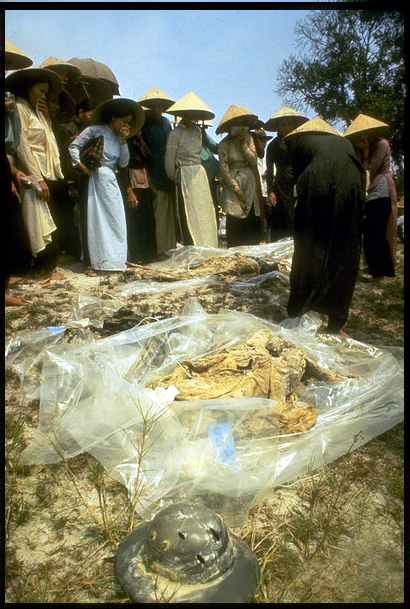
Identifying
remains from mass graves in Hue, May ‘68
The brutality against civilians from
both sides of the war was similar, but given the scale of US troop levels –
half a million by early ’69 – the enormity and volume of atrocities from the
American side were far greater. As Turse titled an earlier article, “A My Lai a
Month.”
Given the variety and number of US combat units implicated, it’s no longer possible to satisfy conscience by writing off Calley’s outfit, the Americal Division, as poorly led and seriously lacking in effective command & control of field units – there were just too many other well regarded, well-led units. The Pentagon no longer has anywhere to hide the unpleasant past.
But how is it we’re only now hearing the full extent of a problem rife among combat outfits in the long Vietnam War. One of many journalists who had embedded with combat units recently reported he had been aware of instances of brutality, but he could never connect the dots – the pattern eluded him as well as most of his fellow war correspondents. It was not that he didn’t suspect something was going on and try to interview soldiers – he did, but they wouldn’t talk. One GI, however, hinted at what we’ve now learned belatedly from Turse:
Given the variety and number of US combat units implicated, it’s no longer possible to satisfy conscience by writing off Calley’s outfit, the Americal Division, as poorly led and seriously lacking in effective command & control of field units – there were just too many other well regarded, well-led units. The Pentagon no longer has anywhere to hide the unpleasant past.
But how is it we’re only now hearing the full extent of a problem rife among combat outfits in the long Vietnam War. One of many journalists who had embedded with combat units recently reported he had been aware of instances of brutality, but he could never connect the dots – the pattern eluded him as well as most of his fellow war correspondents. It was not that he didn’t suspect something was going on and try to interview soldiers – he did, but they wouldn’t talk. One GI, however, hinted at what we’ve now learned belatedly from Turse:
You
wouldn’t believe it so I’m not going to tell you.
No
one’s ever going to find out about some things,
and
after the war is over, and we’ve all gone home,
no
one is ever going to know.*
Aside from the individual GI’s personal responsibility for atrocities committed during the war, can some root source be detected for the widespread mayhem? Was it Kennedy’s hot Cold War rhetoric and initial escalation or Johnson’s later massive raising of the stakes. Possibly causality began with General Westmoreland, the creator of ‘search & destroy’, the policy of attrition, and ‘body count’ as the metric of success.
Or was it the divisional commanders (CO) ambitious for promotion who put enormous pressure on subordinate officers to deliver high body counts. At one HQ, the CO had two large scoreboards maintained by a staff officer, one for weekly National Football League results, the other for the body count ‘score’ called in by his field units.
Perhaps the root the problem was further down the chain of command at battalion or company level – among officers who were intending to make a career of the military and very mindful of the performance metric. The VC had been famously elusive, breaking off an engagement, melting back into the jungle, carrying their dead and wounded with them – in effect denying their adversary a tally.
Aside from the individual GI’s personal responsibility for atrocities committed during the war, can some root source be detected for the widespread mayhem? Was it Kennedy’s hot Cold War rhetoric and initial escalation or Johnson’s later massive raising of the stakes. Possibly causality began with General Westmoreland, the creator of ‘search & destroy’, the policy of attrition, and ‘body count’ as the metric of success.
Or was it the divisional commanders (CO) ambitious for promotion who put enormous pressure on subordinate officers to deliver high body counts. At one HQ, the CO had two large scoreboards maintained by a staff officer, one for weekly National Football League results, the other for the body count ‘score’ called in by his field units.
Perhaps the root the problem was further down the chain of command at battalion or company level – among officers who were intending to make a career of the military and very mindful of the performance metric. The VC had been famously elusive, breaking off an engagement, melting back into the jungle, carrying their dead and wounded with them – in effect denying their adversary a tally.
Early on, field CO’s would inflate
or even fabricate body counts. Following a battle in which the only countable
Vietnamese
casualties were several dead peasants killed in a jeep accident, the frustrated CO told his radioman to signal a body count of 300. The savvy radioman, said, but sir, you can’t call in an even number.
As the war relentlessly rolled on and the toll of civilian dead mounted by virtue of collateral damage (the military euphemism for mistakes) or by deliberate killing, CO’s no longer bothered to fake the numbers – they had bodies, not necessarily combatants, but bodies all the same. All the various explanations may have been contributing factors, or what might be called necessary conditions, but one is still left to reflect on the ‘sufficient condition’ accounting for the descent into acts of depravity of so many GIs and Marines in Vietnam.
The latest revelations remind me of a former student who had been a much decorated big city policeman, respected for making arrests with minimal force. One night he and his patrol partner came upon a burglary in progress. They each covered the store’s exits. When no one emerged from the front, the honored cop went around to the back where he found his partner unconscious, his head beaten in with a crow bar – irreversible brain damage.
Filled with rage and a thirst for revenge, the good cop soon became an avenger, tearing into any miscreant he could lay his hands on. Fortunately for his sanity, he recognized he was going to kill someone without cause. He resigned the force and went to college.
casualties were several dead peasants killed in a jeep accident, the frustrated CO told his radioman to signal a body count of 300. The savvy radioman, said, but sir, you can’t call in an even number.
As the war relentlessly rolled on and the toll of civilian dead mounted by virtue of collateral damage (the military euphemism for mistakes) or by deliberate killing, CO’s no longer bothered to fake the numbers – they had bodies, not necessarily combatants, but bodies all the same. All the various explanations may have been contributing factors, or what might be called necessary conditions, but one is still left to reflect on the ‘sufficient condition’ accounting for the descent into acts of depravity of so many GIs and Marines in Vietnam.
The latest revelations remind me of a former student who had been a much decorated big city policeman, respected for making arrests with minimal force. One night he and his patrol partner came upon a burglary in progress. They each covered the store’s exits. When no one emerged from the front, the honored cop went around to the back where he found his partner unconscious, his head beaten in with a crow bar – irreversible brain damage.
Filled with rage and a thirst for revenge, the good cop soon became an avenger, tearing into any miscreant he could lay his hands on. Fortunately for his sanity, he recognized he was going to kill someone without cause. He resigned the force and went to college.
We know that something similar was
experienced by some of the units that went berserk in Vietnam. In addition, the
elite forces among them, especially Marines and airborne, had been conditioned
for maximum aggressiveness and commonly saw themselves patrolling ‘Indian
country’. In ’67, a Marine company lost a man to a booby trap. Enraged and
unable to find the enemy, they tore what remained of a nearby village apart,
killing men, women, and young children with automatic rifle fire and grenades.
In a word, much like the cop who lost his moral bearings, in the absence of perpetrators upon whom to vent violence, the Marines became brutalized and fell upon powerless civilians within reach. Unlike my student, however, the Marines could not ‘resign’; they were bound to remain at risk in the ethical wilderness of non-frontal guerrilla warfare for the remainder of their tours.
Turse uses this tragic incident as a microcosm of the war:
In a word, much like the cop who lost his moral bearings, in the absence of perpetrators upon whom to vent violence, the Marines became brutalized and fell upon powerless civilians within reach. Unlike my student, however, the Marines could not ‘resign’; they were bound to remain at risk in the ethical wilderness of non-frontal guerrilla warfare for the remainder of their tours.
Turse uses this tragic incident as a microcosm of the war:
In
the story of Trieu Ai one can see virtually the entire
war
writ small. … Angry troops primed to lash out, often
following
losses within the unit; civilians trapped in their
path,
and officers in the field issuing ambiguous or illegal
orders
to young men conditioned to obey – that was the
recipe
for many of the mass killings for army soldiers and
marines
over the years.**
So we turn back to the atrocity photo which Jeff Sharlet ran in Vietnam GI so long ago – at the time a rare glimpse into what was really going on behind the facade of official battle reports crafted in spare military rhetoric. Nearly a decade after that photo was snapped, journalist Michael Herr, who became the Ernie Pyle of the Vietnam War, reported that mutilation of corpses was common among the troops and that many soldiers even carried in their packs scrapbooks of photos of their handiwork.***
The VGI photo brought out by Joe Carey now hangs in Vietnam’s War Remnants Museum in Ho Chi Minh City, formerly Saigon.
So we turn back to the atrocity photo which Jeff Sharlet ran in Vietnam GI so long ago – at the time a rare glimpse into what was really going on behind the facade of official battle reports crafted in spare military rhetoric. Nearly a decade after that photo was snapped, journalist Michael Herr, who became the Ernie Pyle of the Vietnam War, reported that mutilation of corpses was common among the troops and that many soldiers even carried in their packs scrapbooks of photos of their handiwork.***
The VGI photo brought out by Joe Carey now hangs in Vietnam’s War Remnants Museum in Ho Chi Minh City, formerly Saigon.

Vietnam
GI headless photo on the wall in the
War Remnants Museum, Vietnam
Obviously, not all the hundreds of
thousands of young men who passed through the combat units in Vietnam committed
the acts described, but the totality of the cruelty inflicted, now fully
revealed, implicates the command and the entire mission in Southeast Asia.
Above all, the current unearthing of the awful past begs the question how these
latest revelations will affect the planned 15-year long commemoration of the
war and its veterans announced by President Obama with much fanfare on Memorial
Day 2012.
*J Schell, “The Real Vietnam War,” The Nation (February 4, 2013), 22.
*J Schell, “The Real Vietnam War,” The Nation (February 4, 2013), 22.
**N
Turse, Kill Anything That Moves (2013), 39.
***M
Herr, Dispatches (1977), 198-199.