Showing posts with label Hue. Show all posts

Wednesday, November 4, 2015

Final Scenes of a Short but Interesting Life


Back to Nam, into the bush …


Sunset over Phu Bai South Vietnam, 1960s

Post-coup Vietnam was not a happy place. True, Diem, the president, and his notorious brother Nhu, the secret police chief, were gone, but the junta that assumed power couldn’t govern effectively. The generals had few political skills, and by early ’64 they had fallen out among themselves. General Khanh, one of the tougher combat commanders, seized power, and Jeff and his crew of Vietnamese linguists (lingys) were hastened back to Saigon.

However, there was nothing to do this time; Khanh bloodlessly consolidated control within a day. Jeff, with time still to serve, then got sent north to Phu Bai, a remote listening post just below the DMZ. The base was located in South Vietnam’s narrow coastal lowland between the mountains of Laos in the west and the South China Sea to the east.  A chopper flew Jeff and other replacements up. Short on crew, the pilot assigned Jeff to man the door gun, a light machine gun on a 180 degree swivel.

Phu Bai was a fairly primitive base, but perfectly positioned to monitor North Vietnamese military communications across the border. Jeff was billeted in a six-man tent with plank walkways connecting the tents to the heart of the base.  It was blistering hot, and when the monsoon season came, the rains were torrential.

The rest of the place was a series of small wooden structures – HQ, the club, the barber shop installed in a small shack, and a store – except for the air conditioned operational buildings where the Morse code operators, or ‘ditty boppers’, and the lingys worked.

The entire base – not much bigger than a large baseball field – was encircled by barbed wire and defensive bunkers in the event of a Viet Cong (VC) attack. The threat, however, did not seem serious since there was only a single security guard with a sidearm manning the ramshackle front gate.

Jeff’s outfit, called Detachment J, had a two-fold mission in the then-early Vietnam war. They were to intercept and listen to the North Vietnamese Army’s radio messages, as well as maintain radio liaison with South Vietnamese commandos infiltrated across the border into enemy territory.

Off-duty, there wasn’t much for a GI to do in the desolate environment. The little club served cheap drinks to all ranks, and an occasional movie broke the monotony. Boozing was the main preoccupation, as one of Jeff’s buddies who later rendered a familiar scene at the club in a poem:

                   Jeff at the bar has a live one
                   a fool enough to take him on,
                   Phu Bai’s favorite Socrates
                   debating war’s ‘morality’
                   ‘I’m telling you, this war’s bullshit
                   and we’ve got no business here
                   we’re not here to help these people
                   we’re just getting lots of them killed’
                   later, last call passed, cutty’s gone
                   so with a case, two, sometimes more
                   st. pauli girl, chilled black label
                   he, Bill, Jeff … continue on out at the wire
                   closer there to the nearby war
                   Jeff recreating his debate,
                   dismissive of his rival’s stance
                   predicting, boy Cassandra like,
                   disastrous outcomes from the war
                             the sandbag bunker full of drunks
                   but none too drunk to miss the stars
                   moonless clouds of constellations
                   laced above their no ending war … *

It wasn’t just nightly boozing though; there were other laughs and good times as well. Periodically guys were rounded up to drive 6x6 trucks to Hue, the ancient capital, to pick up supplies. A junior officer in a jeep would lead the convoy, issuing strict instructions that the trucks were to stay together in column.

However, like in a slapstick movie, as the convoy reached the city the drivers would sometimes peel off in various directions. That way the ‘lost’ drivers and helpers could spend part of the day in Hue rather than just loading up and heading straight back up the road to Phu Bai.

On an off-duty day at other times, Jeff and a bunch of guys would drive to a wide sandy beach on the South China Sea for an afternoon of sun and surf. A photo from one of those outings reminds one of a relaxed beach scene on Long Island Sound the morning after a rousing house party at a New England college.

Once in a while Jeff and a buddy would borrow a jeep and drive south to the city of Danang on the coast. They’d put up in a hotel and enjoy a few days of creature comforts sorely missed back at tent city in Phu Bai.

Driving back one time over Đèo Hải Vân (Sea Cloud Pass) high above Danang, the two guys pulled over and took in the magnificent view of the heavily jungled mountains rippling down to a beach at the edge of the sea. Spying a finger of forested land jutting from the shore far below – a shimmering green peninsula – Jeff and his good buddy wistfully talked about opening a casino down there after the war.

It was then still early in the conflict and the war had a long way to go, but the memory lingered.

Hitting the books on the antiwar front …


Pro-war rally, Indiana University, 1966

Vietnam behind him, so he thought, Jeff headed back to college. He took a campus job and hit the books hard that first term of ’64. But even before fall classes began, there had been a skirmish in the Gulf of Tonkin between North Vietnamese torpedo boats and an American destroyer. It was an election year, and the incumbent President took full advantage with lethal retaliation, stoking war fever in the land.

As a Vietnam GI with a critical MOS, or Military Occupation Specialty, Jeff took note with some concern, but then the President quieted the drums of war as quickly as he had roused them. It would prove to be a false calm.

As he began his second term at Indiana University (IU), Jeff worried about the rising tensions in Vietnam – deadly Viet Cong (VC) terrorism met by heavy US aerial reprisals inevitably followed by renewed hot rhetoric. Having been assigned to an obligatory reserve unit, as an experienced Vietnamese linguist would he be recalled to active duty?

Fortunately Jeff wasn’t, but not long after his reelection, President Johnson (LBJ) set in motion a massive escalation of US involvement against the VC and their sponsors in North Vietnam. At IU, a small band of students began to organize against the war. From those beginnings emerged the new campus chapter of SDS, or Students for a Democratic Society.

Jeff was friendly with the activists, but stood aside from SDS, not convinced that such a loosely structured group of idealistic students could do much to affect the war, a war for which he had brought home a deep aversion. However, a new friend fresh from the ‘free speech’ struggle at Berkeley arrived on campus and persuaded him to lend his ex-GI status to SDS to strengthen its antiwar posture.

Taking on the war was an uphill struggle at IU, a very conservative place. Default sentiment was ‘rally around the flag’ – the country was at war. Adding to the prevailing mood, the university president, Elvis J Stahr, a former high Pentagon official, invited a string of pro-war Washington heavies to speak at IU.

Nonetheless, Jeff and the small band of activists shouldered on – mounting visible and audible demos against the campus visits by Nixon and a brace of gung ho generals. By his senior year, Jeff assumed leadership of the SDS chapter and stepped up the tempo of antiwar protest.

Decades later, a fellow activist remembered him saying at a rally, “This is the second time in my life that I have belonged to an organization run by Elvis J Stahr,” going on to add that he had first served under Secretary of the Army Stahr in the Army in Vietnam.

Then Jeff posed a rhetorical question, “And so why is the man who was Secretary of the Army, who was involved in making war on another country –
a man of the war machine – qualified to become the President of Indiana University, supposedly an institution of higher learning?”

Wrapping up, he concluded:

                   We need self-determination for students to get the
                   education they want and need, and we need self-
                   determination for the countries in the world now
                   oppressed by the US military machine, today
                   especially in Vietnam.**

An outstanding student as well as a major activist, Jeff’s life at IU was not just protest and no play. He and friends were regulars at Nick’s, a pub a block from the IU library. For lighter refreshments, it was off to the Gables, the soda bar and restaurant on Indiana Avenue, or the pizzeria just around the corner.

Sometimes the group gathered for an evening of folk music at one or another off-campus apartment – several of the activists were talented musicians. Then there were the free-swinging parties at the East 2nd Street house Jeff shared with a few of the guys.

And not least, there were his long relationships with successive girlfriends – with Karin, Karen, and Miki. All in all, good years.


Chicago bound – ready, set, go …


Chicago, “City of Big Shoulders,” cauldron of protest

Jeff headed for grad school. He had won a Woodrow Wilson National Fellowship and applied to Yale, Chicago, and Michigan. He had in mind an academic career— or did he? Chicago was his choice – not only a top school, but in a  city alive with activism and protest.

As his IU mentor later recalled, in ’67 Jeff was ambivalent about his near future, torn between competing visions. Would it be the rigors of a PhD program or his compelling desire to continue the fight against the war – in fact even upping the ante in the process? He enrolled at University of Chicago for the fall term, but his heart wasn’t in the academic game – at least not then with a war that had to be stopped.

By the end of the term, Jeff had made the choice which would determine his destiny. Dropping out of Chicago, he plunged headlong into the city’s many-sided antiwar scene. Draft resistance, however, wasn’t his thing; neither was the pacifist Quaker group, nor yet more SDS marches and demos – been there, done that.

Instead, Jeff poured all his energies into pursuing the grand vision he’d been nurturing for some time – stopping the war by mobilizing the GIs, the guys with the rifles, against it. Not as difficult as it sounded, for Jeff knew that many fighting men in Nam had doubts about the US mission. Yet other than tete-a-tete in bars and GI coffee houses, they had no way to make their voices heard.

To give expression to those GIs – to give them voice – Jeff used his fellowship funds to create a GI-led, underground antiwar paper. It was to be by and for serving GIs as well as their comrades in other armed services deployed in Southeast Asia. With Jeff at the helm and an editorial board of ex-Vietnam GIs, Marines, and airmen, Vietnam GI (VGI) launched in early ’68.

VGI was an almost instant success with the guys in the trenches, on the ships off-shore, and at the airbases arming the attack choppers and fighter bombers. It resonated as well with many GIs at stateside bases being readied for deployment to Nam.

Letters-to-the-editor praising the paper began streaming in to the Chicago office, with the writers often asking for more copies of VGI to share with buddies. Most of all, the letters revealed the real war behind the sanitized military briefings in Saigon – aptly lampooned as the ‘Five O’clock Follies’.

Getting the monthly issue out was challenging work. The lead was always Jeff’s interview with a recently returned combat veteran, but first a good source had to be found and be willing to talk about an unpleasant experience. Other stories arrived in the mail, some from the field in Nam, some from the stateside infantry training depots.

Jeff usually added an editorial, and there were also photos, including those the Pentagon hoped would never see light of day; and of course the many ‘Dear Jeff’ letters featured monthly in the ‘Mailbag’.

Everything had to be edited into good readable prose, but prose easily accessible to the average grunt, usually a high school grad. Then came typesetting, proofing, and printing. Printing VGI got harder and harder as the FBI’s Chicago field office persuasively ‘urged’ many area typographers to refuse to print a ‘subversive’ paper.

Finally, there was the monthly distribution ritual. Normally a periodical could be mailed at a low rate as ‘printed matter’. But Chicago postal inspectors were on the lookout for leftist and anti-government material, hence Jeff and his staff had to go the more expensive ‘First Class’ route not subject to postal inspection.

Even so, great numbers of First Class envelopes, especially addressed to military addresses, could not be simply dumped at the post office without arousing suspicion. Volunteers would therefore drive all over the greater Chicago area depositing small numbers of the paper in many corner mailboxes.

All of this this took money for typesetting, printing, and mailing, hence fundraising was a constant of Jeff’s editorship. Getting the paper out was nearly a fulltime activity, so for most of the time for Jeff and senior staff, earning money from a regular job wasn’t a viable option.

It was an intense time, but Chicago was a lively town replete with legions of activists supportive of the GI antiwar cause. Jeff and friends would occasionally get respite from the fever zone with dinners at friends’ apartments, bar hopping to cool music venues, as well as from parties at the place he shared with fellow editors on the city’s North Side.

Still, the tension level remained high with the Feds, the Army’s military intelligence group in Northern Illinois, and the Chicago Red Squad nosing around combined with the chronic problems of scarce funds and deadlines looming.


On the road for Vietnam GI


The ‘Yard’ at Harvard University, Cambridge MA, 1960s

From his base in Chicago, Jeff covered a lot of ground traveling both at home and abroad on behalf of Vietnam GI (VGI) or as a leader of the GI opposition to the war. By ’68 there was in place a network of GI antiwar coffee houses in the little tank towns outside infantry training bases.

The coffee houses run by antiwar volunteers were havens for GIs less than enthusiastic about the war. Off-duty guys could get a cup of coffee, a piece of pie, and read the irreverent underground press – especially the GI papers, foremost VGI – undisturbed by disapproving non-coms or brass.

Periodically, Jeff traveled the coffee house circuit to rap with GIs and gather their stories for the paper. Some of them were awaiting deployment, while others were just back from the ‘zone’ – the combat zone. During the spring Jeff hung out at ‘Mad Anthony Wayne’s Headquarters’, the coffee house outside the gates of Fort Leonard, MO; in the fall he was at the Oleo Strut, which served the growing number of GI war resisters at Fort Hood, TX.

Another of Jeff’s travel beats were the two coasts, especially the Northeast and the San Francisco Bay Area. That’s where the money was – where the well-to-do antiwar liberals were to be found. Fund-raising was a pressing necessity to keep VGI afloat. Often a wealthy individual would throw a cocktail party with Jeff as guest of honor to talk about his paper and the GI movement as the hat was passed around.

He was also in demand abroad. During the summer it was a trip to Kyoto to counsel the Japanese peace group on how to handle Vietnam deserters being hidden from the Japanese authorities and  US military police. When he served in the Philippines, Jeff had made a leave trip to Japan and liked the country.

Late fall ‘68 Jeff was with a delegation in Stockholm where the Swedish government had given sanctuary to many deserters. Ideally, he would have preferred antiwar GI’s to stay in the ranks and spread the word, but he respected an individual’s decision to bail out of the war.

By far, Jeff’s favorite destination was the Boston area. He was familiar with the town, having visited extended family there during his younger years. Many of his classmates from the Albany Academy had also gone to Harvard, so he was acquainted with Harvard Square and environs as well.

Several of VGI’s most generous financial supporters lived in and around the Square, so it became a frequent stop whenever he hit Boston. Most importantly though, he would visit the Boston Draft Resistance Group (BDRG) and his friends there further along the Charles River embankment in Central Square.

Jeff would give BDRG the templates for the latest issue of VGI, and they in turn would have thousands of additional copies printed. Their cadre of activists would then distribute the paper at military facilities throughout New England. It was a good arrangement.

By late in the year however, a medical problem that Jeff first experienced in Vietnam flared up, and he decided to head home for some doctoring.


“Because I could not stop for Death …”


Veterans Administration Hospital, Miami FL, 1960s

Home for Jeff was the Miami area where his parents lived. Exploratory surgery in early ‘69 detected cancer. It had spread, the odds were not good. Back at his alma mater, Indiana University, a friend arriving at a party of Jeff’s old college pals brought the news – the room went silent.

Despite his dire prospects, Jeff soldiered on, withstanding heavy doses of chemotherapy along with uncomfortable rounds of radiation. He fought hard, and by early spring the disease was in remission. The VA Hospital granted him a furlough.

In relays, friends and comrades from Chicago and Boston made the long drive down to Florida to spend time with Jeff. All of them would sit around drinking wine, listening to music, and laughing – there was lots of laughter about the many good times together.

Some will come, some will go
                                    We shall surely pass …
                                    We are but a moment’s sunlight
                                    Fading on the grass

Through the underground papers and the growing antiwar press inspired by Vietnam GI’s (VGI) success, news of Jeff’s illness flashed across the country and abroad. Dozens of cards and notes began arriving from myriad people in the antiwar struggle – everyone from Bernardine Dohrn, a national SDS leader, to individual GIs who only knew Jeff through his editorship of VGI.

Unfortunately the remission came to an end, and he had to return to the hospital for more chemo, more radiation, and IV’s, always the IV’s. But all was to no avail as he rapidly declined. In great despair one afternoon during late spring, Jeff attempted suicide, but failed. The end was near.

A few weeks later he slipped away – his heart stopped – he was gone. Death at an early age, he was only 27. He was widely mourned wherever an underground paper carrying his death notice was read. At the last SDS convention, a minute of silence in memory of Jeff was observed by the nearly 2000 gathered.

In an uncanny foreshadowing of what would become his destiny, many years later a friend recalled Jeff once telling him of his plans for Vietnam GI:

          He told me that this was what he wanted to do
          at this time in his life. And he thought this would
          be the most important thing he had ever done
          in life.***

Of the many obits, the most eloquent one began:

                 Many good men never came back from Nam. Some
          came back disabled in mind. Jeff Sharlet came back
          a pretty together cat – and he came back angry.
               Jeff started VGI and for almost two years poured
          his life into it in an endless succession of 18-hour
          days, trying to organize men to fight for their own
          rights.

As Emily Dickinson, the poet of Amherst, wrote, Because I could not stop for Death/ He kindly stopped for me.

*J Buquoi, “phu bai nights,” Snapshots from the Edge of a War. e-book         forthcoming via Amazon, 2015.
**D Kaplan, “Reminiscences of Jeff’s March 1967 Peroration,” August 2011.
***D Kaplan, “Last Conversation with Jeff,” August 2011.


Wednesday, February 4, 2015

A Voyage of Discovery – From Bloomington to Saigon

[On this the 4th anniversary of Searching for Jeff, the present post has been written by my collaborator on this blog, Karen Grote Ferb. Karen knew my brother Jeff well during their university days. In 2013 she and her husband Tom traveled to Vietnam where Karen retraced Jeff’s steps as a Vietnam GI during 1963-64.]

I first met Jeff Sharlet at a house party in early January 1966, a little over a year after he returned to Indiana University (IU) from his tour as a US military advisor in Vietnam.  It was a chance meeting.  One of my house mates had been invited, but did not want to go alone; she begged me to go with her.  I really didn’t want to, but she pleaded so long I finally gave in.  Jeff was there, sitting in a dark corner alone.  I’d seen him once before on campus, standing with a group of guys in front of Ballantine Hall.

I introduced myself, and we began a lengthy conversation in that corner, then got away from the general din to continue talking student style sitting on a pile of winter coats in the bathtub.  We talked about socioeconomics, racism, and the war in Vietnam. The war had been building dramatically since the Tonkin Gulf incident in August ’64 shortly after Jeff had returned stateside – culminating in the launching of a major bombing campaign over North Vietnam followed by the landing of the Marines at Danang in early ‘65. 

Our conversation continued over the next eight months until I left for graduate school, and more and more it turned toward the war, as was happening all over the country.  Why were we fighting in Vietnam was the question many were asking, and how could we stop it.
____________________________________________

Fast forward to the digital age and 2004 when I finally
 learned of Jeff’s tragically early death in ‘69.
____________________________________________

Although Jeff was clear that he had done something in Vietnam he couldn’t bring himself to speak of, he didn’t talk much at all about his experiences there that had soured him on our involvement in the war. At the same time, he had developed an admiration for the Vietnamese people, although not for their oppressive regimes beginning with Diem and his cruel brother Nhu, so he joined the IU chapter of Students for a Democratic Society (SDS) during fall of ‘65; I too joined around that time.          

Antiwar protests grew exponentially from the mid-‘60s, not only at home, but abroad, and even in Vietnam itself.  The Buddhist crisis, in particular, had drawn worldwide attention as clergy began to set themselves afire in public places as a protest against the Diem regime.


Jeff at Indiana University, 1965

Fast forward to the digital age and 2004 when I finally learned of Jeff’s tragically early death in ‘69.  I had come across his namesake nephew, at the time beginning his illustrious career as a writer.  At first I thought he was the Jeff I’d known, but a little exploration proved it not so; the namesake was too young and did not resemble his uncle.  The truth was a shock.  Jeff had died of cancer at age 27.  I knew he had an older brother, Bob, so I set out to offer much-belated condolences.

As it happened, Bob, an academic approaching retirement, was determined to give his brother his rightful place in the history of the GI Movement against the Vietnam War by writing a memoir of him.  Jeff too had intended to pursue an academic career. He had begun grad school at the University of Chicago, but dropped out and used his Woodrow Wilson Fellowship funds to create the first GI-led antiwar, underground newspaper. Vietnam GI was aimed at GIs serving in Vietnam as well as on US bases in the States and abroad. 

Contacting Bob at that time was serendipitous because he had little idea of how to reach out and find Jeff’s friends and comrades from his IU days. We determined that, although I’d lost touch with my fellow IU antiwar activists, I could find them for him.
 ___________________________________________________________

I began a voyage of discovery I could not have imagined when I last spoke
with Jeff just a few months before the first issue of Vietnam GI appeared.
____________________________________________________________

Over time I did find many of those people as well as others from Jeff’s high school years, his Army days, and the time he spent in Chicago as an underground editor, which also took him across the country and abroad. Bob eventually interviewed over 150 people who had known Jeff to one degree or another, and I began a voyage of discovery I could not have imagined back in late 1967 when I last spoke with Jeff just a few months before the first issue of Vietnam GI appeared. 

In my wildest dreams I couldn’t have foreseen the depth of knowledge and understanding I would achieve about Vietnam and the war, nor that I would visit Vietnam, now unified, and walk in Jeff’s footsteps, seeing the places he had seen.

I found myself in Saigon’s cavernous Bến Thành Market, in front of which a massive nonviolent Buddhist protest had taken place on August 25, 1963, the very day Jeff arrived in Saigon for the first time. South Vietnamese government troops had opened fire, killing several people, including Quách Thị Trang, a 15-year old student. 


Bến Thành Market Protest and Quách Thị Trang, 1963

The traffic circle was subsequently renamed in her memory and now holds a statue of her in a space shared with a mid-15th century general, Trần Nguyên Hãn, a great poet, talented politician and strategist under Emperor Lê Lợi, and a hero revered for his role in liberating Vietnam from China’s Ming Dynasty.


Quách Thị Trang & General Han, 2014

No longer there to see were street-side execution posts as well as the trenches which Jeff could not have failed to notice; they surely would have added to soldiers’ anxieties about the dangers that too often erupted.


Trenches in front of Saigon City Hall, mid-‘60s
 
Nor were the famously well-known Buddhist self-immolations the only evidence of a profound cultural conflict and repression in the cities of South Vietnam.  Widely reported, the images of monks engulfed in flames stunned the world, although the root cause was not widely known. 

The Catholic Diem regime had retained a French colonial rule that Buddhism was not a religion, but an association, which severely limited the rights of Buddhists as opposed to those of the Catholic minority. A request to fly Buddhist flags on the occasion of Buddha’s 2,507th birthday in 1963 had been turned down while the Vatican flag flew on the occasion of the consecration of Diem's older brother as the Roman Catholic Archbishop of Hue.

A protest in the ancient capital of Hue of about 3,000 Buddhists was fired on by government troops.  The regime, attempting to minimize the damage and even pin the blame on its civil war adversary, the Viet Cong, was hotly contested by a huge protest march the next day of more than 10,000 demonstrators.
 
The protests and self-immolationssix in all, including a Buddhist nuncontinued throughout the summer of ’63, resulting in several clashes between Buddhists and troops, as well as hunger strikes—over 10,000 participated in Saigon alone—sit-ins, and street fighting between Buddhist and Catholic civilians.  All during the summer the great gong at Saigon’s Xa Loi Pagoda’s tolled, while in Hue the violence had left the main pagoda, Tu Dam, nearly a complete ruin.

Although President Diem had insisted he was pursuing a policy of conciliation, the tragedy in the streets of Saigon in August of ’63 would discredit any notion of it.  Having declared martial law, the president had given the police under his brother Nhu free rein starting that August.
_________________________________________________

Nhu’s police plundered, looted, beat, and brutally murdered 
Buddhists with abandon, killing no fewer than 100 in Hue alone.
___________________________________________________

Nhu’s police plundered, looted, beat, and brutally murdered Buddhists with abandon, killing no fewer than 100 in Hue alone. The overall number murdered or ‘disappeared’ was in the hundreds.  Thousands of Buddhists across the country were arrested and tortured by forces under Nhu, Diem’s brother, who also headed the special forces.  On August 25th, 6,000 monks, nuns, civilians, and students were arrested followed by many thousands more over the course of the following month. 

A war that had had not yet received much attention back in the States suddenly had many Americans asking questions that before long would result in massive demonstrations against it. The rest of the world began to wonder what our objectives in Vietnam actually were.  In the end, Washington declared, “… it appears that the government of the Republic of Vietnam, has instituted serious repressive measures against the Vietnamese Buddhist leaders…The US deplores repressive actions of this nature.” 

In spite of this, the American media were not quick to pick up on extent of the underlying conflict between Buddhists and the Catholic regime; that is, within the overarching civil war between Communist North and non-Communist South Vietnam, a religious civil war was raging in South Vietnam between Buddhists and Catholics.
Soon after the police attacks against Buddhists and their pagodas, the commander of the Army of the Republic of Vietnam (ARVN) announced military control over Saigon, instituted censorship of the press, and cancelled all commercial flights into the city.  As the US Government began to lose confidence in its client Diem, Jeff and fellow Vietnamese linguists were quickly rushed to Saigon.
_____________________________________________________

As the US Government began to lose confidence in its client Diem, 
Jeff and fellow Vietnamese linguists were quickly rushed to Saigon.
______________________________________________________

Washington had finally recognized that the Diem regime was behind the attacks and had no intention of reconciliation with the Buddhists, a direct violation of a promise made. President Kennedy was also aware that a group of South Vietnamese generals were planning a coup.
 
The ensuing events in September and early October ‘63, to which Jeff was privy in his position of clandestinely eavesdropping on the ARVN General Staff, led on November 1st to a successful military coup and the execution of Diem and Nhu. 

Coincidentally, a year later in ‘64 – also on August 25 – a group of 10,000 Buddhists attacked and burned to the ground a Catholic village near Danang, after which horrendous bloody clashes erupted between Buddhists and Catholics killing and mutilating each other in the streets.  The violence soon spread to Saigon and other urban centers, creating an atmosphere of anarchy in the entire country.*


Violent clashes between Buddhists and Catholics, August, 1963

Contemporary Vietnam: Now a single unified country under Communist rule, the situation from the early-mid ‘60s has been reversed – the officially atheist Communist government now persecutes Christians, but allows Buddhists to practice their religion, although only a single sect, the Buddhist Church of Vietnam, intended to encompass any and all Buddhist sects firmly under state control.
______________________________________________________
* R J Topmiller, The Lotus Unleashed:  The Buddhist Peace Movement in South Vietnam 1964-1966 (2002), 19


Wednesday, February 27, 2013

Headless in Vietnam – A Long Ago Tale

On patrol with the Wolfhounds, a battalion of the 25th Inf out of Cu Chi, Joe Carey came upon a shocking sight. The year was ’67. Joe was a combat photographer keeping an eye out for shots to illustrate the division’s monthly magazine. Walking through the bush with an infantry squad, they came upon the scene below. Seeing Joe with several cameras slung around his neck, one of the GIs standing in the clearing wordlessly slipped him a canister of film. The GI had taken the photo.


A year later Joe Carey left Nam and returned stateside to Chicago. He heard that Jeff Sharlet, another ex-Vietnam GI he knew from Indiana University, was in town. Jeff had founded the first underground antiwar paper addressed to GIs, Vietnam GI (VGI). It had quickly taken off and found a large and growing readership in Vietnam as well as stateside base camps.

Joe passed the unpublished headless print on to Jeff who realized it was dynamite, the first atrocity photo to surface in the war. Believing that it needed much broader public exposure, Jeff offered the dramatic photo to various national media. One by one they turned it down. Why you might ask. One compelling reason was that the Johnson White House would ‘punish’ any media outlet which blindsided and embarrassed the administration – a paper’s White House correspondent might be excluded from backgrounders or dropped from a presidential trip roster at the last minute.

With no takers, Jeff ran the photo in his May ’68 issue of VGI. Predictably, it created a small sensation in the coast to coast world of underground media. Several civilian papers reprinted the picture for their own large audiences. Not too long after, a European wire service and a Soviet newspaper picked up the photo. By then it had come to the Pentagon’s attention, an unwanted distraction in prosecuting the war.

Because of the adverse publicity, the Army tracked down the GIs who had posed as great white hunters and court-martialed them. Joe Carey was called to testify. Was justice meted out? As the title of a book of that time suggested, “Military justice is to justice as military music is to music.” The three younger men, privates and PFC’s, were acquitted – just following a superior’s orders. The sergeant was reduced one grade – he merely lost a stripe. End of story.

At the time the photo appeared in VGI, I wondered if the shocking scene represented an aberration – several bad apples had killed two Viet Cong (VC) and then took it a step further, decapitating the dead – or was the photo a rare glimpse into the sub rosa nature of the war, a reality that somehow got missed in the extensive media coverage. In the vast literature on the war by ex-GIs over subsequent decades – memoirs, oral histories, autobio’s cum fiction – there were scattered hints, but as a good county district attorney would probably say, all you’ve got is circumstantial evidence, no smoking gun.

Let’s take a retrospective look at some of that fragmentary evidence. In A Rumor of War, one of the first and still one of the best combat memoirs, the author, a Marine lieutenant, admitted to ordering the death of two South Vietnamese villagers he suspected as VC only to learn they were innocent civilians.

A combat rifleman, later a distinguished poet of the war, paraphrased the ‘rules of engagement’ as, if a man’s running, he’s VC. He shot a figure in traditional black peasant garb and conical hat running across a rice paddy. Coming upon the body, he saw it was an old woman, probably frightened at sight of the troops. To no one in particular, the Marine uttered the standard throw-away line, ‘Sorry ‘bout that’, and moved on.

After the war, three widely read oral histories of the GI experience appeared. Two were compiled by a former trooper who interviewed fellow GIs. Due either to self-censorship or the editor’s pen, the interviews were relatively sanitized so that even a guy’s mother could read the book without blushing. The third volume, however, was different. Written by a journalist who gave his respondents anonymity. Called Nam, it was a much rawer account of what went on in the same combat areas when, for instance, they took hostile fire from a ville supposedly free of VC.

The book included boasting stories of what X soldier did to Y civilian encountered in an ambiguous situation, some of the accounts so out of character with the growing memoir literature that I speculated at the time that the tellers were exaggerating, spinning tall tales.

Earlier, ‘71, the ‘Winter Soldier Investigation’ was held at which dissident combat veterans testified in a confessional manner to far more hair-raising tales of war crimes in graphic detail. The horrors related, however, received limited media attention and never gained traction in public consciousness. At that point in time, the public was war weary and just wanted the Vietnam conflict to go away.


Winter Soldier Investigation, Detroit ’71
Marine describes abuse of Vietnamese villagers

Before the antiwar GIs went public and long before the books on the war appeared, there was the My Lai Massacre. Perpetrated in ’68 and covered up by senior officers and the Pentagon, it was blown wide open by investigative journalist Seymour Hersh in ’69. At the time, the general reaction to the sickening killing of over 500 old men, women, and small children was how young American boys could have done such a terrible thing. As life on the home front inevitably moved on and the war continued to rage, the comforting answer seemed to be that the massacre had been a one-off war crime, a departure from daily life in the combat zone.

Some 30 years later in the early 21st century, the Toledo Blade broke an ugly account of an airborne unit that had gone on a seven-month rampage – torturing, raping, murdering, mutilating, even scalping – generally indiscriminately killing large numbers of South Vietnamese villagers. As one paratrooper described it, “Imagine Dodge City without a sheriff.”

The story initially garnered national media attention, but that was just when the US was mopping up in Afghanistan in the wake of 9/11 and on the cusp of the Iraq War. Suffice it to say that with America again at war in the Third World, on two fronts no less, other than a Pulitzer Prize for the journalist’s subsequent book, the Dodge City airborne soon became yesterday’s news.

And now, early in 2013, comes a new book on what went on in Vietnam behind the curtain, so to speak, based on a decade of meticulous research in long forgotten military records. With the chilling title, Kill Anything That Moves, the study irrefutably demonstrates that My Lai, Tiger Force, and myriad other instances of savage treatment of South Vietnamese peasants caught between the armies were not isolated, one-off incidents.

It was neither a few bad apples, nor aberrant behavior by warriors otherwise observing the Geneva Convention on civilians and non-combatants, but instead a serial pattern of atrocities and war crimes. As author Nick Turse makes clear, accountability can no longer be reckoned by simply laying such incidents at the door of an abysmally unqualified commander like Lt Calley or a clutch of airborne crazies.

Of course, atrocities in Vietnam were not a one-way street. As a matter of strategy and politico-military policy, the VC had been committing atrocities against the South Vietnamese rural population since the late ‘50s when the insurgency began. Their overarching purpose was to defeat the government of President Diem and unify the country under the flag of North Vietnam – at any cost.

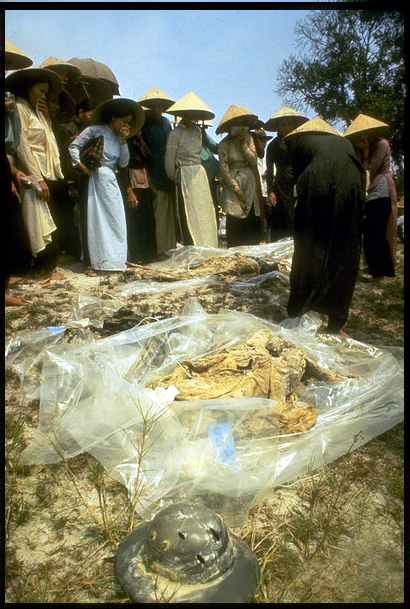
The VC too had sought to win ‘hearts & minds’ in the rural areas. Ideally they tried to do so through political education and indoctrination, but, failing to persuade a particular village, they didn’t hesitate to resort to fear, intimidation, and violence to achieve their objective. This meant singling out pro-Saigon village leaders and their families as object lessons with public beheadings, disembowelings, and impalings. Nor was the regular North Vietnamese Army (NVA) merely conducting warfare as generally understood – witness the mass executions of civilians when the NVA controlled Hue during the Tet Offensive of ’68.


Identifying remains from mass graves in Hue, May ‘68

The brutality against civilians from both sides of the war was similar, but given the scale of US troop levels – half a million by early ’69 – the enormity and volume of atrocities from the American side were far greater. As Turse titled an earlier article, “A My Lai a Month.”

Given the variety and number of US combat units implicated, it’s no longer possible to satisfy conscience by writing off Calley’s outfit, the Americal Division, as poorly led and seriously lacking in effective command & control of field units – there were just too many other well regarded, well-led units. The Pentagon no longer has anywhere to hide the unpleasant past.

But how is it we’re only now hearing the full extent of a problem rife among combat outfits in the long Vietnam War. One of many journalists who had embedded with combat units recently reported he had been aware of instances of brutality, but he could never connect the dots – the pattern eluded him as well as most of his fellow war correspondents. It was not that he didn’t suspect something was going on and try to interview soldiers – he did, but they wouldn’t talk. One GI, however, hinted at what we’ve now learned belatedly from Turse:

          You wouldn’t believe it so I’m not going to tell you.
          No one’s ever going to find out about some things,
          and after the war is over, and we’ve all gone home,
          no one is ever going to know.*

Aside from the individual GI’s personal responsibility for atrocities committed during the war, can some root source be detected for the widespread mayhem? Was it Kennedy’s hot Cold War rhetoric and initial escalation or Johnson’s later massive raising of the stakes. Possibly causality began with General Westmoreland, the creator of ‘search & destroy’, the policy of attrition, and ‘body count’ as the metric of success.

Or was it the divisional commanders (CO) ambitious for promotion who put enormous pressure on subordinate officers to deliver high body counts. At one HQ, the CO had two large scoreboards maintained by a staff officer, one for weekly National Football League results, the other for the body count ‘score’ called in by his field units.

Perhaps the root the problem was further down the chain of command at battalion or company level – among officers who were intending to make a career of the military and very mindful of the performance metric. The VC had been famously elusive, breaking off an engagement, melting back into the jungle, carrying their dead and wounded with them – in effect denying their adversary a tally.

Early on, field CO’s would inflate or even fabricate body counts. Following a battle in which the only countable Vietnamese 
casualties were several dead peasants killed in a jeep accident, the frustrated CO told his radioman to signal a body count of 300. The savvy radioman, said, but sir, you can’t call in an even number.

As the war relentlessly rolled on and the toll of civilian dead mounted by virtue of collateral damage (the military euphemism for mistakes) or by deliberate killing, CO’s no longer bothered to fake the numbers – they had bodies, not necessarily combatants, but bodies all the same. All the various explanations may have been contributing factors, or what might be called necessary conditions, but one is still left to reflect on the ‘sufficient condition’ accounting for the descent into acts of depravity of so many GIs and Marines in Vietnam.

The latest revelations remind me of a former student who had been a much decorated big city policeman, respected for making arrests with minimal force. One night he and his patrol partner came upon a burglary in progress. They each covered the store’s exits. When no one emerged from the front, the honored cop went around to the back where he found his partner unconscious, his head beaten in with a crow bar – irreversible brain damage.

Filled with rage and a thirst for revenge, the good cop soon became an avenger, tearing into any miscreant he could lay his hands on. Fortunately for his sanity, he recognized he was going to kill someone without cause. He resigned the force and went to college.

We know that something similar was experienced by some of the units that went berserk in Vietnam. In addition, the elite forces among them, especially Marines and airborne, had been conditioned for maximum aggressiveness and commonly saw themselves patrolling ‘Indian country’. In ’67, a Marine company lost a man to a booby trap. Enraged and unable to find the enemy, they tore what remained of a nearby village apart, killing men, women, and young children with automatic rifle fire and grenades.

In a word, much like the cop who lost his moral bearings, in the absence of perpetrators upon whom to vent violence, the Marines became brutalized and fell upon powerless civilians within reach. Unlike my student, however, the Marines could not ‘resign’; they were bound to remain at risk in the ethical wilderness of non-frontal guerrilla warfare for the remainder of their tours.

Turse uses this tragic incident as a microcosm of the war:

          In the story of Trieu Ai one can see virtually the entire
          war writ small. … Angry troops primed to lash out, often
          following losses within the unit; civilians trapped in their
          path, and officers in the field issuing ambiguous or illegal
          orders to young men conditioned to obey – that was the
          recipe for many of the mass killings for army soldiers and
          marines over the years.**

So we turn back to the atrocity photo which Jeff Sharlet ran in Vietnam GI so long ago – at the time a rare glimpse into what was really going on behind the facade of official battle reports crafted in spare military rhetoric. Nearly a decade after that photo was snapped, journalist Michael Herr, who became the Ernie Pyle of the Vietnam War, reported that mutilation of corpses was common among the troops and that many soldiers even carried in their packs scrapbooks of photos of their handiwork.***

The VGI photo brought out by Joe Carey now hangs in Vietnam’s War Remnants Museum in Ho Chi Minh City, formerly Saigon.


Vietnam GI headless photo on the wall in the War Remnants Museum, Vietnam

Obviously, not all the hundreds of thousands of young men who passed through the combat units in Vietnam committed the acts described, but the totality of the cruelty inflicted, now fully revealed, implicates the command and the entire mission in Southeast Asia. Above all, the current unearthing of the awful past begs the question how these latest revelations will affect the planned 15-year long commemoration of the war and its veterans announced by President Obama with much fanfare on Memorial Day 2012.

*J Schell, “The Real Vietnam War,” The Nation (February 4, 2013), 22.
**N Turse, Kill Anything That Moves (2013), 39.
***M Herr, Dispatches (1977), 198-199.