Showing posts with label Pentagon. Show all posts

Wednesday, May 21, 2014

Danse Macabre High above San Francisco Bay -- Rise of GI Protest

It might be said that GI protest against the war in Vietnam first came to public attention in South Carolina at Fort Jackson. At least that was the locale of the first major indication that not all soldiers wanted to ‘get with the program’.

The war was well underway in the fall of ’66 when Captain Howard Levy, a physician, refused to train Special Forces because the Green Berets committed war crimes against civilians. America was again in a hot war, the first since Korea, and the Army was in a no-nonsense mood. Levy was brought before a court-martial and sentenced to three years in federal prison.

His martyrdom to conscience made him a cause celebre in the national media – it was not every day that a medical officer was sent to prison. But the unflagging US escalation continued, and the Levy case was soon swallowed up in a cascade of combat stories coming out of Vietnam. Was it then nothing more than a futile, isolated gesture?

Actually no, since Dr Levy had been preceded by other GIs breaking ranks.  In June ’65, just months after President Johnson’s initial dispatch of the first US combat units, a West Point graduate in Vietnam refused to board a plane for a distant outpost, stating that the war was not ‘worth a single American life’. He was court-martialed and dismissed from the service. Later in the year, another officer participated in a civilian peace demonstration stateside carrying an antiwar sign. He was given two years at hard labor.

Several months before Capt Levy spoke up, three privates at Fort Hood TX announced they would not participate in an immoral war. They too were imprisoned. Just days after Levy’s conviction in ‘67, two Black Marines were arrested for questioning the war and in short order sentenced to six and 10 years. In early ’68 an Army lieutenant was arrested for picketing the White House.


           Capt Levy being escorted to the courtroom, 1967

Other than the Levy case, these incidents made barely a ripple in the media – the public barely noticed. The juggernaut rolled on – by December ’65, 165,000 troops had been deployed, and by the end of ’67 the total had topped 485,000.  As Soviet leader Khrushchev aptly noted, America had staggered into a bog and was caught in a quagmire.

However, listening to US commander General Westmoreland (Westy), you wouldn’t have known it. By late ’67 he was speaking optimistically of our progress in the war, but only a month later the Viet Cong (VC) launched the Tet Offensive against every major city in South Vietnam. They were defeated militarily, but achieved a tactical political victory by piercing the illusion of Westy’s rhetoric.

The VC had penetrated the US Embassy compound in Saigon, and it was seen live on television back home. After three years of war the American public got its first sense that all was not going well. To put a fine point on it, the country’s most trusted broadcaster, Walter Cronkite, concluded a nightly newscast with the statement, “we are mired in stalemate.”*

By ’67 the public, still largely supportive of the war, had become aware of the burgeoning civilian antiwar movement – massive marches had been mounted in New York and Washington – but the notion of unrest over the war in the military had not registered, not even with civilian activists. No one reading a newspaper or watching television could have missed the fact that the nation had grown increasingly divided over the war, but the various isolated incidents of GI protest – mostly hidden away on military installations – had not resonated.

Then in ’68 amidst the swirl of dramatic political events, a series of incidents at the Army stockade, the military prison at the Presidio of San Francisco, at last called attention to rising GI opposition to the war. However, those events couldn’t have involved men less likely to have spiked interest in the emerging GI antiwar movement.


Presidio stockade, San Francisco

The prisoners in that stockade were not antiwar activists. Only a few of the 27 men involved were even conscious of or interested in the war issue. A couple of the prisoners had served in Vietnam and were proud of their service while the vast majority consisted simply of maladjusted young men at odds with the regimentation of military life.

It was the Army itself in the person of the commanding general of the Sixth Army who, through wild overreaction to their behavior and his own exceptionally poor judgment, managed to convert a gaggle of relatively apolitical prisoners into martyrs of GI protest.

The event became known by the misnomer, the ‘Presidio Mutiny’.  Originally an 18th century Spanish fortress, the Presidio of San Francisco sat on a cliff overlooking the Gold Gate Bridge. Within the complex was the stockade where soldiers violating military discipline in one way or another were confined to serve short sentences.

Most of the stockade inmates had gone AWOL – an acronym for ‘away without leave’, a common offense – and had been caught. The stockade – usually well over capacity – sometimes had to ration food when the prisoner count soared. Conditions were miserable – serious overcrowding, too few toilets that regularly backed up, and arbitrary punishments.

Add to that poor, if not incompetent, prison administration and grudging, surly guards – some cruel and sadistic – and the stockade became a potential tinderbox of unrest and unruly prisoner behavior. One prisoner thought the place resembled an 1850’s insane asylum.

Daily routine involved prisoners leaving the barracks under guard for work details on the grounds of the base – usually mowing lawns, washing cars, chopping firewood, and the like. Guards were armed with shotguns and had standing orders to shoot anyone trying to escape. There had been two shooting incidents in the summer of ’68.
_____________________________

The heavy caliber buckshot hit him in the back, 
blowing a hole the size of a grapefruit
_________________________________

That fall, a mentally unbalanced young GI asked another prisoner for advice on attempting suicide – a fairly common occurrence at the stockade.  He was told half-facetiously that, if all else failed, he could make a run for it and get shot by a guard. The next morning on a work detail after taunting the guard, the prisoner did just that – started to run and was fatally wounded by a shotgun blast.

Looking at the profiles of the victim and the shooter, there was almost a strange inevitability that their intersection that day would end in death. Private James Richard ‘Rusty’ Bunch was a frail, seriously disturbed boy of 19 who had been in trouble on and off since enlisting in the Army. Caught AWOL, he had arrived at the Presidio stockade just a few weeks earlier in the fall of ’68.

Even by the standard for eccentric behavior in the stockade, Rusty stood out as quite bizarre. He appeared to be living in a fantasy world complete with flying saucers and Martians. He told fellow prisoners he could walk through walls and often sat on his bunk conducting two-way conversations with himself and writing incoherent notes. Before his arrest, he had told his mother he had died twice and been reincarnated as a male witch.

The guard in charge of Bunch’s detail was a 22-year old Mexican-American who reportedly had served as a military policeman (MP) in Vietnam and was due for discharge in the next few months. He had little experience with the shotgun he carried. The guard was well aware there had been a recent rash of escape attempts and that a fellow guard was being court-martialed while two others were being charged for escapes occurring on their watch.

During a smoke break, Rusty Bunch speculated aloud to the other three prisoners in the work detail whether the guard would actually shoot anyone. Hearing this, the guard said that if he didn’t open fire on someone trying to get away, he himself would be punished. There were several versions of what Rusty then said to the guard:

  •     Will you promise to shoot me?
  •     I won’t run unless you promise to shoot me.
  •     Aim for my head.
  •    You’d better shoot to kill.
And If I run, will you shoot me? to which the guard replied, You’ll have to run to find out.

The guard thought he was kidding – often prisoners would taunt their minders – but then Rusty started to run. The guard chambered a round, shouldered the weapon, aimed, and pulled the trigger. Later he said he intended to shoot at the fleeing man’s buttocks, but the heavy caliber buckshot hit Bunch in the back, blowing a hole the size of a grapefruit. He died enroute to the hospital.

The brutal death of Rusty Bunch set off a rumble in the detention barracks – beds were tossed, windows broken, latrines trashed. That night the prisoners held a meeting about the killing. All agreed that the victim had been off his rocker. In a place where behavioral outbursts were not infrequent, Bunch’s strange pronouncements about supernatural powers and space ships had set him apart. Confirming his self-destructive intent, death notes were found in his bunk.

Nonetheless, the inmates were outraged and decided that a non-violent protest against the shooting and to air their grievances against stockade conditions was called for. The next day, following morning roll call, 27 of them stepped out of the ranks, walked to the lawn, and sat down in a circle. They were quickly surrounded by guards, and the stockade commandant was summoned.

When he arrived, a prisoner stood up and began reading the list of grievances they had drawn up, but the officer almost immediately interrupted him. Holding a copy of the Uniform Code of Military Justice (UCMJ), the commandant began reading aloud the article on mutiny. When the prisoners started singing to drown him out, he moved to a command car with a loudspeaker and continued.


Demonstration at the Presidio stockade, 1968

The group was ordered to disperse and return to the barracks. Most complied, but some remained sitting and were carried away by the MPs who had arrived. The 27 were confined to the barracks while the stockade commander conferred up the chain of command. In an over-reaction to a peaceful protest, the politically conservative commanding general of the Sixth Army confirmed the decision to press mutiny charges against the 27.

A preliminary inquiry was held before a military judge – the equivalent of a civilian arraignment – to determine if charges were justified and, if so, under which article of the UCMJ to proceed in a general court-martial. Army defense counsel for the 27 argued cogently for a lesser offense than mutiny – willful disobedience – but the prosecutor, echoing the command line, insisted on going forward with the extreme charge of mutiny.

A mutiny conviction in the event of violence carried a maximum penalty of death by hanging – in other instances life imprisonment. The lesser offense of willful disobedience entailed a max of three years confinement and a dishonorable discharge. Obviously, having gotten the word from on high, the presiding judge came down for mutiny.

Normally, soldiers charged under the most serious articles of the military code are court-martialed individually before a military tribunal, but the 27 were broken up into several groups for a series of collective trials, a procedure which effectively made defense more difficult.

The first batch tried – the alleged three ringleaders – were defended by both military and civilian counsel. Prominent among the latter were Terence Hallinan and Howard DeNike of the San Francisco bar. Defense counselors did their best on behalf of their clients in the face of command bias in a system aptly described as ‘military justice is to justice as military music is to music’. At the heart of the proceeding were differing perceptions of what had happened to Pvt Bunch, whose death was the catalyst for the alleged mutiny.


Attorney Terence Hallinan, San Francisco, 2003

There was a Rashomon-like quality to the conflicting versions of prosecution and defense. To an outside observer in retrospect, the victim had clearly set out and managed to achieve so-called ‘suicide by cop’ or in this instance by armed guard. The competing versions of Rusty Bunch’s death, however, were irreconcilable – justifiable homicide vs murder.

Argument then turned to motive for the ensuing protest, at the core of which was whether it was simply a peaceful demonstration (the defense), or a mutinous assembly, an ‘unlawful concert’ in the language of military jurisprudence (the prosecution).

From the defense table, motive was described as a reaction to a fellow prisoner’s death, but the prosecution held a radically different view. For the Army, the intent of the unlawful concert was antiwar, anti-military, and in opposition to the Johnson administration.
______________________________________________________

Was the motive simply a peaceful protest or a mutinous assembly?
_____________________________________________________

The latter assertion of intent prevailed despite defendant testimony that at the barracks planning meeting the night before there had been absolutely no discussion of US policy in Vietnam. In fact, the list of grievances drawn up had entirely concerned local stockade conditions and the guards’ inhumane behavior.

The first trial concluded predictably with a verdict of guilty of mutiny by the panel of officers. Taking note that no violence had occurred, the court abjured the maximum penalty but handed down extremely stiff sentences of 14 to 16 years imprisonment. The defendants were stunned. The San Francisco press promptly ran news of the heavy sentences, and public outrage in the Bay Area – a hotbed of antiwar sentiment – was immediately ignited.

The news and reaction to it soon went national and reached the halls of Congress. Several members took to the floor in protest, and the phones began ringing at the executive suites of the Pentagon. It was felt in Washington – both in  senior political and military circles – that the Presidio 27 had been over-charged under the UCMJ and that the sentences were wildly excessive for what had transpired.

The Secretary of the Army felt the heat and reacted swiftly. The Sixth Army commandant was contacted and urged to tone things down in subsequent trials, but, given the Pentagon’s policy of not interfering in courts-martial within commands, the general ignored the signal and proceeded with mutiny prosecutions. But exercising command prerogative, he reduced the sentences to two to five years, which, however, did not quiet the negative public and political reaction to the case.

Having received thousands of letters protesting the sentence, the Secretary of the Army took action. The Army’s top jurist, who normally reviews all court-martial verdicts, with barely time to glance at the long trial record quickly reduced the five-year sentences to two years.

Shocked by the outcome of the initial proceeding, defense counsel mobilized for the ensuing courts-martials. Studies were made of the backgrounds of the 27, and psychiatric expertise enlisted. The survey of the defendants presented a sad picture of young men from checkered personal situations who were almost uniformly unfit for military service and unable to adapt to Army life.
___________________________________________

Undeterred, military justice ground on; 
all remaining defendants were convicted.
___________________________________________

They were largely small town boys from unstable families where alcohol abuse was rife and children suffered violence. Some of them were runaways, truancy was not uncommon, and several had been abandoned by one or both parents. Many were school dropouts or had been expelled. The median education for the 27 was 10th grade. Some of the soldiers had exceptionally low IQs, well below the Army’s minimum.

Individual stories were horrific. One defendant’s mother had been involved with a dozen men before he was 15 while another never lived in one place longer than 18 months. Most had enlisted to escape from the family or to get out of trouble with the law. The deceased, Rusty Bunch, who, according to his mother, was a quiet, religious boy, had joined up when his best friend was drafted.

All of the 27 had been AWOL, some multiple times. One man went AWOL on his first day of Basic Training, another took off after just three days in the Army, while seven others never made it through the eight-week course.

Once in the stockade, suicide attempts were not infrequent – usually by cutting one’s wrists – one prisoner who did so was bandaged up and sent back, only to hang himself with his bandages –  or drinking toxic liquids. In some instances guys were trying to get a psychiatric discharge, a so-called Section 8, but others were seriously trying to kill themselves, one man five times.

The stockade authorities classified all suicide attempts as ‘suicide gestures’ merely designed to gain attention. Usually the man would be patched up and thrown in an isolation cell on reduced rations. No surprise then that an Army psychiatrist examining one of these individuals exclaimed, “My God, you’re insane – what are you doing in the Army?”**

Testifying for the defense at a follow-on trial, a prominent civilian psychiatrist told the court that at the time of the demonstration, all 27 “if given proper psychiatric testing by military authorities, would have been declared unfit for service.”***

Undeterred, military justice ground relentlessly on, and all remaining defendants were convicted. However, the public furor and Pentagon concern over adverse publicity for the Army had reached such a level that the heretofore obdurate General Larsen had abandoned his crusade. Sentences went from one extreme to the other – from the original 16 years to a few months. The rest of the 27 ended up with three to 15 months confinement time.

By the conclusion of the final court-martial in June ’69, Pvt Bunch had gone from a tragic figure to an unintended public martyr to the rise of GI protest against the Vietnam War. Given his heavy-handed reaction, General Larsen had nearly singlehandedly stimulated GI antiwar protest and the public’s awareness of it.

No longer isolated acts, by ’68 GI opposition had begun to come together into at least an inchoate movement spanning stateside bases, European and Far Eastern installations, and the military’s most vulnerable point – among the troops in Vietnam.

Early in the year, brother Jeff Sharlet, back from his Nam tour, had founded the first GI-edited antiwar paper addressed to the troops – Vietnam GI (VGI), which, along with The Bond and The Ally, formed the trio of papers that inspired the creation of dozens, eventually hundreds, of GI underground base and unit papers. As the Presidio trials proceeded, VGI and the local GI papers seized on the case as a rallying point.

In 1970 the Presidio Mutiny case gained an enduring place in the annals of the GI movement thanks to Fred Gardner’s still definitive book – The Unlawful Concert: An Account of the Presidio Mutiny Case – dedicated to “Jeff Sharlet, founder of Vietnam GI, dead at 27.”

No one put the impact of the case better than Hal Muskat, a major GI activist of the day, speaking years later,

                        The Presidio 27 was the best thing that ever
                        happened to the GI movement – it put us
                        on the front page. ****
_________________________________________________
*CBS television news, February 27, 1968.

**R Sherrill, Military Justice is to Justice as Military Music is to Music (1970), 31.

***Ibid, 21.

****G Nicosia, “The Presidio 27,” Vietnam Generation, vol 2, no 1 (1990), 77.


Wednesday, November 7, 2012

Shadow Highway – "They Just Keep a-Coming"

It was a low-tech engineering marvel with a lethal purpose. North Vietnam’s (NVN) shadow highway to the south steadily and stealthily delivered men and materiel to the battlefields of South Vietnam (SVN). Its immense success was reflected in admiring nicknames coined by Americans tasked to shut it down. Because of Ambassador Harriman’s illusion of a neutral Laos through which the shadow highway passed, US Saigon Embassy personnel cynically referred to the Ho Chi Minh Trail (the Trail) as the “Averell Harriman Memorial Highway.” A Marine general called it the “Ho Chi Minh Autobahn,” while a Green Beret who had reconnoitered the route said that at times it was “like the Long Island Expressway – at rush hour.”
 
What Washington dubbed the Ho Chi Minh Trail (actually its official name was the Trường Sơn Strategic Supply Route) had ancient origins in the Annamite Mountains and jungles of Southeast Asia along the western border of what became SVN after the defeat of the French colonialists in 1954. It had long been a loosely connected network of primitive paths and trails through the wilderness trod only by aboriginal tribes inhabiting that sparsely populated, inhospitable area. Only in the late ‘40s during the long Vietnamese war for independence against the French did the network take on some semblance of a logistical trail system. The Viet Minh, the communist-nationalist guerrilla army created by Ho Chi Minh, used the system of trails as a clandestine route for moving fighters from the northern area of France’s Indochina colony to the Mekong Delta in the south below Saigon.
 
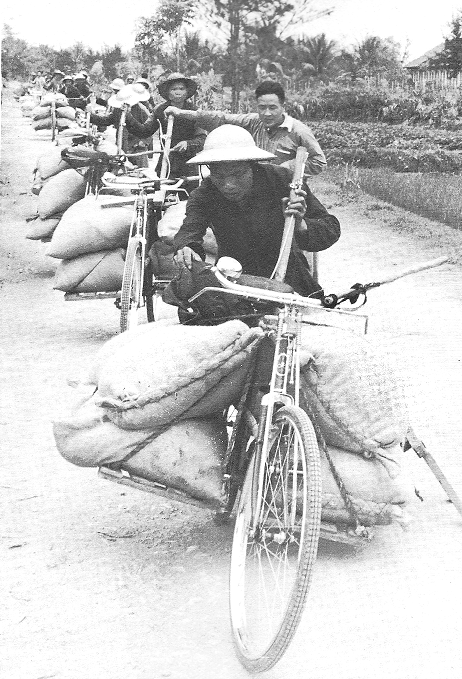
After ’54, the system fell into disuse, temporarily as it turned out. In ’59 the Communist Party of NVN decided to significantly support the ongoing low-level guerrilla insurgency against the government of SVN, and the Trail again saw military traffic. Because the early Trail involved climbing steep, heavily forested mountains and traversing rough jungle terrain, elephants were initially used to carry the heavy supplies. Eventually the preferred vehicle for transporting larger-caliber weapons, ammo, and foodstuffs became specially reinforced bicycles pushed, not ridden, by porters. Frames were strengthened, handlebars fixed with a long steering stick, and a pole for stabilizing the bike arose from the seat. Fully loaded, the bikes carried several hundred pounds.
 
 
Bike porters on the Ho Chi Minh Trail
 
After ’65 when the war escalated on both sides, the Trail was widened, and heavy duty Chinese army trucks replaced bikes. A truck-relay system was developed with designated individual sections of the Trail responsible for keeping their own fleets on the road. An underground pipeline was laid to provide fuel to the way stations along the Trail. Early on, Pentagon planners calculated that only as few as 20 truckloads of cargo a day, a fraction of the truck traffic on the Trail at any one time, had to get through for the NVN to meet its supply requirements in the south. By then the Trail had become a dual system – roads safe only at night for the trucks, while troops marched off-road by day, often having to cut trail as they went.
 
Throughout the Trail’s active service from ’59 to the fall of Saigon in ’75, North Vietnamese Army (NVA) troops moved along the route with heavy packs weighing as much as 85 lbs that contained food, clothes, and ammo for both the long journey and, ultimately, the SVN battlefields. To reach the Saigon-Mekong Delta region in ’64 by foot took five months.* Even later, after the system was considerably engineered and improved, the full trek still lasted as long as six weeks. To say that NVN’s ‘long march’ was arduous and tested the limits of human endurance would not be an exaggeration.
 
 
On the Trail through the mountains
 
Not all the NVA troops that moved as units were destined for the Mekong theater of operations. The Trail, which paralleled SVN’s border through Laos and Cambodia, had various ‘exits’, much like an American superhighway. The first exit was just below the Demilitarized Zone (DMZ) separating North and South Vietnam for units assigned to the Hue-Phu Bai sector, the area where brother Jeff Sharlet served in ’64. Although trail time was shorter for troops headed for that sector, they still had to climb over a rugged mountain range in northeast Laos to reach their destination.
 
While the Trail was NVN’s conduit for matching US troop levels in the south with NVA combat regiments and battalions, it was maintained by a separate command consisting of tens of thousands of engineering troops, anti-aircraft units, infantry for ground security, and huge numbers of young women volunteers assigned to roadwork – a highly dedicated and efficient combat support force stationed along the myriad byways and alternate routes of the 8000-mile road system.
 
 
The Trail and its ‘exits’
 
For the NVA troops trekking down trail, the terrain, predators, disease, and weather added to the ordeal. The foot trails were stony, rest areas rough-hewn, and the rainforests through which they passed either suffocatingly hot and humid or rain-drenched, perpetually damp, and steamy during monsoon season. Insects and jungle creatures plagued the transiting soldiers. Mosquitos swarmed in clouds; leeches abounded, whether in water crossings or dropping from trees; and poisonous snakes were ever a danger – everyone carried anti-snake venom, which had to be self-administered within three minutes of a bite. Many soldiers died enroute from disease – malaria, typhoid fever, amoebic dysentery, and many other infectious diseases, even plague, were endemic.
 
However, in terms of sheer ferocity and a staggering death toll, nothing along the Trail matched the US Air Force’s bombing and strafing campaign. When ‘Rolling Thunder’ was launched during spring ’65, Washington believed a relentless bombing campaign of NVN would ‘persuade’ the Communist regime to sue for peace or at least cause them to cease and desist stoking the southern insurgency with streams of men and supplies down the Trail. As the fighting intensified and US illusions about NVN’s commitment and steadfastness began to fall away, the strategic objective shifted to shutting down the pipeline feeding the Viet Cong’s (VC) insurgency against the SVN regime. In military-speak, the objective became ‘interdiction’ to prevent cross-border infiltration from NVN via Laos and Cambodia.
 
For this purpose, the hi-tech might of the world’s greatest military power was brought to bear on the Trail. The battle in the air against the enemy became a veritable separate, secret war apart from the ground war in SVN where GIs and Marines were going head to head with the VC and NVA battalions from the DMZ to the Mekong Delta. The air war was concealed from Congress as well as the American public because a large percentage of the thousands of air strikes were against the Trail in nominally neutral Laos and Cambodia.
 
At the outset prop-driven Douglas trainers were deployed to bomb and strafe enemy formations spotted along the shadowy trail. As the flow from the North increased, the air war escalated when Phantom jets armed with rockets and napalm entered the fray. B-52 bombers from Guam, designed for Cold War intercontinental warfare with the Soviets, were added to the order of battle. Carrying enormous bomb loads, the bombers cruised unseen seven miles up from where their deadly cargoes of 750 lb bombs were dropped from map coordinates.
 
 
B-52s over the Trail
 
As part of the Pentagon’s evolving electronic warfare, a device was created for detecting the presence of humans invisible in the impenetrable jungle below from the air. Colloquially known as ‘people sniffers’, the device was slung under a helicopter which reconnoitered suspected Trail areas, picking up the scent of urine. Coordinates would be transmitted, and perhaps the most destructive air weapon of all would be called in – a converted C-130 cargo plane nicknamed ‘Spooky’ because, being slow and flying at low altitude, it operated at night.  Bristling with automatic rapid-fire Gatling-type guns, Spooky would fly over the identified area, sometimes at only 1500’, and literally shower the jungle below with lead at the rate of 15,000 rounds a minute, eerily lighting up the night with red tracers.
 
One might think such overwhelming power would prevail, would have defeated NVN’s effort to sustain the war in the south. On the contrary, through surprising feats of Engineering 101 and often simple, even primitive countermeasures, the Trail remained a busy military thoroughfare as the vital route to the ground war in the south and ultimate victory in ’75. To counter relentless air attacks, the NVA positioned anti-aircraft guns at critical chokepoints on the Trail, ensuring that US bomb runs were not cost-free. Later, batteries of Soviet surface-to air missiles (SAM) were added, greatly increasing Air Force fixed-wing losses. In the course of the separate war over the Trail thousands of NVA trucks were destroyed and heavy casualties sustained, while the US lost 500 planes with their air crews.
 
Air attacks on the Trail were most effective against bridges over the many rivers that had to be crossed. Engineering crews could put pontoon bridges in place relatively quickly, but they too would be knocked out the next day by prowling Phantoms. For this special challenge to Trail traffic, combat engineers came up with a couple of workable, low-tech solutions. The first was a cable bridge, but one without a roadway. Two strong cables would be strung across a river invisible from the air at water level a truck-width apart. When a truck convoy arrived at a crossing, the tires were removed, the rims aligned on the cables, and the trucks driven across, and refitted with tires on the opposite bank.
 
This bridging technique worked well, but was time-consuming, so another equally simple but even more amazing solution found. A pontoon structure called a ‘peek-a-boo’ bridge was rigged out of the inner tubes of truck tires, and powerful pneumatic pumps were hidden on each side of a waterway. When not in use, the bridge would be concealed by deflating the tubes and letting the structure sink and float beneath the water’s surface. Upon arrival of the trucks, the pneumatic pump would inflate the tubes, the bridge would emerge from the depths, and the convoy would pass over it.
 
Road repair from bomb damage, a constant, was essentially a no-tech job. Without the availability of bulldozers, the largely female road crews posted along the Trail filled bomb craters overnight with just picks and shovels. Occasionally, when a stretch of trail was being repeatedly targeted, the engineers would cut an alternate route below the triple canopy jungle, thus hiding it from the air. Often this involved cutting down trees and clearing brush, but when the NVA realized that their hi-tech adversary had airborne means for detecting foliage decay, they changed tactics. Trees and bushes were instead carefully dug up and transplanted elsewhere, an elementary gardening procedure.
 
However, the NVA’s most primitive but effective countermeasure – and a devilishly clever and amusing one too – was its diversionary response to the vaunted airborne people sniffers. Pots of buffalo urine were hung in the trees in areas away from the Trail causing the planes to release their munitions harmlessly on empty stretches of jungle. Still, the relentless air attacks never ceased.
 
After the Communist Tet Offensive of ’68, Creighton Abrams replaced General Westmoreland (Westy) as overall US commander and inherited not only a grinding ground war, but also the shadowy, hotly contested air war over the Trail. The interdiction campaign remained his major preoccupation right up to the final days of active US involvement in the Vietnam War late ’72. Transcripts from Abrams’ regular briefings clearly indicate that in spite of the best efforts of a superpower, interdiction had remained a frustrating and elusive objective. In late ’70, his deputy commander for air operations conceded that the scope and effectiveness of the Trail had increased:
 
          Over the past year we’ve seen a continual increase
          in the road network, the trails, the alternate route
          structure … which gave the enemy many options
          in terms of moving his equipment and supplies ….


          [The NVA’s dispersal of their trucks] has been
          accomplished beautifully, they move at night, they
          move at regular predetermined times, they move to
          one place, stay and hide, unload, pick up another
          truck and move on down, hiding in the [jungle]
          canopy, it’s just an extremely difficult problem.**
 
As American involvement in the war was winding down 18 months later in ‘72, it was evident that NVA infiltration had trumped US interdiction. As a frustrated General Abrams exclaimed to his staff: “it’s a more or less continuous thing – you know, they just keep a-coming.”***
 
Years after in post-mortems on the war, a senior North Vietnamese officer conceded that US air attacks, especially Spooky’s saturation strafing, had hurt them badly, while Westy’s deputy stated flatly in an interview that the fact that the  “Ho Chi Minh Trail was never closed” was a major factor in the failure of the US mission in Southeast Asia.****
 
*J Zumwalt, Bare Feet, Iron Will (2010), 232
**L Sorley, ed, Vietnam Chronicles: The Abrams Tapes, 1968-1972 (2004), 495
***Ibid, 818
****Quoted in R McNamara, In Retrospect (1995), 212


Wednesday, October 24, 2012

Death in Saigon, Camelot in Disarray

The story began on a steamy day in Foggy Bottom, late August, Washington, ’63, and played out with all the elements of a fictional spy thriller. Thanks to the passage of time and declassification, we can now eavesdrop on the highly secret daily moves within the US government (USG) that led to the coup in Saigon. A year earlier, JFK had installed a taping system, and recently the audio tapes and follow-on memoranda as well as a lengthy, detailed Central Intelligence Agency (CIA) history of events have all been made public.

Foggy Bottom was a local name for the State Department complex along the Potomac River. Everyone of importance was out of town, Jack Kennedy (JFK) up on Cape Cod at the family compound, the Secretary of State at the United Nations (UN) in New York, the CIA chief at his California get-away, the Defense Secretary and others out of reach on that end-of-summer weekend.

Three senior diplomats remaining in the capital kept an eye on US-South Vietnam (SVN) policy. Recent news had not been good, and cables from Saigon indicated conditions in SVN were getting much worse. President Diem’s brother Nhu, the de facto secret police chief, had just sent squads of Special Forces and combat police into three major Buddhist pagodas, and over a thousand priests and nuns had been roughed up and arrested. Reportedly, several hundred were killed.

Since spring, the predominantly Catholic government of Diem had been in sharp conflict with the Buddhist religious establishment, which represented the predominantly Buddhist population. It had started on a minor note to which the regime had reacted violently, killing nine unarmed civilians. In reaction, saffron-robed Buddhist monks called bonzes had begun martyring themselves in public squares – gasoline and a match – creating shocking photos on the front pages of the world press and embarrassing the regime’s patron, the United States.

The US, present when SVN was established and Diem installed in the mid-‘50s, by then had much political capital invested. The escalating Buddhist crisis was distracting attention from the government’s flagging fight against Communist North Vietnam’s insurgency, and Washington became concerned. Things weren’t going well with the US client state anyway – endemic corruption and resistance to reforms to engender popular support had become the norm.

On July 4th 1963, the US Embassy in Saigon threw its annual Independence Day party. A number of senior South Vietnamese Army (ARVN) generals, including General Tran Van Don, ran into an ex-comrade in arms, Lou Conein. French by birth, American by citizenship, a long serving hand in the Saigon CIA Station. Conein had first arrived in Vietnam in ‘45 as a WWII OSS* operative, and had fought alongside some of officers now generals in driving the Japanese occupation forces out of Indochina. His old friends invited him to join them for drinks at the nightclub at the Hotel Caravelle where they revealed they were planning a coup against Diem, and asked Conein to find out what Washington’s attitude would be.


General Don, coup plotters’ contact with Conein for US Embassy

Conein reported back to them that the US was non-committal, but would not stand in the way – what the conspirators hoped to hear. Planning began, then on August 21st the raid on the pagodas occurred, and Nhu falsely implicated the generals. They were furious, it was the final straw.

The next day, they sent word to the American Embassy asking the USG for a signal. It was the very day the new ambassador, Henry Cabot Lodge, arrived. He’d been briefed earlier and was disposed toward regime change. He cabled State for instructions and ordered Conein to liaise with the cabal. In addition, a team of Army Security Agency (ASA) linguists (lingys), including brother Jeff Sharlet, were quickly flown into Saigon from Clark Air Base in the Philippines (PI). Set up at an out of the way base, their classified mission was to tap into the conspirators’ communications.† 

Lodge’s urgent cable reached Washington that humid Saturday morning, instantly setting in motion a flurry of activity. Since spring the President himself and most of his senior advisers had become disenchanted with Diem’s leadership, especially his brother’s actions. It had become clear that the war against the insurgents would not be won without a regime change.

The ambassador needed immediate guidance, so the key officer, Assistant Secretary of State for the Far East Hilsman, and his superior, the Deputy Secretary of State, began urgently drafting strong, unambiguous instructions for regime change in Saigon – at the very least, the removal of Nhu.

Protocol required that the communication be approved by the Under Secretary of State who was in town, but at the golf course. With the cable in hand, the draftsmen rushed out to Burning Tree Golf Course where they caught up with Secretary Ball at the ninth hole. Ball insisted on calling JFK at his Hyannisport retreat. The President suggested circulating the draft for more approvals.

By Saturday evening, Rusk had been reached at the UN, as well as the acting chiefs at the Pentagon and CIA, and the Joint Chiefs of Staff. Shortly after 9 PM, JFK’s White House Vietnam adviser telephoned him at the Cape and secured final approval. At 9:36 PM, the cable that would irreversibly transform America’s commitment in Southeast Asia went off.

Marked ‘Top Secret’ and ‘Eyes Only – Ambassador Lodge’, the text was as direct as diplomatic language permitted. The ambassador was to see Diem forthwith to say that the USG could no longer tolerate Nhu, but if Lodge’s efforts were to no avail, then, in the delicate phrasing of high diplomacy, “we must face the possibility that Diem himself cannot be preserved.” The key generals were to be told that if Diem proved obdurate about his brother, then the USG is “prepared to accept the obvious implication that we can no longer support Diem” himself. The ambassador was assured that Washington would back him “to the hilt.” As history has recorded, a ‘green light’ had been given.


Ambassador Lodge and President Diem

On Monday, August 26th, with all the foreign policy principals back in town, there was alarm that the cable had been too strong, even incendiary. The President’s advisers were divided – McNamara at the Pentagon, McCone of CIA, and General Taylor of the Chiefs all felt that Hilsman, Harriman, and Ball had gone too far. Concerned over the divide among his inner circle, JFK quickly convened the National Security Council.

At that first of many meetings, the President served as moderator, generally questioning rather than expressing his views. However, at the outset when several inner circle people proposed withdrawing the cable, JFK rejected that course of action.

Despite the concern over the tone of the cable, Hilsman led off the initial session, expressing the broad consensus that Nhu had to go. He added that the two key generals who had sent word to Lodge told their US contacts “you have got to make up your mind.” From where the generals stood, things had reached a critical point, and the USG could no longer sit on the fence. JFK called another meeting for Tuesday and asked that Ambassador Nolting, the outgoing Saigon envoy be present. McNamara suggested designating the policy group an Executive Committee or ExComm.

As the ExComm went through a series of meetings that last week of August, no clear agreement on what to do about the situation in Saigon had been reached, and the President was beset by indecision.

On August 28th, domestic politics momentarily intruded on the ExComm deliberations. That was the day of the great march on Washington, 250,000 strong, culminating in Martin Luther King’s (MLK) iconic ‘I Have a Dream’ speech at the Lincoln Memorial.  JFK broke off a late afternoon session to receive MLK and a delegation from the historic event.

 
MLK (l) leading a delegation to meet with JFK (r), August 28, 1963

Although JFK was deeply skeptical about its likelihood of success, he decided at the next day’s ExComm on one more attempt to get Diem to oust Nhu. If it failed, the ambassador was to learn of the generals’ plans, but without committing the USG. Ruefully, JFK observed that America was “hip-deep in mud in Vietnam” and if he let the country go “down the drain,” Congress would be madder than hell.

JFK remained distressed that his closest advisers disagreed, not only in Washington, but at the Saigon embassy where Lodge was an enthusiastic coup proponent while the general commanding the military advisors, essentially a career staff officer an old cavalry officer with no knowledge of guerrilla warfare, was doubtful and the CIA station chief less than keen. However, as the leading authority on the secret history of the Vietnam War has concluded: “In effect the President rejected an immediate coup, but accepted that one would eventually take place.”**

By the end of that hectic week in August, JFK directed a cable be sent leaving the initial green light signal on the table, but expressing his second thoughts. No doubt divining Washington’s hesitation and ambivalence, the generals, who were risking their lives and feared possible betrayal either by one of their own or even the Embassy, abruptly suspended planning for a near-term coup. The diplomatic reason given – they didn’t feel ready.

The pressure was off at the embassy, but Jeff and the ASA team continued their covert assignment on a 24/7 basis, recording and translating the intercepted communications of the target generals, and no doubt highlighting key words that turned up. Their ‘product’, destined for the National Security Agency, was so politically sensitive that it was rigged to explode should the guards be stopped enroute to the airport for the flight to Washington by South Vietnamese police or military personnel.

Decades later Jeff’s buddy, the late Ed Smith††, told me that at the time they had no idea why they were listening in on US allies. Despite their top secret and cryptographic security clearances, the ‘big picture’ was well above their pay grade. Jeff and the intercept team did not have ‘Need to Know’, a concept I understood well from my own ASA experience in Cold War Europe where  the translator working next to me and I were not permitted to discuss our respective work – compartmentalization was the name of the game.

September arrived, and nothing had changed in Saigon. The bumbling Diem remained blissfully unaware of the real state of affairs in the country, having long encouraged overly optimistic reports. Even his brother Nhu privately referred to the regime as ‘mandarin’ and ‘feudal’. Washington’s dilemma was that while the war was unwinnable with Diem in power, they foresaw political instability and a lost cause in the long run without him.

Meanwhile, Saigon was awash in rumors; an observer commented that the “city seemed as taut as a piano wire.”***  The senior conspirator of the summer plotters, General Minh, known as ‘Big Minh’, asked the CIA contacts to keep the lines of communication open, so Conein, under orders from the ambassador, listened and reported through channels.

Lodge himself remained committed, but like JFK in Washington, he presided over a divided house. By all reliable accounts, things were not going well in South Vietnam, but his CIA chief, Jocko Richardson, tended to minimize the political crisis while his military adviser, General Harkins, written off by history as a “compelling mediocrity,”**** kept unrealistically insisting the war was going well. To reduce the dissonance, the ambassador engineered Richardson’s recall to Washington while JFK, anxious to gain more clarity, dispatched General Taylor and State’s Walt Rostow to Saigon on a fact-finding mission.


JFK,  Gen Taylor, and Sec McNamara conferring, September 24,1963

Then in early October, the USG learned the Saigon generals had resumed coup-planning. All indications were that they were in earnest. General Don, now liaison for the plotters, ran into Agent Conein and invited him to his office to learn the latest developments. Don passed on that Big Minh wanted to meet with Conein; they met for an hour, and Minh expressly asked Washington’s stance on a coup. He stressed that they were not seeking assistance, just assurance that the USG would recognize the post-coup government.

That promise came back quickly from JFK who directed the Embassy not to encourage a coup, but not to discourage one either. Essentially it was a repetition of the ambiguous signal of August, but satisfactory to the generals. They just wanted to be sure as they proceeded that the Americans would not betray them to Diem and Nhu.
 
Washington now became uneasy relying on Conein as its sole conduit to the conspirators. More a man of action than reflection, he wasn’t the ideal person to convey and negotiate USG positions. For the generals, however, there was no question of any other liaison – they knew Conein well and trusted him. So he remained Washington’s ‘man in the middle’. To throw off any possible surveillance by Nhu’s people, Conein and Don would meet seemingly by chance in nightclubs, at the airport, and even at the dentist they coincidentally shared, or use cut-outs, intermediaries, since both men were well-known around Saigon.

Conversely, from their side the generals wanted to be certain Conein was speaking with authority. An unobtrusive meeting was arranged at the airport between General Don and Ambassador Lodge as the ambassador awaited a flight. Don asked him in French for whom Conein spoke. Lodge replied unequivocally, “Il parle pour moi. Il me représente." (He speaks for me. He is my representative.)

Unexpectedly a ‘monkey wrench’ was thrown into the works when Harkins, a protégé of General Taylor, who opposed a coup, on his own initiative told General Don to cease and desist the plotting. Alarmed that the Americans had changed their collective position, the generals sought clarification. Conein told Don that the general had been out of line, and the ambassador, although an old Boston friend of Harkins, quickly set him straight. Meanwhile covering all bets back in Washington, the CIA director assured JFK that if the coup went awry, the Agency would disavow Conein as a rogue agent.
 
By mid-October, Jeff, Ed Smith, Fred Baumann, and their team finished their stint and headed back to the PI, but the surveillance mission continued with another group of lingys sent out from Clark Air Base. Meanwhile, Conein was instructed to ask Big Minh and the generals for their operational plans so the USG could evaluate the odds of success, but the plotters dithered and promised only to give the embassy 48-hour advance warning. Back in Washington, confidence in the outcome waxed and waned as the ExComm constantly reviewed the order of battle of rebel and loyalist forces.


The President, already quite uneasy, was getting mixed messages from his people. Ambassador Lodge came on strong while General Harkins via a backchannel was feeding Taylor dissent. Near the end of October, JFK signaled Lodge to slow things down, but the ambassador cabled back it was too late. The US was implicated, and at that point events in Saigon were beyond its influence.

 
On November 1st 1963, the conspirators’ promise of two days’ warning dissolved into four hours when they summoned Conein. Arranging for a Green Beret team to guard his family should the coup fail, Conein rushed off with a radio and his sidearm to coup headquarters from where he radioed the embassy a stream of reports for the next 18 hours.
 
The generals had planned well; loyalist forces were neutralized, but Diem and Nhu remained at large. Finally promised safe passage out of the country, the brothers surrendered, but soon after were assassinated by a special unit loyal to General Minh.
 
The unexpected news of the killings shocked official Washington. It was front page news around the world – I read about it in Izvestiia in Moscow†††. When the President received the news, he turned ashen, jumped up, and rushed out of the room. His close adviser, Arthur Schlesinger, later said he had never seen JFK so distraught since the Bay of Pigs fiasco in ’61.
 
Whatever his intentions for Vietnam might have been, JFK was too shrewd not to instantly grasp that the United States was complicit in the death of a head of state, and, absent a successor to ensure political stability, America would be stuck in Vietnam.
 
Camelot, the aura of style, grace, and, above all, effectiveness in the world at large, was in disarray. Then a mere three weeks later with the assassination of the young president, the Camelot on the Potomac passed into history as a brief moment of unbridled optimism, the romance of great power, and, yes, unchecked hubris.
________________________________________________
 
*The Office of Strategic Services or OSS was the United States’ clandestine military arm during WWII, and precursor of the CIA established in 1947.

**J Prados, Kennedy Considered Supporting Coup in South Vietnam, August 1963, National Security Archive Electronic Briefing Book No. 302 (2009), 15. http://www.gwu.edu/~nsarchiv/NSAEBB/NSAEBB302/index.htm

***R Phillips, Why Vietnam Matters (2008), 200.

****D Halberstam, The Best and the Brightest (1972), 183.

† http://jeffsharletandvietnamgi.blogspot.com/2011/06/conein-lawrence-of-vietnam.html

††† http://jeffsharletandvietnamgi.blogspot.com/2011/10/surveilling-and-surveilled.html