Showing posts with label Laos. Show all posts

Wednesday, November 7, 2012

Shadow Highway – "They Just Keep a-Coming"

It was a low-tech engineering marvel with a lethal purpose. North Vietnam’s (NVN) shadow highway to the south steadily and stealthily delivered men and materiel to the battlefields of South Vietnam (SVN). Its immense success was reflected in admiring nicknames coined by Americans tasked to shut it down. Because of Ambassador Harriman’s illusion of a neutral Laos through which the shadow highway passed, US Saigon Embassy personnel cynically referred to the Ho Chi Minh Trail (the Trail) as the “Averell Harriman Memorial Highway.” A Marine general called it the “Ho Chi Minh Autobahn,” while a Green Beret who had reconnoitered the route said that at times it was “like the Long Island Expressway – at rush hour.”
 
What Washington dubbed the Ho Chi Minh Trail (actually its official name was the Trường Sơn Strategic Supply Route) had ancient origins in the Annamite Mountains and jungles of Southeast Asia along the western border of what became SVN after the defeat of the French colonialists in 1954. It had long been a loosely connected network of primitive paths and trails through the wilderness trod only by aboriginal tribes inhabiting that sparsely populated, inhospitable area. Only in the late ‘40s during the long Vietnamese war for independence against the French did the network take on some semblance of a logistical trail system. The Viet Minh, the communist-nationalist guerrilla army created by Ho Chi Minh, used the system of trails as a clandestine route for moving fighters from the northern area of France’s Indochina colony to the Mekong Delta in the south below Saigon.
 
After ’54, the system fell into disuse, temporarily as it turned out. In ’59 the Communist Party of NVN decided to significantly support the ongoing low-level guerrilla insurgency against the government of SVN, and the Trail again saw military traffic. Because the early Trail involved climbing steep, heavily forested mountains and traversing rough jungle terrain, elephants were initially used to carry the heavy supplies. Eventually the preferred vehicle for transporting larger-caliber weapons, ammo, and foodstuffs became specially reinforced bicycles pushed, not ridden, by porters. Frames were strengthened, handlebars fixed with a long steering stick, and a pole for stabilizing the bike arose from the seat. Fully loaded, the bikes carried several hundred pounds.
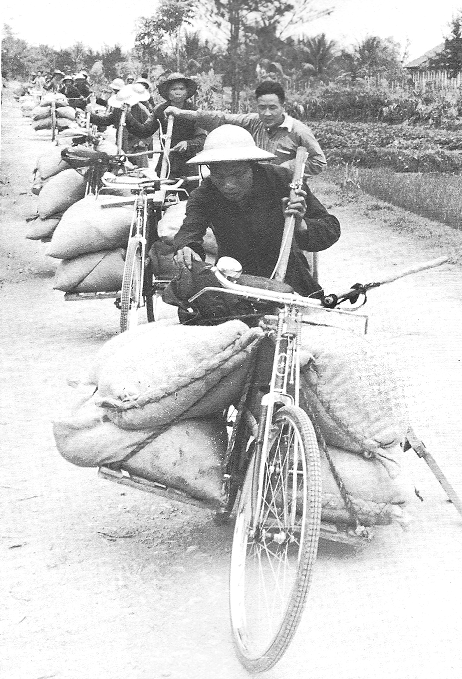
 
 
Bike porters on the Ho Chi Minh Trail
 
After ’65 when the war escalated on both sides, the Trail was widened, and heavy duty Chinese army trucks replaced bikes. A truck-relay system was developed with designated individual sections of the Trail responsible for keeping their own fleets on the road. An underground pipeline was laid to provide fuel to the way stations along the Trail. Early on, Pentagon planners calculated that only as few as 20 truckloads of cargo a day, a fraction of the truck traffic on the Trail at any one time, had to get through for the NVN to meet its supply requirements in the south. By then the Trail had become a dual system – roads safe only at night for the trucks, while troops marched off-road by day, often having to cut trail as they went.
 
Throughout the Trail’s active service from ’59 to the fall of Saigon in ’75, North Vietnamese Army (NVA) troops moved along the route with heavy packs weighing as much as 85 lbs that contained food, clothes, and ammo for both the long journey and, ultimately, the SVN battlefields. To reach the Saigon-Mekong Delta region in ’64 by foot took five months.* Even later, after the system was considerably engineered and improved, the full trek still lasted as long as six weeks. To say that NVN’s ‘long march’ was arduous and tested the limits of human endurance would not be an exaggeration.
 
 
On the Trail through the mountains
 
Not all the NVA troops that moved as units were destined for the Mekong theater of operations. The Trail, which paralleled SVN’s border through Laos and Cambodia, had various ‘exits’, much like an American superhighway. The first exit was just below the Demilitarized Zone (DMZ) separating North and South Vietnam for units assigned to the Hue-Phu Bai sector, the area where brother Jeff Sharlet served in ’64. Although trail time was shorter for troops headed for that sector, they still had to climb over a rugged mountain range in northeast Laos to reach their destination.
 
While the Trail was NVN’s conduit for matching US troop levels in the south with NVA combat regiments and battalions, it was maintained by a separate command consisting of tens of thousands of engineering troops, anti-aircraft units, infantry for ground security, and huge numbers of young women volunteers assigned to roadwork – a highly dedicated and efficient combat support force stationed along the myriad byways and alternate routes of the 8000-mile road system.
 
 
The Trail and its ‘exits’
 
For the NVA troops trekking down trail, the terrain, predators, disease, and weather added to the ordeal. The foot trails were stony, rest areas rough-hewn, and the rainforests through which they passed either suffocatingly hot and humid or rain-drenched, perpetually damp, and steamy during monsoon season. Insects and jungle creatures plagued the transiting soldiers. Mosquitos swarmed in clouds; leeches abounded, whether in water crossings or dropping from trees; and poisonous snakes were ever a danger – everyone carried anti-snake venom, which had to be self-administered within three minutes of a bite. Many soldiers died enroute from disease – malaria, typhoid fever, amoebic dysentery, and many other infectious diseases, even plague, were endemic.
 
However, in terms of sheer ferocity and a staggering death toll, nothing along the Trail matched the US Air Force’s bombing and strafing campaign. When ‘Rolling Thunder’ was launched during spring ’65, Washington believed a relentless bombing campaign of NVN would ‘persuade’ the Communist regime to sue for peace or at least cause them to cease and desist stoking the southern insurgency with streams of men and supplies down the Trail. As the fighting intensified and US illusions about NVN’s commitment and steadfastness began to fall away, the strategic objective shifted to shutting down the pipeline feeding the Viet Cong’s (VC) insurgency against the SVN regime. In military-speak, the objective became ‘interdiction’ to prevent cross-border infiltration from NVN via Laos and Cambodia.
 
For this purpose, the hi-tech might of the world’s greatest military power was brought to bear on the Trail. The battle in the air against the enemy became a veritable separate, secret war apart from the ground war in SVN where GIs and Marines were going head to head with the VC and NVA battalions from the DMZ to the Mekong Delta. The air war was concealed from Congress as well as the American public because a large percentage of the thousands of air strikes were against the Trail in nominally neutral Laos and Cambodia.
 
At the outset prop-driven Douglas trainers were deployed to bomb and strafe enemy formations spotted along the shadowy trail. As the flow from the North increased, the air war escalated when Phantom jets armed with rockets and napalm entered the fray. B-52 bombers from Guam, designed for Cold War intercontinental warfare with the Soviets, were added to the order of battle. Carrying enormous bomb loads, the bombers cruised unseen seven miles up from where their deadly cargoes of 750 lb bombs were dropped from map coordinates.
 
 
B-52s over the Trail
 
As part of the Pentagon’s evolving electronic warfare, a device was created for detecting the presence of humans invisible in the impenetrable jungle below from the air. Colloquially known as ‘people sniffers’, the device was slung under a helicopter which reconnoitered suspected Trail areas, picking up the scent of urine. Coordinates would be transmitted, and perhaps the most destructive air weapon of all would be called in – a converted C-130 cargo plane nicknamed ‘Spooky’ because, being slow and flying at low altitude, it operated at night.  Bristling with automatic rapid-fire Gatling-type guns, Spooky would fly over the identified area, sometimes at only 1500’, and literally shower the jungle below with lead at the rate of 15,000 rounds a minute, eerily lighting up the night with red tracers.
 
One might think such overwhelming power would prevail, would have defeated NVN’s effort to sustain the war in the south. On the contrary, through surprising feats of Engineering 101 and often simple, even primitive countermeasures, the Trail remained a busy military thoroughfare as the vital route to the ground war in the south and ultimate victory in ’75. To counter relentless air attacks, the NVA positioned anti-aircraft guns at critical chokepoints on the Trail, ensuring that US bomb runs were not cost-free. Later, batteries of Soviet surface-to air missiles (SAM) were added, greatly increasing Air Force fixed-wing losses. In the course of the separate war over the Trail thousands of NVA trucks were destroyed and heavy casualties sustained, while the US lost 500 planes with their air crews.
 
Air attacks on the Trail were most effective against bridges over the many rivers that had to be crossed. Engineering crews could put pontoon bridges in place relatively quickly, but they too would be knocked out the next day by prowling Phantoms. For this special challenge to Trail traffic, combat engineers came up with a couple of workable, low-tech solutions. The first was a cable bridge, but one without a roadway. Two strong cables would be strung across a river invisible from the air at water level a truck-width apart. When a truck convoy arrived at a crossing, the tires were removed, the rims aligned on the cables, and the trucks driven across, and refitted with tires on the opposite bank.
 
This bridging technique worked well, but was time-consuming, so another equally simple but even more amazing solution found. A pontoon structure called a ‘peek-a-boo’ bridge was rigged out of the inner tubes of truck tires, and powerful pneumatic pumps were hidden on each side of a waterway. When not in use, the bridge would be concealed by deflating the tubes and letting the structure sink and float beneath the water’s surface. Upon arrival of the trucks, the pneumatic pump would inflate the tubes, the bridge would emerge from the depths, and the convoy would pass over it.
 
Road repair from bomb damage, a constant, was essentially a no-tech job. Without the availability of bulldozers, the largely female road crews posted along the Trail filled bomb craters overnight with just picks and shovels. Occasionally, when a stretch of trail was being repeatedly targeted, the engineers would cut an alternate route below the triple canopy jungle, thus hiding it from the air. Often this involved cutting down trees and clearing brush, but when the NVA realized that their hi-tech adversary had airborne means for detecting foliage decay, they changed tactics. Trees and bushes were instead carefully dug up and transplanted elsewhere, an elementary gardening procedure.
 
However, the NVA’s most primitive but effective countermeasure – and a devilishly clever and amusing one too – was its diversionary response to the vaunted airborne people sniffers. Pots of buffalo urine were hung in the trees in areas away from the Trail causing the planes to release their munitions harmlessly on empty stretches of jungle. Still, the relentless air attacks never ceased.
 
After the Communist Tet Offensive of ’68, Creighton Abrams replaced General Westmoreland (Westy) as overall US commander and inherited not only a grinding ground war, but also the shadowy, hotly contested air war over the Trail. The interdiction campaign remained his major preoccupation right up to the final days of active US involvement in the Vietnam War late ’72. Transcripts from Abrams’ regular briefings clearly indicate that in spite of the best efforts of a superpower, interdiction had remained a frustrating and elusive objective. In late ’70, his deputy commander for air operations conceded that the scope and effectiveness of the Trail had increased:
 
          Over the past year we’ve seen a continual increase
          in the road network, the trails, the alternate route
          structure … which gave the enemy many options
          in terms of moving his equipment and supplies ….


          [The NVA’s dispersal of their trucks] has been
          accomplished beautifully, they move at night, they
          move at regular predetermined times, they move to
          one place, stay and hide, unload, pick up another
          truck and move on down, hiding in the [jungle]
          canopy, it’s just an extremely difficult problem.**
 
As American involvement in the war was winding down 18 months later in ‘72, it was evident that NVA infiltration had trumped US interdiction. As a frustrated General Abrams exclaimed to his staff: “it’s a more or less continuous thing – you know, they just keep a-coming.”***
 
Years after in post-mortems on the war, a senior North Vietnamese officer conceded that US air attacks, especially Spooky’s saturation strafing, had hurt them badly, while Westy’s deputy stated flatly in an interview that the fact that the  “Ho Chi Minh Trail was never closed” was a major factor in the failure of the US mission in Southeast Asia.****
 
*J Zumwalt, Bare Feet, Iron Will (2010), 232
**L Sorley, ed, Vietnam Chronicles: The Abrams Tapes, 1968-1972 (2004), 495
***Ibid, 818
****Quoted in R McNamara, In Retrospect (1995), 212


Wednesday, September 12, 2012

The Mountains of Laos

From the entrance of the squad tent, Jeff could see the mountains of Laos. Brother Jeff Sharlet was in the narrowest, most northern part of South Vietnam serving at an American base near the small ville of Phu Bai in 1964. From where he stood, the South China Sea was to his left; to his right was the rugged Annamite Range as far away as Laos, maybe 50 miles as the crow flies.
 
Jeff was an American ‘military advisor’, one of 16,000 sent mostly by President Kennedy to help South Vietnam (SVN) quell a guerrilla insurgency guided from Communist North Vietnam (NVN).  At that point it wasn’t much of a war, what political scientists called a low-intensity conflict with hard fighting between the SVN Army (ARVN) and the insurgents in the far south in the Mekong Delta as well as occasional hit and run skirmishes in the Central Highlands, but relative quiet around Phu Bai not far below the DMZ and the border with NVN. From Hanoi’s strategic perspective, the action was in the more populous southern part of the country in and around Saigon, the capital.
 
Phu Bai was a very small  outpost relative to regular military bases. Jeff’s outfit was called Detachment J, a subunit of the 3rd Radio Research Unit (RRU), the euphemism for the intelligence-gathering facility tucked away behind barbed wire at Saigon’s Tan Son Nhut Airport. The 3rd RRU and Det J were part of the Army Security Agency (ASA), an independent communications intel agency nominally within the Army, but actually under aegis of the National Security Agency (NSA) in Washington. In effect, Phu Bai was NSA’s listening post in closest proximity to NVN.
 
It was an ASA installation, but the base also accommodated a much smaller Marine unit doing much the same thing. ASA intercepted NVN military land communications while the Marines’ beat was the small coastal NVN Navy’s ship to shore and ship to ship communications. Both units were made up of Vietnamese linguists like Jeff, Morse code operators, cryptographers, security guards. and the usual logistical personnel.
 
Marine corporal Dave Reinhardt was in the first Vietnamese class at Army Language School in Monterey CA; he’d been assigned to Phu Bai with the 1st Composite Radio Company, a unit attached to the 3rd RRU, the year before Jeff arrived. Phu Bai was not far from the ‘street without joy’, a stretch of highway named by the French who had been frequently ambushed there during the First Indochina War (1946-54).* Dave described the area as peaceful in 1963, with little evidence of the insurgent Viet Cong (VC) – except for road mines. The terrain was mostly flat with little vegetation. Right across from the base was an old French airstrip, the control tower abandoned, but with a long enough runway in good condition for large US military aircraft to land.
 
A year later in ’64, the Pentagon (DOD) began taking a greater interest in remote Phu Bai. Up to that point, the Central Intelligence Agency (CIA) had been responsible for running ‘black ops’, clandestine operations, against NVN, although most of its efforts had ended in failure. Defense Secretary McNamara decided DOD could do a better job and lobbied the White House. In mid-January President Johnson (LBJ) authorized OPLAN 34A, a comprehensive plan described as “a wide variety of sabotage and psychological operations [psy ops] against North Vietnam.”** The centerpiece would be to continue cross-border commando infiltrations, which DOD took over from the CIA on February 1st.
 
Coincidentally, that was the day after General Khanh carried out a coup against the military junta that had overthrown President Diem several months earlier. As soon as the US got an inkling the coup was underway, Jeff and a contingent of linguists were sent back to Saigon from their home base in the Philippines, but since the coup was quick, bloodless, and successful there was nothing for them to do. However, DOD needed to rapidly strengthen the small ASA detachment at Phu Bai, which would be tasked as communication liaison with SVN commandos infiltrated into NVN as well as for psy ops, so orders were cut for Jeff and a dozen other ASA personnel to report to Det J.
 
Arriving at Phu Bai, Jeff found a ramshackle jumble of low buildings, high antennas, communication vans, large squad tents, a truck park, and construction sites in various stages of completion. The whole assemblage was surrounded by barbed wire with a single gate manned by a couple of ASA security guards armed with .45s. The topography was pretty barren except for a small hill of just under 600’ used for additional antennas. Outside the wire was an old, overgrown Vietnamese cemetery, most likely the graveyard for the nearby ville of about 7,000 inhabitants.


Construction at Phu Bai base, 1964
 
The nondescript buildings housed the communications and intercept equipment as well as the work areas for the lingys, crypts, and ditty boppers, as the ASA guys called their specialties. Most of them were billeted in the large tents set on wooden platforms with space for eight cots with mosquito netting and footlockers. Wooden walkways linked the tents to other parts of the base. Given the heat, humidity, and flying insects of Southeast Asia, at night the side flaps were usually up and mosquito nets down. Jeff and his bunkmates posted a sign out front reading:

CANVAS CASTLE MOTEL – 3
·         Air conditioning
·         Wall to wall plan
·         Scenic view
·         Floor show nightly
NO VACANCY
 
Amenities were minimal. There was an enlisted men’s club with cheap booze and a jukebox; a small PX, or military store that sold liquor, beer, and toothpaste; a one-chair barber shop in a wooden hut, a tent with some workout equipment; and the mail room. The touchdown of the C-123 Caribou mail plane was a daily event. Less welcome were the nearby ARVN heavy artillery unit firing randomly and thunderously day & night and the constant hum of powerful diesel generators powering the base’s equipment—both of which took some getting used to, as Jeff wrote home.

The classified work required attention, but otherwise formal military duties were at a minimum. Given the steamy climate, the standard uniform would barely qualify as military-informal. Occasionally the men were trucked outside the compound to a rifle range to practice firing their carbines. When someone asked why the truck bed was covered with sandbags, the answer was, ‘road mines’. Otherwise, no ammo was handed out, probably as a safety measure, since few if any ASA troopers had weapons experience.

Jeff worked alongside a congenial group of young college guys like himself—Ralph Adams, John Buquoi, Bill Jernigan, Peyton Bryan among others. Ralph Adams was the best linguist and served as the base commander’s (CO) interpreter for administrative business with local Vietnamese. Later Ralph would make a career with the NSA, rising to executive director before retirement.

 
Ralph Adams off duty talking to a Vietnamese boy

As the CO’s aide, Ralph had use of a jeep he’d occasionally loan to Jeff and his buddies. Off duty they’d don civvies and roam the countryside – north to nearby Hue on the coast, south over the picturesque Hai Van (Sea Cloud) Pass to Danang, and occasional afternoons at white sand beaches on the South China Sea.

By late May ’64, Jeff finished his Vietnam tour and headed back to the States, to ‘the world’ as GIs would later say. Not long afterward, a major event in what became the American war in Vietnam occurred. A US destroyer on an electronic surveillance mission in the Gulf of Tonkin cruised close to the NVN coast well within the 12-mile international waters limit, drawing the attention of NVN torpedo boats. A brief sea skirmish occurred.

The destroyer escaped unscathed thanks to warnings from the Phu Bai Marines who intercepted the attackers’ communications, but a furor ensued in Washington. On the basis of bad information and worse advice, LBJ used the incident as a pretext to launch a heretofore secret air strike against NVN. Planes from the carriers Ticonderoga and Constellation carried out 64 attacks on NVN naval facilities ashore. Far more consequential, LBJ used the patriotic fervor whipped up by ‘Operation Pierce Arrow’ to push through an almost unanimous Congress a loosely worded resolution that he, and later President Nixon, would use to provide political cover for our subsequent long involvement in Vietnam’s civil war.

Security began to tighten at the ASA base after the Tonkin crisis. Everyone pulled night guard duty once or twice a week using parachute flares that cast spooky shadows to illuminate the area. The man assigned to guard the sandbagged radio direction finder outside the perimeter at the air strip was given a couple of grenades and the reassuring company of a guard dog in addition to his weapon and ammo. One of the GIs, noting all the on-base construction and the new runway being added across the road, figured something was afoot.  He was right.

As we learned much later from the leaked Pentagon Papers, LBJ was secretly laying the groundwork for a planned escalation of US involvement. A usable justification arrived just over six months later in February ’65 at Pleiku in the Central Highlands. The VC carried out a devastating attack on US military advisors’ barracks, so the President commenced a systematic bombing campaign, Rolling Thunder, against NVN and sent in the first combat units. As National Security Advisor McGeorge Bundy subsequently explained, “Pleikus are like streetcars;” in effect, it was a convenient vehicle for the planned escalation.***

A Marine battalion (bttn) was assigned to defend Danang airbase; another was sent north to provide security for the top secret operations at Phu Bai. Because ASA guys had minimal military training, the unit commander strengthened the bunker network, added more wire to the base perimeter, and stepped up weapons practice to include light machine guns and bazookas.

As the war increased in intensity with hundreds of thousands of American troops in-country, the heretofore distant base at Phu Bai was no longer a backwater immune from armed clashes and casualties. By the late ‘60s, Phu Bai personnel had increased from a few hundred in Jeff’s day to several thousand to become the largest ASA unit world-wide. By then, the Agency no longer had the place to itself.

With VC bttns and North Vietnamese Army regulars maneuvering in the operational area that the US Saigon command called I Corps, the 1st Marine Division took up residence followed by the Army’s elite 101st Airborne (ABN). Phu Bai and its environs became a vast military camp, home to tens of thousands of combat troops and their command headquarters. The once largely empty terrain had become quite congested with barracks and facilities for large fighting formations.


Phu Bai in the late ‘60s: Marine Hq and an Address board for 101st ABN units

In ’69, Phu Bai, an otherwise obscure dot on military maps, acquired sudden visibility in the world press and the halls of Congress (publicity unwanted by the principals involved, as it turned out). In early May, General Zais, CO of the 101st ABN, ordered elements of the division with Marine support to assault and take an enemy-held peak with in the Annamite Range abutting Vietnam’s border with Laos. Their assignment – to attack and destroy, or ‘attrit’ in the parlance of the US mission in Vietnam, the opposition.

As not infrequently happened, US intelligence underestimated the NVA’s strength, so the force sent to do battle was inadequate. Although the elevation was just over 3000’, it was a steep climb through bamboo thickets, waist-high elephant grass, and triple canopy jungle. The opening attack went badly; friendly fire killed two paratroopers and wounded 35, the first of five such incidents in the course of the battle. Subsequent assaults went little better against a battle-hardened NVA regiment firing downhill from well concealed, heavily fortified bunkers, trench lines, and fighting holes.

US air power was not effective in the visually impenetrable terrain, and the 101st began taking significant casualties. In fact, the enemy was so disdainful of air attack that their cooking fires were openly visible. In spite of mounting losses and an incredibly challenging battlefield complicated by weather and mud, command kept sending the survivors back up the hill for 10 days of brutal fighting when the summit was finally reached. After a massive bombardment by 150,000 pounds of napalm, 20,000 artillery shells, and 1,000,000 pounds of bombs, all they found was a small rear guard, the main force off to fight another day. Finding a piece of cardboard, a GI scrawled on it in large letters ‘Hamburger Hill’ and attached it to what remained of a tree. Another paratrooper added the words, “Was it worth it?”

In the midst of the fighting, a US wire reporter interviewed commanders as well as bloodied troops, many of whom were enraged at the high death toll, and wrote a scathing article, calling the engagement a ‘meatgrinder’. The public was shocked, and members of Congress led by Senator Ted Kennedy attacked the operation using words like ‘savagery’, ‘senseless slaughter’, and ‘madness’. General Zais and other senior commanders received sharp criticism. Back in barracks at Phu Bai, the hat was reportedly being passed to raise a $10,000 bounty for taking out the general.

In the long American war of attrition, holding ground was never a tactical objective, so US troops left the mountain, which the NVA predictably reoccupied soon after.  As a kind of epitaph, a Vietnam veteran and military historian has written that the Battle of Hamburger Hill became “an enduring symbol of the overall futility of America’s war in Vietnam.”****

*B Fall, Street Without Joy (1961)

**J Prados, Keepers of the Keys: A History of the National Security Council from Truman to Bush (1991), 201

***D Halberstam, The Best and the Brightest, (1972, 1973), 646

****J H Willbanks, “Hell on Hamburger Hill,” Vietnam (June, 2009), 24


Wednesday, January 18, 2012

"If It's Tuesday, This Must Be Laos"

It was a pleasant spring day in Schenectady in upstate New York (NY), home to General Electric (GE) and Union College. At the college, a Be-In, a countercultural gathering of students, was underway on the great library lawn framed by early 19th c. buildings. One of my students had organized the event and I’d promised to take a look, but before I could get downstairs from my faculty office President Nixon announced that the US had just extended the Vietnam War into neighboring Cambodia, nominally a neutral country. The date was April 30, 1970 and in the military-speak of the day the President called the invasion an ‘incursion’.


Union College looking out from the library

The college had been relatively quiet in the course of the evolving Vietnam antiwar movement sweeping American academe the past several years. There had been protests on campus, but nothing on the scale of student protest at the University of Wisconsin-Madison, Indiana University, or at Columbia University downriver in New York City during spring ’68. That changed on a sunny afternoon in April ’70 the Union College student body erupted along with fellow students at dozens of other colleges across the country upon hearing news that the unpopular Vietnam War that was supposed to be winding down had instead been expanded.

Hundreds of Union students marched into downtown Schenectady, an old blue-collar town near where the Mohawk River flows into the mighty Hudson River, first rallying at the gates of GE, a major war contractor, then moving on to the Selective Service office, and finally sitting down at the intersection, blocking the exit from GE’s main plant where thousands worked. It was peaceful and even had the implicit blessing of the college, which sent down sandwiches and beverages for the protestors. However, tragic events unfolded in academe in the days to come. On May 4th National Guard troops fired on a group of student demonstrators at Kent State in Ohio, killing four and wounding nine. Two days later, several students were wounded by police gunfire at the State University of NY at Buffalo, while at Jackson State College in Mississippi two students were killed and a number wounded by the State Police.

In every corner of the war-weary country America was in an uproar at the abrupt turn of events in Southeast Asia. Up until the Cambodian ‘incursion’, Nixon had been steadily downsizing our forces in Vietnam. The idea that the long, aimless war was now being extended into another country sparked widespread outrage. And yet, unknown to all but a select few in Washington, US forces had been secretly waging war against the North Vietnamese Army (NVA) in Laos and Cambodia since ’65.

American strategists were well aware that the Ho Chi Minh trail, the route for troops and supplies from North Vietnam into South Vietnam, passed through the two neighboring neutral countries, neither of which was strong enough to prevent the powerful NVA from using their heavily jungled border areas. As the US escalated the Vietnam War, the NVA and its southern guerrilla force, the Liberation Army of South Vietnam (NLF), aka the Viet Cong (VC), increasingly began using Cambodian territory as sanctuary for rear area facilities. It was those bases that Nixon’s spring invasion targeted.

By that time, the US had been bombing the Laotian-Cambodian section of the Ho Chi Minh trail and the sanctuaries for several years. All the airmen in the operations were sworn to secrecy, but by ’69 there was a leak, and the White House had to inform a small group of key senators and members of the House of the classified air operations.

However, that was only part of the clandestine war in Laos and Cambodia. Not long after the first Marine combat units landed at Danang in spring ’65, the US was conducting surgical cross-border raids not just into Laos and Cambodia, but into North Vietnam as well. One of the main elite units involved was Marine Force Recon. By mid-year 1970 brother Jeff had been dead a year, succumbing to an illness which first hit him while in the bush below the DMZ in South Vietnam in ’64. But his paper, Vietnam GI survived him, and the July issue carried a scoop on Force Recon’s ops under the headline “If it’s Tuesday, this must be Laos.”

Shoulder patch of 1st Marine Force Recon

In a front page interview Marine Cpl Craig Walden of Force Recon noted the public uproar over Nixon’s Cambodian caper with irony because he was well aware US forces had been operating in the adjoining countries “for years” by 1970. He knew firsthand from his initial tour 1965-66 fighting with the 1st Force Recon, which he described as a guerrilla warfare unit specializing in infiltration and sabotage. Force Recon’s casualties in its secrets ops were extraordinarily high – out of the 240 men he had trained with only five came back.

Force Recon Marines would chopper out of Danang Air Base and drop directly into Cambodia or Laos where they’d ambush NVA units coming down the Ho Chi Minh trail. On another occasion they were dropped into Laos from where they crossed into North Vietnam above the DMZ, their objective a rail center through which the NVA fed troops and military supplies into the Ho Chi Minh trail system. The mission included eight Marines and two CIA men. The Marines blew up the rail switching station while the CIA guys photographed the results and gathered IDs, documents, and maps off the enemy dead before the group withdrew.


NVA river crossing, Cambodian border, ’66. Photo credit Li Chi Hai

To avoid a conspicuous US footprint, none of the raiders on the op carried dog tags, IDs, or personal information. Also left behind were uniforms and Marine-issued arms – Craig wore Levi’s and tennis shoes. Everyone carried a foreign-made weapon of choice, quite often the compact and very lethal Swedish K submachine gun.

On another op into North Vietnam through the adjoining countries, Force Recon’s target was a particular NVA colonel. They went in during the wee hours and shot their man with silenced weapons, but extrication was hair-raising. The rally point was a nearby soccer field where the pickup chopper could land, but as soon as it touched down, the field’s night lights suddenly went on, brightly illuminating the LZ or landing zone. The raiders began taking rifle fire, and a pack of guard dogs were unleashed. They got away clinging to the chopper’s runners with dogs snapping at their heels.

Gravely wounded during his second Vietnam tour, Craig Walden* returned to the States, and after long recuperation at Great Lakes Naval Hospital, went home to Chicago where he became part of the three-man editorial team which carried on Jeff’s Vietnam GI.

*For Craig Walden’s harrowing story, see the post titled Bad Intelligence, Sorry ‘bout That,
24 August 2011.