Wednesday, February 26, 2014

Back to the ‘World’ – Return from ‘Nam

For a year my brother, Jeff Sharlet, and I were on different ‘fronts’ of the global Cold War. It was 1963-64, and Jeff was soldiering in Vietnam while I was studying in Moscow. I had learned Russian for my sojourn to the Soviet Union. Jeff had been taught Vietnamese for his Southeast Asian tour.

He was a translator/interpreter in the semi-secret Army Security Agency (ASA) while I was grad student on the official US-USSR Cultural Exchange. We’d both been carefully vetted for our encounters with the Communist orbit – Jeff to assure his political loyalty since his work was highly classified.

Conversely for my program, any connection to the American intelligence community would have been a disqualifier. University authorities took great care to protect the integrity of the academic exchange. Jeff and I both passed muster and shipped out to our respective destinations.

In the Moscow State University dorms in the former Lenin Hills, I shared a suite of rooms with a Soviet law student. Jeff was billeted with five other GIs in a large field tent at a US military outpost in South Vietnam, a small base not far below the Demilitarized Zone (DMZ) and the border of Communist North Vietnam. As he wrote home, “we are completely out of contact with the outside world here.”


Jeff’s ‘accommodations’, South Vietnam, 1964

By the ‘60s, the Cold War between the superpowers was approaching mid-point with Washington leading the West, Moscow dominating the East. Fortunately it was not a head-to-head military confrontation; instead, the Cold War was waged in the realm of ideas, propaganda, covert action, and proxy wars in the Third World.

One of those proxy wars, the hottest one, was in Vietnam, a country split into North and South by the Geneva Accords following the French colonists’ defeat in 1954. Backed by the Soviets and Communist China, North Vietnam was supporting a low intensity guerrilla war in the south. The aim was to overthrow the Saigon government and unify Vietnam under the Communist flag.

Jeff was assigned to ASA’s Detachment J, 3rd Radio Research Unit (RRU) at a place called Phu Bai. His work included electronically eavesdropping on North Vietnamese Army communications as well as liaising with South Vietnamese commandos being infiltrated north through the DMZ and over the border.†

My academic tasks in the capital of the Soviet Union fell under the heading of Khrushchev’s slogan of ‘peaceful coexistence’, the idea that capitalist and socialist countries could coexist amicably and avoid fighting each other.

Implicit in the cultural exchange was the hope of mitigating international tensions through people-to-people programs. Hence, while I was researching Marxist legal theory for my PhD dissertation as well as studying Soviet law, my Soviet counterpart was studying at an American university.

In late spring ’64, Jeff and I had both coincidentally finished up our time abroad and were ready to head home to the States. For Jeff, it would be back to the ‘world’, as Vietnam GIs were wont to call the journey. The road back would be a long one for each of us, not just in sheer distance, but in the psychological gulfs we’d be navigating.

Reverse culture shock was just part of it – Jeff would be returning to college, quite a remove from the secrecy-shrouded atmosphere of the place  he was leaving, an area of scrub foliage and low sand dunes characterized by a National Security Agency (NSA) official as  ‘virtually a Viet Cong camp ground’.

The transition would be easier for me although, by definition in those days, an American living in Soviet society got used to being ‘watched’ and had to be careful what was said and to whom. Hence, returning to the States would be a radical change from living in a high vigilance, closed society, but that’s a story for the next post.

Jeff had gone to Asia, if not positive, at least open-minded about the US mission in Vietnam. But in the course of being involved in ill-conceived and fouled up political and military operations while simultaneously getting acquainted with ordinary Vietnamese and their culture, he had become increasingly disillusioned.†† On his return to the ‘world’, he’d have to sort out his thoughts and feelings about the war – what he had experienced ‘over there’.
Jeff’s road home began from one day to the next at the tiny base at Phu Bai. One day he was at work amidst the great heat and humidity in the working ‘uniform of the day’ – shirtless, shorts, and flip flops; the next day he was dressed in Class A’s heading for the airfield with his gear.
He was very glad to be leaving, writing presciently in a last letter just weeks before the infamous Gulf of Tonkin incident in August ‘64, “I hope I get out of the Army before anything blows up in Southeast Asia.”

Jeff caught a hop on a C-123, a large cargo plane that made two scheduled trips a day in and out of Phu Bai. The plane headed south toward Saigon, making a single stop on the coast of the South China Sea at Danang.


A C-123 taxiing for takeoff

Arriving at the military side of Saigon’s vast airport/air base, Jeff took a taxi over to nearby Davis Station, home to ASA’s 3rd RRU. He bunked there for his week’s leave in Saigon before moving on. He had many friends among the linguists (lingys) and cryptologists (crypts) there from his previous duty station in ’63 at Phu Lam, not far from the Davis base.

After a merry time drinking with good buddies at favorite bars and restaurants in Saigon, then known as the ‘Paris of the East’, it was time for the next leg of Jeff’s journey. That meant flying from Saigon to his home base, the 9th ASA battalion located at Clark Air Base in the Philippines.

In a kind of tradition when a lingy finished his tour and was headed home, his friends would see him off – Jeff’s friends from as far back as ’62 at the Army Language School (ALS) on the California coast did just that – among them John Buquoi, Harvey Kline, Dave Gustin and, if he was in town, Fred Baumann.

The drill was an informal farewell party in the upstairs lounge at the airport – tasty toasted ham and Swiss sandwiches with lots of Dijon mustard and, of course, plenty of ’33 beer, Vietnam’s cheap brew – before Jeff shoved off for the flight line.

‘Mileage’ post at Davis Station, HQ, ASA 3rd RRU

Back at Clark, a sprawling air base, Jeff had an exit physical at an Air Force clinic. His medical report was then sealed along with his basic military file and copies of final orders in a large brown envelope to be hand-carried back to the States.

Separation processing would take place stateside. In military jargon, one was ‘separated’ until a reserve obligation was completed a few years later and final discharge papers issued.
Again, another farewell party before take-off, this one with friends at the 9th ASA, Keith Willis and others. Jeff boarded a civilian 707, a World Airways charter under military contract, for the lift back to the States. The plane made the same stops as on the way over – Guam and Honolulu – finally touching down late at night at Travis Air Force Base north of San Francisco.

The flight was met by a military bus that took Jeff and the other GIs to a transient barracks on the base. Incoming traffic was apparently heavy because each GI was assigned to a particular bunk in an 8-man room for a specific time slot (about six hours). The following morning Jeff was shaken awake by the next GI assigned to that bunk.


He was directed to a bus for the short ride to Oakland Army Terminal where final out-processing took place. A quick breakfast at the mess hall there and he reported to the ‘Separation Processing’ facility located in a hangar.

At the front of the cavernous space, a podium and several tables were set up. Rows of wooden benches were provided for out-processing troops, a few hundred from bases all over the world. Jeff didn’t know anyone – he may have been the only ASA Vietnam GI in the group.

Separation was typically Army, slow and bureaucratic. At the podium a corporal would call out a name, directing the soldier to one of the tables or ‘processing stations’ – there were nearly a half dozen of them. Jeff would complete his business at one ‘station’ and be sent back to the benches to wait until he was called again – over and over.*

The stages of separation were:

Personnel/Records: Jeff handed over his thick brown envelope. A clerk reviewed the contents and various documents were signed.

Security: A military intelligence clerk briefed Jeff on the ASA secrecy commitment, to wit, if any classified information was divulged he would face federal prosecution, up to 10 years imprisonment, and a $10,000 fine, serious money in those days.

He was also warned against travel behind the Iron Curtain for five years, and there was one additional bizarre caution. If you were to undergo surgery involving general anesthesia, you were to notify ASA in advance so a de-briefer could be on hand in the event of ‘inappropriate disclosures’.

Equipment turn-in: A GI was expected to return all the uniforms issued him except the one he was wearing. A couple of privates unceremoniously dumped Jeff’s duffel bag on the floor and made an inventory of its contents. If any part of the original issue was missing, the cost would be deducted from the soldier’s final paycheck.

Physical Exam/Medical: Essentially blood and urine tests for which the out-processee was sent to an adjoining room.

Payroll: Jeff was given his final ASA paycheck as well as travel funds to cover the flight back to his hometown of record.

Finally at dusk after an all-day laborious process, the GIs were released and bussed to the San Francisco Airport to catch their flights. At the airport, Jeff cut out and headed into the city to revisit the town and see friends.

While in the Bay Area, John Sharlet, our cousin, who was then studying Russian at ALS down the coast in Monterey, came up to San Fran to meet Jeff for dinner. Back east the cousins had gone to prep school together, but hadn’t seen each other for several years.

A few months later in fall ’64, Jeff found himself back in school at Indiana University (IU), a college boy again, to finish his education. He threw himself into the coursework, eager to catch up on his life. Nonetheless he remained unsettled by memories of the war, but couldn’t say a word to anyone. Everything remained secret.

Jeff knew there were many other GIs deeply skeptical about the wisdom of US involvement in Vietnam. Once the war dramatically escalated the following spring of ‘65, the number of disaffected Vietnam GIs would eventually grow and become legion.

Five years later after returning from ‘Nam, Jeff took his secrets to an early grave, although not before founding the underground paper Vietnam GI, which became a rallying point for emerging GI opposition to the war.
___________________________________________

*I am indebted to John Buquoi, Jeff’s Vietnam buddy, for his help in reconstructing the ‘separation’ process.


Wednesday, February 12, 2014

Man in a Red Devil Suit – Lives of the New Left VI

One remarkable profile remains as we reach the end of this series on the Indiana University (IU) New Left reunion, summer 2013.† Jim Retherford has had an extraordinarily noteworthy and diverse career on the left from his early years at IU to present day.

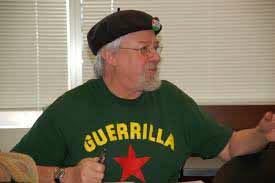
He has been a fearless New Left editor, a political performance artist, part of a guerrilla theater troupe, and along the way got acquainted with some of the legendary figures of the unforgettable ‘60s/early ‘70s. Running through the years of his rich resume, one sees he also has been an award-winning journalist and graphic designer – a veritable man of the left ‘for all seasons’.

Jim Retherford arrived at IU in ’60 with good student journalist credentials, but as a typical politically naïve freshman. Campus events soon politicized him.

He got off to a good start as a college journalist, landing a position on the staff of the campus daily, the Indiana Daily Student (IDS), his first semester and by spring becoming the paper’s Sports Editor.

Then he inadvertently witnessed an early IU New Left action and came away politicized. A tiny group of students, the Fair Play for Cuba Committee (FPCC) protesting the US naval blockade of Cuba during the Missile Crisis of fall ’62, were jeered, harassed, and threatened by a crowd of several thousand hostile students. Jim came away shocked and a lifelong supporter of the Cuban Revolution.       

As an activist, Jim leaned toward dramatic action in matters political. A few years after, Students for a Democratic Society (SDS) was organized at IU, and Jim joined up. The group, opposed to the Vietnam War, had adopted a policy of open meetings, open mike. On one occasion a conservative student leader took advantage and filibustered a meeting with a pro-war rant.

Other than shouts to end the harangue, the group sat passively, reluctant to violate SDS’s policy of openness. Jim Retherford was not having it, so he and a fellow activist took a large American flag off the pole in the corner, grabbed the speaker, ‘wrapped’ him in the flag, and duck-walked him off stage to much laughter and relief.

The following year, 1966, several students created an alternative ‘underground’ campus paper, The Spectator, and several months later Jim became the first editor. The experience would take him beyond political awareness and radicalize him.


A lively political-cultural alternative to IDS, Spectator drew on Underground Press Service and Liberation News Service (Jim worked with Marshall Bloom, the founder) – both New Left wire services – for stories ignored by the mainstream media. Under Jim’s aegis, the paper became increasingly critical of IU’s administration and trustees as well as the local political establishment.
         
Spectator gave ample coverage to the spirited IU New Left, of which the university president was highly critical. When brother Jeff Sharlet, then SDS president, rebutted the criticism in a major speech, Jim promptly published the full text. ††

The paper afforded great visibility to the  major demos against the campus visits of Army General Maxwell Taylor; General Lewis Hershey, Director of the Selective Service System; Secretary of State Dean Rusk; as well as to the sit-in blocking Dow Chemical recruiters at the Business School.

In the midst of all the protest, Jim Retherford was summoned by his draft board. He turned up at the induction center wearing Viet Cong-style black pajamas and rubber sandals and handed out antiwar leaflets to the inductees. The feds weren’t amused and responded with an over-the-top threefold indictment against him for trivial technical violations of the Selective Service law, including one for not carrying his draft card.

Meanwhile, by early ‘68 the university authorities, who had become quite irritated with Spectator’s criticism of their policies, moved to silence Jim and the irreverent paper. The Spectator staff was ordered to vacate its campus premises. Impatient, the Dean of Faculty decided to expedite the eviction. With a fire axe in hand, he broke down the door, destroyed equipment, and scattered files.

Undeterred, Jim moved the paper off campus to what he called the ‘liberation zone’ and continued the steady drumbeat of coverage and sharp criticism of IU’s administrators.  Street sales of the paper in Bloomington reached nearly 1,000; there were also mail subscriptions as well as orders from bookstores as far away as Boston and San Francisco.

In late spring ’68, Jim Retherford went on trial in federal court. He was convicted and sentenced to six years in prison. His bond revoked, he languished in jail for nearly three months until his conviction was overturned on appeal thanks to a prominent New York lawyer on the left.

Jim left Bloomington, moved to New York, and onto the national stage of the antiwar struggle. Earlier in ’67 he had already played a role as an organizer of the siege of the Pentagon when thousands of protestors from all over the country encircled the immense building in an attempt to ‘levitate’ it.


Jim Retherford at the Pentagon, Washington DC, 1967

In New York, Jim soon hooked up with poet, singer, and activist Ed Sanders, co-founder of the Fugs, a well-known psychedelic rock band of the day. He got to know Yippie leader Jerry Rubin, whose book he agreed to ghostwrite. DO IT! Scenarios of the Revolution was published in early ‘70 to much fanfare. 

Who can train guerillas by the dozens?
Send them out to kill their untrained cousins?
F**king-a man!
CIA Man!†††

In early ’69, federal conspiracy charges were filed in Chicago against Jerry Rubin, Dave Dellinger, Tom Hayden, and others for their parts in the antiwar demonstrations at the Democratic National Convention. With Rubin and Abbie Hoffman in the lead, the defendants turned the trial into raucous political theater with Federal Judge Julius Hoffman cast as villain. As Jerry’s friend and ghostwriter, Jim was invited to Chicago to take in the wild courtroom scene.

Enroute back to New York, he stopped off in Bloomington to visits friends and heard that Clark Kerr, former President of the University of California and bête noir of the ’64 Free Speech Movement at Berkeley, would be speaking at IU.

Jim planned a Yippie counter-performance. As Kerr began his remarks, Jim, who’d been hiding in the wings, rushed onstage decked out in a red devil costume and threw a cream pie in the speaker’s face. Hoping to get away, the ‘red devil’ was nonetheless caught, arrested, convicted of disorderly conduct, and sentenced to 90 days in jail. The ‘pieing’ of Clark Kerr made the nation’s papers.

The ‘70s were an eventful time on the East Coast, and Jim Retherford was in the thick of it. In late spring ’70, he went to New Haven CT with the band ‘Elephant’s Memory’, an experimental rock group better known as backup for John Lennon and Yoko Ono’s Plastic Ono Elephant’s Memory Band. The band performed at a huge May Day demo on the ‘green’ across from the Yale campus as thousands protested the trial of Bobby Seale and the New Haven Black Panthers.

Hey little chile don’t you put me on trial
You got me burnin’ on a fiery pile††††

That summer, Jim joined Abbie Hoffman’s ‘guerrilla theater’ for a Yippie happening at Madison Square Garden in New York. Mocking a big band just back from a tour of Communist East Europe covertly underwritten by the CIA, Hoffman and his troupe dumped 20 pounds of manure at the Garden’s entrance just as the crowd was arriving for the concert.

The following year a New York federal grand jury subpoenaed Retherford and fellow Yippies, ‘fishing’ for information about a bombing in Washington with which the five had no connection. Calling themselves the ‘Ever-Expanding Number’, the Yippie group duly appeared at the federal building with Jim sporting a King Kong outfit. If they were looking for antiwar guerrillas he figured, why not dress like a real gorilla.

Finally, election night 1972 found Jim Retherford walking the streets of Manhattan in the company of John Lennon and friends. In despair over Nixon’s landslide victory over George McGovern, the group came up with the idea of breaking the windows of a major bank. The tequila bottles they tossed shattered, but the bank’s windows survived.

Later in the decade, Jim left New York and relocated to Texas, first Houston, then Austin, where he raised his young son. He eventually joined the staff at the University of Texas-Austin.

Fast forward to the present, Jim Retherford retired several years ago as Senior Graphics Designer Emeritus, General Libraries, University of Texas at Austin. However as a long time Austinite, he continues to take part in the city’s progressive politics.

At IU last summer, Jim, the final speaker,  rose to talk about his life at the New Left gathering, but time was short on the kick-off event, and he only had a chance to sketch a few of his adventures. Let’s listen to him in his own voice:

Hi, I’m Jim Retherford, and what a long, strange trip it’s been. I came to Bloomington a farm boy from north central Indiana, 1960. I was skinny then. I kind of left Bloomington in the summer of ’68, although I had a tendency to come back and create some diversions for everybody.

In October ’69 when Clark Kerr began his lecture series at IU on how he had figured out [how to cope with the ’64 Free Speech Movement at Berkeley], I decided to practice a little reverse Marxian repressive power … and he ended up getting a pie in the face.


Jim Retherford in costume, Bloomington IN, 1969

I came here as a journalism student and spent two and a half years in the Journalism Department. I left the department very angry at the chairman for lying to me about stuff. It was during that time that I became politicized…. The Fair Play for Cuba march [October ‘62] started a number of things going.

One, it started in me a long-term quest that continues today – to understand and appreciate the revolution in Cuba and what it accomplished. That was just the beginning.

The other thing that it created – a strain that has continued – was when I was in the city room of the Indiana Daily Student (IDS) right after the Fair Play march when two guys in trench coats, whom I recognized from pictures taken at the march, came into the room and introduced themselves as graduate students. [laughter] …

They asked if me and my friend, who was the IDS chief editorial writer at the time, if we had known anything about those guys [the pro-Cuba marchers]. I was only a sophomore at the time, but I knew this was bullshit. That was the beginning of my distrust of the intelligence apparatus.

In ’66 a group of graduate students – by then I was in the English Department – started talking about forming an alternative newspaper. I attended all their meetings and helped launch the new paper [The Spectator], but I didn’t really get along with the other organizers. There wasn’t good chemistry, so I just helped on the journalistic part of the paper – telling them how to lay it out and stuff, but I didn’t get really active in it.

The grad students all flunked out of school and a Spectator staff came together that following September. There was somebody who the Dean of Students wanted to be the editor, but nobody wanted her so they talked me into doing it. I edited The Spectator for the next two years.

That was a radicalizing experience. From the very beginning I made space in The Spectator for all points of view, but when Robert Turner* [a conservative student leader] took advantage of it, we kind of got rid of that policy because it was redundant to say the same thing over and over again. We’d heard enough of that.

During this period of time, I became more questioning and more radical and it ended up that I was moving up the FBI watch list as I found out later. In ’67 just 11 days before my 26th birthday, which would have freed me from all my draft-duty obligations, I woke up and had two federal indictments for Selective Service violations which were non-existent. I wasn’t even a [draft] delinquent.

Then in January, a third indictment was added. I went to trial in May ’68. I was convicted and sentenced to six years in prison. My appeal bond was revoked as they [the feds] tried to block my right of appeal. I ended up in jail for about two and a half months waiting for all that to shake out.

 I moved to New York to be near my lawyer, Leonard Boudin.** I got involved in the Movement in New York, spent seven or eight years there. I worked with Jerry Rubin. I conceptualized and ghostwrote his book [DO IT! (1970)]. I was tied in with the Yippies, did a bunch of stuff with the Artist’s Movement, and worked with the Young Lords organization*** to take over a rock-and-roll festival in New York and divert $20,000 to the People’s Community Clinic in the South Bronx.

I was [also] involved with a bunch of people who did some crazy things, and I ended up doing a lot of defense committee work. Those of you who’ve done that know how depressing and debilitating it is. It kind of sucks the life out of you, you’re doing this instead of the stuff you need to and want to be doing. You’re on the defensive.

I joined a group that seemed like a ‘serve the people’ organization [Fred Newman’s Centers for Change], but it turned out to be a cult or turned into a cult. I had a son by a woman who was in that organization. She almost killed him, her and the cult-leader. When the child was in good enough health, I took him and left New York. I spent basically 17 years kind of hiding in Houston and then in Austin.

In Austin now I am on the Board of Directors of the New Journalism Project. I’m one of the people working on a project called the Rag Blog, which is a digital outgrowth of The Rag’, one of the first underground papers in the country [during the ‘60s].**** We also run a radio station [Rag Radio], and we do a lot of outreach things. That’s basically what I’m doing now and why I’m here.


Jim Retherford in recent years

Long a premier journalist with prizes to his credit, Jim Retherford continues to publish. In 2004 the New York Times ran his op-ed, and, since its inception in ’06, several of his essays have appeared in the ‘Rag Blog’, a weekly online journal of the left edited by Thorne Dreyer in Austin, Texas.

A modest individual, Jim Retherford has compiled an amazing curriculum vitae of a lifetime on the left. This brings to a close Lives of the New Left, a series responsive to the historical question, What became of the Indiana New Left?

The essays in response, framed in the lives of the individuals profiled, are also meant to reflect the generation of ‘60s activists writ large of whom the IU group was an integral part.
________________________________

† There were additional speakers at the reunion assembly, but only the recordings of the remarks by the 15 individuals profiled in Lives of the New Left I-VI, were sufficiently audible.

†† For an account of Jeff Sharlet’s public exchange with the IU president, see, http://jeffsharletandvietnamgi.blogspot.com/2011/08/elvis-and-new-left-at-indiana.html

Links to music videos:


*Robert F Turner, as an IU undergrad, was President of the IU Conservative League, which brought various conservative speakers to campus and distributed literature. Later, Turner focused on the Vietnam War as national research director and Indiana State Chairman of the Student Committee for Victory in Vietnam. Following graduation he was commissioned an Army officer and served two tours in Vietnam. Professor Turner is currently Associate Director of the Center for National Security Law at University of Virginia Law School. See http://jeffsharletandvietnamgi.blogspot.com/2013/07/blueprint-fr-police-state-in-american.html.


**The late civil liberties lawyer and left-wing activist Leonard Boudin was involved in the defense of the ‘Bloomington Three’ (B-3) after their arrest following the IU demonstration protesting President Kennedy’s naval blockade of Cuba during the Missile Crisis of October ’62. Known for his representation of high profile anti-Vietnam War defendants such as Daniel Ellsberg and Dr Benjamin Spock, Boudin also served as defense counsel for less well-known individuals and organizations. On the case of the B-3, see the profile of Paulann Hosler Sheets in http://jeffsharletandvietnamgi.blogspot.com/2013/11/activist-legacies-in-hoosierland-lives.html.

***The Young Lords was a Puerto Rican nationalist organization that evolved from a Chicago street gang as a result of Mayor Daley’s political machine’s ‘urban renewal’ program during the ‘60s. When an entire Puerto Rican neighborhood was evicted in favor of up-market real estate development, the Young Lords confronted the machine in the Division Street Riots of 1966. In ’68 the Young Lords reorganized as a human rights movement and spread to cities across the country. They quickly achieved national prominence for mobilizing thousands of people in similar neighborhood actions in other places. The organization continues to exist to this day in the struggle for Puerto Rican rights and independence.

**** The Rag was a legendary alternative newspaper in Austin TX, a major center of the counterculture of the ‘60s. The paper covered radical politics, the war in Vietnam, civil rights struggles, the student freedom movement, Women’s Liberation Movement, and local protest politics as well as national and world news from the Liberation News Service. Closely associated with the SDS chapter at University of Texas-Austin, the Rag featured articles by national SDS and other New Left leaders. From a reunion of former staffers, the Rag Blog.com was founded in 2006. An online news magazine, it features much of the same content as its predecessor and is edited by Thorne Dreyer, one of the original Rag editors, who also hosts Rag Radio. This post has benefited from his Rag Radio interview with Jim Retherford in 2010; see https://archive.org/details/RagRadio02-23-2010.


Wednesday, January 29, 2014

Farewell Europe, Hello Vietnam

Late summer ’58, my European Cold War tour was drawing to a close. I had secured an ‘early-out’ on my three-year enlistment. That meant getting out of the military three months early to return to college. My adventures on the Continent would soon come to an end.†

Karin, an attractive young German girl whom I had hung out with much of the past year, was not yet due back to school for her last year. She was an only child of divorce – her mother, remarried, lived in Bad Homburg, an upscale suburb of Frankfurt am Main; her father lived up in Hamburg on the north coast of West Germany, a Cold War composite of the American, British, and French post-WWII occupation zones.

Karin proposed a farewell fling before we’d inevitably have to go our separate ways – she soon to university in her homeland, I back to college in the States to pursue my new aspiration of ultimately becoming a professor. Since her father was off in London on business for his bank, she and I would stay at his place. We caught an express train to Hamburg, a city largely destroyed by allied bombing during the war, but rebuilt since and again a flourishing center of sea commerce at the intersection of the North and Baltic seas.

Hamburg was Karin’s second home, and she knew the city and environs well. We spent the first day on the Baltic Sea beach at Travemünde. For the last leg of the trip out to the beach, we rode a rickety two-car trolley-train that clattered along a lengthy spit of land parallel to the sea. The day was sunny, but windy. Obviously German bathers knew how to deal with the elements, for the beach had row upon row of open-ended, wooden cabanas, each with a colorful awning. We rented one to get out of the wind and warm-up after swimming.


The beach at Travemünde

The next day we went down to Hamburg’s great harbor, the second largest in Europe, on the River Elbe, its access to the North Sea.  It was a bustling place with tugs crossing to and fro and freighters from many ports of call. Karin’s cousin was a Merchant Marine officer, and his ship was in port. He welcomed us aboard, and we toured a working ship that plied the world’s trade routes.

Then he took us for a swing around the harbor on a small craft that nosed in and amongst the jetties and ships. Putt-putting amidst hovering ocean-going vessels was akin to exploring mighty canyons. We stood off a safe distance and watched cargo ships loading and off-loading hard goods and grains at the port’s various terminals. Quite fascinating.


The harbor at Port of Hamburg

On my final day in north Germany – Karin would be staying on to see her father on his return from England – we took the train and ferry across the Baltic straits to Denmark for dinner in Copenhagen, an especially festive European city. Returning very late to Hamburg, we picked up my overnight bag and taxied to the main railway station. I was due back at my Frankfurt garrison for ‘separation processing’ – in the Cold War military full discharge came much later after several years in the inactive reserves – and to pick up my travel orders for stateside.

As planned, I caught the last train of the night from Hamburg’s Hauptbahnhof to points south. Standing in the cavernous departure hall on the nearly deserted platform, Karin and I said our fond goodbyes – for me it was Farewell Europe.

Final out-processing from my intelligence outfit, the Army Security Agency (ASA), took place at Agency’s HQ in the I G Farben building where I had worked in a well-guarded, tightly secured classified operation. Summoned to the office of the commandant, I expected a little pro-forma chat on leaving the Agency. I presented myself, saluted the colonel, was put at ease, and then pleasantly surprised when he rose from his desk, a document in hand, and solemnly began to read from it.

It was a special ‘Letter of Commendation’ in which he wrote:

               Upon your departure from ASA Europe, I wish to take
               this opportunity to express my appreciation and
               commend you upon the manner in which you have 
               executed your assigned duties while on duty with this 
               division…

              Your willingness to earnestly apply yourself and the
              skillful use of your linguistic talents have contributed
              abundantly to accomplishment of not only the branch
              mission, but also of the entire ASA Europe….

Needless to say I was pleased ASA had noticed, came to attention, gave a sharp salute, and left his office, believing the time had come to hit the road. Not so fast – I was instructed to report to another office before leaving the building for the final time. Locating the office, the legend on the frosted glass door merely bore the letters ‘CIC’ in modest black caps.


The author off-duty, Frankfurt am Main, West Germany, 1958

I had been ‘invited’ to a so-called exit interview by the Counter-Intelligence Corps (CIC), a shadowy branch of the Army charged with preventing treasonous activity by US military personnel, especially those of us bearing secret information that could give aid and comfort to the enemy. With the utmost seriousness, a gruff CIC sergeant (sgt) warned that if I divulged any classified information about my mission, I would face 10 years imprisonment plus a $10,000 fine – serious money in those days.

With that sobering message filed away, I shouldered my duffel bag and began the long return home. While I had arrived in Europe by air so that ASA could get maximum mileage out of me – at the end of my tour I was to depart by slow troopship. My orders took me back up to the North Sea, but this time to Bremerhaven, the US military’s port of embarkation. Ironically, I was retracing the steps of my grandparents who had emigrated from the Tsarist Russian Empire in the late 19th century, making their way to the New World from the very same port to which I was headed.

My ship was waiting. Named the USNS Geiger for a Marine general, it had been acquired by the Navy for Korean War service. The Geiger carried a crew of 200+ and could transport 2000 troops. For this crossing, its complement of passengers was to be an ‘element’ – Army-speak – of the 3rd Armored Division. After its role in WWII under General Patton, the 3rd had gone on to serve for years as a frontline unit in Cold War West Germany facing large Soviet forces across the border in East Germany.


USNS Geiger steaming out of Bremerhaven

I was fine with riding the waves with such a distinguished combat outfit except that I was the sole ASA soldier on the ship’s roster. In berthing arrangements aboard ship, the structure of the 3rd Armor was maintained, meaning that all troopers in a given formation along with their sgts were assigned to a common compartment. Officers were of course bedded down separately above decks and far more comfortably.

As an outlier, I was attached to the unit’s oddball collection of GIs –  soldiers designated to be mustered out of the Army under less than honorable conditions, as well as those slated for ‘Section 8’ discharges, men with psychological problems.

As you can guess, the oddballs along with me were given the least desirable accommodations on the Geiger – down near the ship’s screws with the immense, noisy driveshaft turning the propellers constantly running overhead. I found myself assigned for the return home in a densely packed, hot, humid, and relatively airless space. Uncannily, like my family leaving Russia, I too would be crossing the North Atlantic in steerage.

On our first day at sea, my fellow passengers were already becoming restless, loudly arguing among themselves as some whiled away the time lying in their bunks while others played craps against the bulkhead. There were even a few fights in one of which I glimpsed the flash of a short blade. Underscoring that we were in the butt end of the boat, I noticed when we exited for chow that an armed sentry was posted at the hatch.

I settled into my bunk with a book, figuring it was going to be a trip to forget, but shortly after lunch I was startled to hear my name shouted down the hatch – ‘Sharlet, Sp-5, report topside’. I climbed the two-story high metal ladder, and was met by a sailor who escorted me to the office of the ship’s chaplain. The chaplain, a Baptist minister and naval officer, invited me to take a seat and explained that he had two things he wanted me to do during the journey.

I was puzzled that he even knew of my existence until he gestured to the file on his desk, my file, from which he had apparently learned that I was the only detached GI aboard with some college education who was also Jewish. The two tasks were that I was to edit the ship’s daily paper for the troops, and with a Jewish holiday coming up – to preside over religious services for Jewish troops who wished to observe the occasion.

I had no problem with editing a paper, but wasn’t sure about my other assignment. I didn’t have much of a religious education, but I did my best. The chaplain had given me an office on the bright, sunny promenade deck and even assigned me an assistant, a company clerk from the 3rd Armor with office skills.

Every morning after chow I’d head to ‘my office’ and set up for the day’s paper. Then, at a designated time, I’d go up to the captain’s bridge to meet with the ship’s exec or executive officer (XO), a starchy type. He’d tear several sheets off the ship’s teletype, glance through them, and hand them to me as the source for the latest news. If he passed the material on without comment, I was free to use any of it in the day’s paper, a single legal-size sheet mimeographed on both sides.

However, if the XO drew my attention to a section of the teletype he had bracketed, that meant it was censored and could not be shared with the troops. That happened on two occasions – the first was a brief report on an aerial dogfight between Chinese Nationalist and Red Chinese fighter jets over the Taiwan Straits.

The other censored story concerned US airborne troops in Lebanon. President Eisenhower had ordered them ashore to combat ‘communist subversion’. I naturally followed the XO’s orders, musing to myself that, although I was soon putting the military behind me, the Cold War remained alive and well.

We published that day’s paper, and I gave the Middle East no further thought. Usually my assistant and I would hang out in our comfortable office the rest of the day, not returning to our billets until after evening chow. That afternoon was an especially pleasant one with a soft ocean breeze and just a light chop on the water. I was standing at the rail of the promenade deck taking the sun when suddenly I noticed that the ship had begun a 180-degree turn mid-ocean.

As the Geiger took a new heading back toward Europe, I thought, so long fall semester back in college. I figured it had just been decided on high that the 3rd Armor Division was needed as reinforcement in Lebanon, and I was along for the ride, stuck with them. But the ship continued turning, now making a full circle in the Atlantic. Puzzled, I shouted down to sailors on the deck below wearing big, blocky life jackets and asked what was going on.

Fate smiled on my academic plans as I learned the whole thing was a routine exercise, a simulated man overboard drill. We steamed on to our destination and my future. Only years later did I learn that just two months earlier it was the Geiger that had transported the paratroopers from US European bases to the shores of Tripoli.

After what seemed an interminable crossing, we sighted the outer banks of New York Harbor, and then the Statue of Liberty came into view. Though I hadn’t been overseas that long and was certainly never in harm’s way, I felt a little emotional tug at seeing the Lady of the Harbor.

Along with me, my French Citroën stowed below decks, and the 3rd Armor, the Geiger pulled into the Brooklyn Navy Yard docks on schedule. We disembarked, Navy longshoremen off-loaded my car, and I was once again a civilian. I headed north toward Boston and my junior year in college. ‘My war’ was over, but brother Jeff Sharlet’s lay ahead on the far side of the world. For him, it would be a reluctant Hello Vietnam.
_______________________________
† For those adventures from college to Cold War Europe, see previous posts:


Wednesday, January 15, 2014

Long March from Bloomington – Lives of the New Left V

Most of us went to college, followed our youthful enthusiasms, and later moved on to grad school and career tracks, but not the New Left activists of Indiana University (IU) during the ‘60s. Many of them had arrived on campus politically aware, while the others were soon politicized and radicalized by the inescapable crisis of those years, the Vietnam War.

For the New Left, the war seemed emblematic of the ills of American society – thus, opposing the war while supporting the Civil Rights Movement and other ‘freedom’ movements and causes became the order of the day.
         
The New Leftists at IU were never numerous – essentially a small minority of students on a large campus – but they were a tightly knit band of brothers and sisters determined to stop a war and change society. I’d been aware of the IU New Left for some time in the course of researching a memoir on my brother Jeff Sharlet, IU ’67. He was part of the group, one of the few ex-Vietnam GIs on the campus left at that time. He became a campus leader of the SDS chapter, the Students for a Democratic Society.

Jeff’s activism didn’t end with graduation. Winner of a prestigious Woodrow Wilson National Fellowship, he went on to the University of Chicago, but soon withdrew to continue the struggle against the Vietnam War. Until his early death in ’69, he was a founding leader of the emerging GI opposition to the war. †

During summer of 2013 I had the opportunity to get better acquainted with my brother’s old IU comrades. They had gathered for a grand reunion of the New Left back in Bloomington where it all began for them. One of the kick-off events was an informal assembly called a ‘Town Hall’ at which a couple of dozen rose to speak about their activist days as students and their lives beyond Indiana University.

Sure, they graduated, left town, and moved on, although the activists took away not only parchment diplomas, but the political commitment that had marked their university experience as well.  In effect, Bloomington for them was the point of departure for a ‘long march’ down through the years. And although the war in Vietnam is long over, new as well as extant old domestic issues still preoccupy most of the IU New Left who are carrying on the struggle to this day.

The profiles at hand are of two of those ‘long marchers’, Marilyn Vogt-Downey and Sandi Sherman. Their early experiences at Indiana with the Young Socialist Alliance (YSA) and other left groups have informed and shaped their life choices. For both, their initial political commitments have guided their respective paths from Bloomington through many years ‘on the road’, so to speak, as they continued the pursuit of social justice.

As committed Trotskyists and, for a long period of time, members of the Socialist Workers Party (SWP), their journeys have taken them far and wide, Sandi throughout the States while Marilyn has also traveled extensively abroad. Each is a paragon of the activist life on the left.

Marilyn Vogt-Downey arrived at Indiana University as a grad student. Since leaving Bloomington, she has had a notable career as a long-time revolutionary, a scholar, translator, union activist, and secondary school teacher. Her work has taken her to New York, Paris, Moscow, the former Leningrad, and Tallinn, capital of Estonia.

Along the way, she has made many valuable translations from Russian, contributed to a number of books, and, during the ‘90s, published two books of her own – The USSR 1987-1991: Marxist Perspectives (1993) of which a reviewer wrote that “serious historians of the Soviet Union would ignore at their peril;” and Notebooks for the Grandchildren: Recollections of a Trotskyist Who Survived the Stalin Terror (1995) with Mikhail Baitalsky.


Marilyn also made presentations at a number of conferences on Trotsky’s legacy,  both here and abroad, and has championed numerous causes, including the posthumous rehabilitation of victims of Stalin’s purge trials of the ‘30s, opposition to NATO’s Balkan bombing campaign, a statement against the war in Afghanistan, petitions on behalf of various individuals prosecuted by the US government, and most recently, support for the post-9/11 Muslim hunger strikers at the Guantanamo Bay detention camp in the Caribbean.


 Marilyn Vogt-Downey at the ‘Town Hall’, Bloomington IN, 2013

With verve, she described her life and times at the New Left reunion of August ’13:

I am Marilyn Vogt, actually Marilyn Vogt-Downey, and I came here from Bloomington, Illinois [with a BA degree]. We had had a committee … and when I got here we set up the Committee to End the War in Vietnam [CEWV]. Was anybody here in that?

So, yeah, and then pretty soon the [national office of the] YSA figured out we were here, and Russell Block* and I, Randy Green and Dennis and one other woman reconstituted the [IU] YSA. How many of you knew Russell Block? I think almost everybody knew Russell Block. Yeah, so we reconstituted the YSA [chapter] that had been disbanded earlier on. Then we were involved in all the things everybody here has been talking about, all the antiwar work and everything that was going on here in the ‘60s.

Professor Russell Block, Munich, Germany

Then I left here, I was married, and we went to Albany [NY]. The women’s movement kind of really hit in the ‘70s, and I left my husband, went to New York City and joined the Socialist Workers Party [SWP]. They hired me to work at Pathfinder Press [SWP’s publication arm] so I got to work on translating Trotsky’s [books] for the writing series. That was exciting until they had no more money in ’75 and laid us off.

I worked [at Pathfinder] with George Saunders, rather George Shriver [his actual name], and we put out the samizdat stuff. We started translating all this stuff that was coming out of the Soviet Union, all the underground literature. We started translating it and getting it into ‘Intercontinental Press [a Trotskyist international weekly] and to the International Socialists and others.

SWP made the ‘turn to industry’, and I ended up becoming a pipe fitter. [However,] unfortunately I got caught with a sailor smoking pot and got expelled [from the party] (laughter). I didn’t actually smoke, but it was a time when the party was having trouble with COINTELPRO,** and they were going to trial. Suddenly it occurred to us that Larry the sailor might have been a cop, so we thought it was a good idea to get me out of there. So SWP expelled me, they were very hostile.

Then I went to Paris and worked with Gerry Foley *** [an IU alumnus] who was an international editor on ‘International Viewpoint’. I was a typesetter for that. When I came back, I remarried. I married a Welshman, a lovely Welshman named Nicholas Downey. Unfortunately, he died just about a year and three months ago.

Anyway [on return from Paris] I had decided to become a high school teacher. I taught Trotskyism. Yes! I taught socialism and the workers and the US rogue state. I taught that for about 12 years and then I retired.

I was in the UFT [United Federation of Teachers] and fought the horrible leadership, the so-called leadership – the Unity Caucus of UFT, horrible people … those bastards, those sell-out creeps. I had also been in other groups that worked on the [US] Labor Party.

In defense of Marxism, I got out a couple of books that you can’t afford to buy because they’re too expensive. Lastly, I want to say that lately I’ve been working on Lynne Stewart’s case and on behalf of Bradley Manning.**** I’m going to his court-martial in Washington [where] I’m going to support the Gitmo [Guantanamo] hunger strikers as well.

All these causes are very important, but I’m not in a party so I’m running around like a chicken with its head cut off, trying to make things work. You can’t do it that way, it doesn’t work that way. Lynne Stewart should be released from prison, she’s dying from cancer. How many of you have heard about her case? All right, how many of you have done something about it? Okay, this is really serious, so if you want more details we’ll talk about it later.

For the other speaker, Sandi Sherman, opposition to the Vietnam War while at Indiana became seminal for a lifetime on the left. As a student it took her awhile to find her political direction, but soon she was active on the emerging issues of the late ‘60s/early ‘70s – abortion rights and women’s liberation. She received her BA degree in ’73, left Bloomington, and joined the Socialist Workers Party, spending nearly the next two decades as a party activist in various parts of the country.

During the past several years, Sandi has focused primarily on labor issues at the University of Minnesota (MN) where she is a ‘program/project specialist’ at the university’s cancer research center. As a member the American Federation of State, County and Municipal Employees (AFSCME), she was a major activist, playing a significant role in two strikes against the university system over wage issues.
         
Most recently, in June 2013, Sandi testified on behalf of her union local before the Board of Regents, speaking in opposition to the university’s plan to shift more health insurance costs to the clerical staff, the lowest paid stratum of the MN community. Like the deeply committed person of the left she has long been, for Sandi the issue was not just a local matter. As she wrote, “Our fight is a fight for all working people.”


 Sandi Sherman testifying, University of Minnesota, 2013

From the IU Town Hall assembly, here’s Sandi Sherman telling of her long march in her own words:

I’m Sandi Sherman. I was here from ’69 to ’73. I grew up in Indianapolis and was born in Maryland. My parents were Democrats, my father a liberal Democrat. I came to college with a kind of – well, I wasn’t a Republican, but I was very naïve.

I remember going to the ’69 moratorium event [to hear a speaker] and I was completely turned off. I thought he was a jerk so I went right back to my dorm room and said, “This is not for me.”

So it took me a little while to get active. But through Ike [Nahem]†† and David and Barbara Webster, I became active in the Abortion Rights Movement. I was also very active in the Gay Liberation Front. I had a lot of gay friends, so I was very active in that.

[Those issues] helped radicalize me and then of course, the war in Vietnam, I would say much more than Bloomington was the seminal influence on my life. It changed my life, it made me see that we live under imperialism, and I was opposed to that.

I wanted to fight to change the world and joined the Young Socialist Alliance. After graduation I left Bloomington with Barbara Webster in my little VW packed to the gills. We drove out to San Francisco and broke down in the Wasatch Mountains (laughter) ….

From there I joined the Socialist Workers Party and was very active for the next 19 years. I lived in San Francisco, San Jose, Kansas City, New York – where I met my husband Bill – Milwaukee, Pittsburgh, and now we’re in the Twin Cities, Minneapolis, Minnesota. I’m a clerical worker at the University of Minnesota and an activist in the American Federation of State, County and Municipal Employees. We were on strike twice in 2003 and 2007. I was an organizer – I was a picket – I organized all the picket squads in 2007.

Now if you want higher wages let me tell you what to do
You got to build you a union, got to make it strong,
...
It ain't quite this simple, so I better explain
Just why you got to ride on the union train.
'Cause if you wait for the boss to raise your pay,
We'll all be a-waitin' 'til Judgment Day.†††

Right now, I have to go back tomorrow because on Monday we’re having a big rally at the President’s office in opposition to some really big take-backs in our healthcare coverage that they’re planning to blame on Obamacare. I’m still a supporter of SWP; I organized volunteers to get ‘The Militant [SWP’s newspaper] online weekly, but I’m not as active as I was.

I don’t have the energy, but still have the heart. I still believe in this fight.

So for Marilyn Vogt-Downey and Sandi Sherman, veterans of the left, the long march from Bloomington continues – the fight goes on.

___________________________

† Jeff Sharlet created 'Vietnam GI' in 1968 as the first GI-edited underground antiwar paper addressed to Vietnam GIs, see http://jeffsharletandvietnamgi.blogspot.com/2011/06/vietnam-gis-mission.html


*Russell Block, a friend of Jeff Sharlet’s at IU, arrived at the university in 1965 where he earned an MA in Linguistics in ’67. He subsequently studied at the University of Washington, Heidelberg University, and the University of Hamburg where he took his PhD in English and German. He currently teaches at Hochschule München (Munich University of Applied Sciences). While at IU, Russell was affiliated with the New Left as a member of YSA and a leader of CEWV. He was nominated by the IU Revolutionary Student Party to run for student body president. At the University of Washington, he continued his involvement with YSA.

**COINTELPRO or ‘Counter Intelligence Program’ was created by the FBI during the ‘50s to sow disinformation,  carry out illegal break-ins, and perpetrate other ‘dirty tricks’ against dissidents of various persuasions, especially those on the left. The program’s secret existence was exposed in the early ‘70s when a group of anti-Vietnam War activists broke into a regional FBI office and hauled off thousands of classified documents which they sent to the media. For the story of the break-in, see Betty Medsger, The Burglary: The Discovery of J Edgar Hoover’s Secret FBI (2014).

***The late Gerry Foley, American socialist, prolific journalist, and master linguist – he reportedly read 60 languages and spoke 12 fluently – was a full-time revolutionary who supported the causes of oppressed and persecuted people at home and abroad. Gerry attended grad school at IU where he met George and Ellen Shriver, founders of the campus YSA, and became part of the group during his time at the university. After he left IU, Gerry participated in the national defense of the ‘Bloomington Three’ while attending the University of Wisconsin-Madison where he was active in the campus YSA and Fair Play for Cuba Committee.

****Progressive defense attorney Lynne Stewart represented defendants in the terrorism case following the 1993 bombing of the New York World Trade Center. She in turn was charged with and convicted of aiding and abetting terrorism and other charges as a result of her work as defense counsel in the case. Disbarred and dying of cancer in prison, she applied for compassionate release under federal law which provides for sentence reduction under extraordinary circumstances, foremost of which being life-threatening illness. She was granted a release on December 31, 2013. Bradley Manning, now known as Chelsea Manning, was diagnosed with gender identity disorder while serving as a US Army intelligence analyst. In 2013 he was convicted of espionage, among other offenses, for leaking thousands of classified documents into the public domain. Dishonorably discharged and sentenced to 35 years in prison, there have been mixed reactions to his punishment. Many felt his actions were traitorous, but some saw the leaked material as a positive catalyst for the ‘Arab Spring’, while others simply believed the sentence was overly harsh.