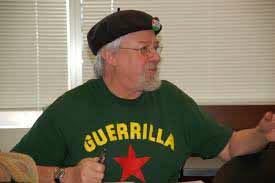
The
‘60s were fast-moving for those involved in the Vietnam antiwar movement of the
day. Most of the young activists on the campuses considered themselves New Left
(NL). The Old Left, epitomized by the American Communist Party (ACP), was merely
a shadow of itself after years of hounding by the Federal Bureau of
Investigation, better known as the FBI, and by Congressional committees and
federal prosecutors.
The
NL had arisen from the ashes but not without significant changes in shape and
style from its predecessor. Gone were the Old Left notions of ideological
fidelity; a hierarchical structure capped by centralized leadership; policy
discipline; and secrecy. The NL tolerated diverse ideas; eschewed rigid structure
and top-down leadership; disdained preoccupation with organizational
discipline; and, most differently, the NL banished closed-door meetings in
favor of functioning as an open organization.
Predictably,
it was only the rare activist who had presence of mind or the time – full time
students comprised the vast majority of the NL – to take notes or keep a
journal on those exciting times in their lives. But, unbeknownst to them, the
FBI had assessed the NL as a security threat to the government and dedicated
itself to covertly recording the political doings of the activists as proxies
for the sprawling, amorphous NL writ large.
Working
through agents of the FBI field offices in large cities near universities but
more often through local informants, little that targets of surveillance did in their daily
routines was not of interest to the Bureau. Whether in a formulaic-style memo
written by an agent summarizing an informant’s report or a direct account – say
of a NL meeting – in an informant’s own words, a large volume of documents
known as the target’s file was assiduously compiled in the FBI field office and
dutifully copied to FBI HQ, Washington.
In
their earlier penetration of the Old Left, the Bureau had relied on undercover
agents who joined the ACP or its Trotskyist rival, the Socialist Worker’s Party
(SWP). However, the typical NL activist was a college student and much younger
than the average FBI agent; hence, the use of campus informants who, given the
open nature of most NL gatherings, had no difficulty mingling freely with the
activists they were observing.
Decades
later when the tumult of the antiwar movement was but a memory, many
individuals began invoking the Freedom of Information Act (FOIA) to access
information the FBI had gathered on them. By then the confidential reports had
been declassified. The vast trove of FOIA files constituted a de facto history
of the New Left – or did it? Even in the heavily redacted format (to protect
informants’ names), reading several individual FOIA files side by side offers
an unusual up-close view inside the antiwar movement and the activities of many
of its young supporters.
No
one reading these long ago accounts is likely to suggest that the FBI and its
clandestine minions had set out to contribute to the historical canon on the
period. However, given the Bureau’s mission to stymie and disrupt the NL
through disinformation and other patently illegal tactics, the emphasis in the
numerous reports that flowed relentlessly into the ‘files’ tended to be
unvarnished writing and factual accuracy to the greatest extent possible.
Accuracy
was generally achieved such that many former activists, upon reading their FOIA
files 20 to 40 years later, have been reminded of moments in their early
political lives they had forgotten and have often been astonished to find near
verbatim accounts of their remarks at meetings.
Two
major Indiana University (IU) activists from the ‘60s – friends of my late
brother Jeff Sharlet – shared their FOIA files and gave me permission to
discuss them in this blog. One of the former activists is Dwight Worker, who
recently published an autobiographical memoir, The Wild Years (2013),
and with whom I spoke and corresponded extensively. Dwight’s complete FOIA file runs 1300 pages
and weighs in at around 7 pounds.

Cover sheet,
Dwight Worker’s FOIA file
In
effect, I have two versions of Dwight Worker’s IU years (1964-68) as a New Left
activist – his own and the FBI’s. Often Dwight’s personal account and the
covert government rendering concur on particular events, but sometimes the eager
beaver informants (there were 6 of them) missed or were unable to observe, not
to mention comprehend, the full extent of his actions. In some instances the
FBI version and Dwight’s’ narrative are at variance.
By
comparing the two accounts of Dwight Worker’s activist years, we will be able
to better judge the reliability of FBI files as apertures into the
micro-history of the opposition to the war in Vietnam. To be sure though, the
extensively redacted government documents need to be used cautiously and
carefully as guides to the past.
Once
the FBI field office in Indianapolis – 50 miles to the north of the IU campus
in Bloomington – drew a bead on Dwight during fall ’65, a memo on his personal
background was among the first documents placed in the confidential file opened
on him. The special agent who wrote the memo indicated that the information had
been obtained from the IU Admissions office, one of several administrative
branches of the university that cooperated with the government in its
surveillance of students. The profile gave a bare bones description:
DWIGHT JAMES WORKER was born 5/17/46 in East Chicago, Indiana. His parent was referenced as Fred Worker, 2518 Hart Road, Highland, Indiana. He graduated from Highland High School, 1964, ranking 14th out of 249 students. ...He is registered with Draft Board 178, Hammond, Indiana....He has attended Indiana University at Bloomington, Indiana, from 6/19/64 to the present date....He is employed 10 hours [a week] at the Big Wheel Restaurant and resides at 505 East 8th Street, Bloomington, Indiana.
Dwight’s version of his background is understandably more extensive than the Admissions file. He was one of seven children of Fred Worker and his spouse, a housewife. His father dropped out of school in the seventh grade during the Depression, served in WWII with General Patton, was very patriotic, and ran his home like ‘a boot camp’. According to Dwight, the family was working poor, living from paycheck to paycheck.
Two
significant aspects of Dwight’s early years were missed by the FBI – to wit,
that one of his older brothers served in Vietnam in ’64 and that in his first
year at IU he took his first political step by joining SNCC, the Student
Nonviolent Coordinating Committee, and working on their campaign to register
Black voters.

Dwight Worker at
Indiana University
During
his Sophomore year in the fall of ’65, an SDS chapter, Students for a
Democratic Society, took shape at IU, and Dwight became actively involved.
Accordingly, the FBI designated him a target for surveillance. SDS’s open
organizational meeting on October 3, 1965 became the subject of a 5-page report.
The document’s cover sheet indicated that a new file had been opened on Dwight
Worker. Other than as a rank and filer, he
didn’t play a particularly active role at that meeting at which officers were
elected and various proposals voted on:
The Indiana University chapter of SDS held a public meeting at Indiana University to elect officers for the current academic year on October 3, 1965. Approximately 45 people were in attendance.The International Days of Protest, October 15 and 16, 1965, were discussed. It was decided that since SDS did not have enough members and is a minority on the Indiana University campus, a demonstration would not be effective on these dates. It was felt it would be far more effective if SDS turned out all of its member to protest against Richard Nixon when he speaks at Indiana University on October 17, 1965.
What
the FBI was unaware of was that Dwight Worker didn’t simply drift into the
fledgling IU New Left; he was quite purposeful in his decision to get involved.
As mentioned, he had already become politically active in the Civil Rights Movement
on campus during his first year, but it was a family tragedy that drove him
into the ranks of the antiwar movement.
His
brother Wayne, while serving with the Navy in Vietnam, suffered a very serious
head injury in late ’64. In a coma for seven months, Wayne regained
consciousness in a Chicago Veterans Administration (VA) hospital to find
himself paralyzed, unable to speak clearly, and with severe memory loss.
Dwight
spent time with his brother at the VA hospital. His father was devastated by
his son’s condition, and Dwight returned
to school in the fall angry.
Angry at the war
drums going on in the US,
angry at what I
had seen at Hines VA
hospital, angry at the
terrible waste, angry at the
big lie.
[The
Wild Years (WY), 52]
Not
long after that SDS organizational meeting, former Vice President Nixon arrived
on campus to speak in support of American involvement
in the war in Vietnam, by then well underway since President Johnson’s (LBJ)
major escalation during the spring of ’65.
Dwight
joined the SDS protest demonstration outside the university auditorium where
Nixon was speaking. An undercover informant reported seeing him at the demo.
Otherwise the report had little to say about the protest. Nonetheless, three
days later an FBI agent called upon Dwight’s high school guidance counselor who
handed over his school records without hesitation.
In
his recent memoir, Dwight had much more to say about the Nixon action, his
first demonstration as an antiwar activist:
We were a pretty harmless bunch, perhaps
20 of us in total …
surrounded by 10 campus
cops and over a thousand
jeering, shouting
counter-demonstrating
students. COMMUNISTS!
‘COWARDS! TRAITORS! Send them
to Vietnam
instead’ they were shouting.
…
I held up my sign that said
‘Negotiate, Don’t
Bomb’. … They were throwing
things at us. …
I looked at a nearby
policeman and told him
about it…. He answered, ‘I
would be throwing
things at you too’. (WY, 54)
As
he became more active in SDS, Dwight became a singular focus of the FBI’s
attention. In late ’65 and early ’66, he attended an SDS National Council at the
University of Illinois on behalf of the IU chapter, as well as taking part as a
speaker at a campus SDS forum and an all-day SDS conference at the
university. FBI informants duly filed
accounts of these occasions:
Informant
attended the SDS forum at Indiana
University on November 5,
1965. He stated that
the first speaker was DWIGHT
WORKER, an
active member of SDS, who
spoke on a trip to
Europe he had made recently.
WORKER con-
cluded that international
student opinion is
heavily against US policy in
Vietnam … [a policy]
he described as
‘Imperialism’. WORKER seemed
insistently against US
foreign policy in Vietnam.
Another
informant reported that Dwight Worker was among 50-60 people attending an
all-day SDS conference on February 19, 1966 at which a ‘reorganization
proposal’ by Jeff Sharlet and Jim Wallihan was passed, and plans were made for
a major demonstration in the spring when General Lewis Hershey, Director of the
Selective Service System, was scheduled to speak at IU.*
Either
out of modesty or memory lapse, Dwight was silent in our communications as well
as in his memoir on his participation in various SDS gatherings, so it would be
reasonable to assume that the FBI got it right that he was quite active in the
IU chapter.
For
further confirmation, Dwight makes cameo appearances in two other FBI documents
amidst the Bureau’s heavy black-ink redacting – in February ’66 at the
Activities Fair for Spring semester registration, he is observed manning the
SDS table, while in a brief August memo he is listed among the new leadership
as SDS Treasurer.
Elsewhere
in Dwight’s FOIA as a result of the frequent black cross-outs, the file is
simply cryptic. One report reads, ‘On February 24, 1966 this source advised’
followed by six blacked-out paragraphs. Another document states mysteriously:
On July 23, 1966, DWIGHT WORKER was
observed
in the vicinity of the
Indiana University Auditorium
and Showalter Fountain by
[redacted] in company
with an unknown girl. WORKER
and the girl got
into a 1959 Ford, green,
bearing 1966 Indiana
license plate [redacted].
Presumably
the report alludes to the campus rendezvous point for people heading to
Indianapolis that day to demonstrate at LBJ’s scheduled speech there. A group
of IU students, among whom was Karen Grote, collaborator on this blog, did
indeed make it to the capital for the protest, but at the instigation of the
Secret Service 28 of them were preemptively arrested before the President
spoke.**
During
IU’s Spring semester ’67, Jeff Sharlet became president of the campus SDS. A
student informant reported to the FBI that Dwight Worker among 46 others attended
the first meeting at which Jeff presided on February 23, 1967. He described the
session in some detail:
Jeff
Sharlet was chairman of this meeting…. Sharlet
stated that he had attended
the regional SDS
conference at Northern
Illinois University. … He said
that next month there will be
another regional
meeting. He volunteered
Bloomington, Indiana as
the site for the next
meeting.
SDS HQ in Chicago accepted the
invitation, and the next regional meeting was held at IU on March 17-19, 1967.
The campus chapter announced that the conference would not be open to the
public, only members, and credentials would be checked. Given the FBI file’s
comprehensive account of the event, including the lengthy agenda, it’s obvious
that the informant was a member of SDS.
According to his or her oral report to
an FBI agent, the conference theme was ‘Student Power’ in the universities with
draft resistance a secondary topic:
At the Sunday afternoon session … Jeff
Sharlet
gave a talk on the subject of
student power. All
of the discussion was focused
on the point of
student leadership in the
university by SDS
members. ***
Dwight Worker who was in
attendance that Sunday as well as at other sessions saw himself as a kind of protégé
to Jeff Sharlet, the SDS leader. Jeff was an older ex-Vietnam GI and as Dwight
saw him quite mature. He added:
Jeff was absolutely unique at IU. He had this
charisma, an understated
charisma. He was
always calm, the one who put
things in bigger
perspective. Jeff was
masterful in handling
meetings with agent
provocateurs and dis-
ruptive individuals in
general.
He liked my energy and
enthusiasm for antiwar
stuff – Up against the wall
mother-fucker – but
thought I had just too much
unrestrained
energy at times. Jeff would
tell me to calm down,
relax, it’s going to be OK. ****
In Dwight’s case, there was
little about him that the Bureau did
not regard as worthy of the file. They even kept track of what might
be considered his ‘extracurricular’ or at least non-antiwar activities.
Apparently FBI Indianapolis had a mail subscription to the
IU campus paper, Indiana Daily Student
(IDS). Several
clippings turned up in Dwight’s FOIA. One was unrelated to opposition to the
war, while the other was a purely human interest story.
In the former article, IDS wrote that Dwight Worker had
conducted the initial organizational session of the Sexual Freedom League
at which a slate of officers was elected. In the latter clipping, which
included a head shot of Dwight, he is credited with saving a toddler
from drowning at a local lake.
By the fall of ’67, the FBI had
fashioned an imposing political profile for Dwight Worker that they shared per
request with a US Army Military Intelligence (MI) unit at a base just north of
Indianapolis. Dwight was characterized as a major political activist at IU. No
doubt he came to MI’s attention because of his involvement in draft resistance
at the university.

FBI profile on
Dwight Worker, 1967
Reporting
on a meeting of the IU anti-draft organization on October 5, 1967, a
confidential source wrote that:
At this meeting DWIGHT WORKER proposed
minor harassments of the
draft boards. He
stated that he thinks the
Selective Service
System is very
discriminatory, and he will
refuse
to go to Vietnam under any
circumstances.
Just
several weeks later, the New Left at Indiana University staged its most
dramatic action, and the FBI gave the event and Dwight Worker’s considerable
role in it maximum coverage in his file.
Dow
Chemical corporate recruiters were scheduled to meet with interested IU
students at the Business School. Campus activists heard that the manufacturer
of napalm was in town, and the Committee to End the War in Vietnam (CEWV), an
umbrella group for the university New Left, hastily organized several dozen
students to sit-in at the B-school, effectively blocking the recruitment
effort.
Dow
had recently visited the University of Wisconsin where a pitched battle
hospitalizing a number of people had ensued between protestors and the Madison
police. The IU Administration took note and prepared for all eventualities. The
sit-in got underway with Dwight Worker conspicuously in the forefront of the
group, and police in riot gear quickly moved in. The room was cleared of
protestors but for four students who chose to resist, among them Dwight.

Dwight Worker (see
arrow) at the Dow sit-in, 1967
The
FBI’s extensive account relied on newspaper coverage of the clash as well as on
their well-placed informant. Given the violence which occurred between the
police and the four resisters, the latter’s report was relatively bland:
About 3:15 PM on
October 30, 1967, a group of
students in the Business
School attempted to
enter the interview rooms
occupied by Dow
representatives. [IU] Safety
Division police
were unable to close the
door. The students
made a concerted rush, and
several of them
assaulted police officers.
Police reinforcements
rushed to the scene and
arrested 35 students….
Actually,
another memo in the FBI FOIA file provided a clear hint of the forthcoming
battle with the Dow. At a meeting earlier in October, the discussion turned to
police harassment of protestors generally. Dwight was present and offered the
group karate lessons, promising ‘he could teach them some simple karate techniques and …
how to combat the police’.
Apropos,
a clipping in the file from the Bloomington press gave a more vivid account of
the Dow story, focusing its coverage on Dwight Worker. Their angle was the
irony that Dwight, whom they had lauded earlier in the year for saving the
toddler, was back in the news as the title of the piece indicated:
Heroism
Forgotten in Aftermath
Worker
Faces Charges After Riots
Dwight Worker made the news
again for
conspicuous conduct.
Pictured in
Bloomington and
statewide papers
as a young
man being
dragged semi-
conscious by a
policeman
… he was
identified as one of
36 demonstrators
arrested in
the IU Business
School after a
wild clubbing,
slugging fight
between
policemen and sit-ins
protesting Dow
Chemical’s
on-campus job
interviews.
Worker, a 21-year old
Psychology
Senior faces charges
of disorderly
conduct, assault and
battery and
resisting arrest. …
A police night stick had
clipped Worker on the back of
the head and he spent two days
in the IU Health Center with a
concussion.*****
.jpg)
Dwight Worker
being dragged to police bus following Dow protest, 1967
Meanwhile,
unbeknownst to Dwight as he was pursuing his activism at IU, the Indianapolis
FBI had been anonymously mailing newspaper clippings on his activities to his
parents. Often handwritten marginalia was added, ‘Do you know this is what your
son is doing’.
After
the Dow melee, Dwight drove home to visit his family after a long interval. As
soon as he entered the house, his father confronted him in a rage, calling him “a GODDAMN COMMUNIST” and
took a swing at his son.
‘We know, we know what you been doing
in Bloomington. Get out of
here and don’t
ever come back!’ …
I hugged my crying mother and
left. That
was the last time I saw or
spoke with them
for years. (WY, 78-79)
Following
Dwight’s involvement in the mayhem at the B-school, the local FBI had amassed a
thick file on him and decided to recommend him to the Secret Service as a
serious national security threat. The recommendation was to include him in the
‘Security Index’, individuals who, in the event of a national emergency – and
depending on the priority assigned – were to be either immediately detained or
put under close surveillance.
FBI
HQ, Washington, was sufficiently persuaded so that J Edgar Hoover sent the
Director of the Secret Service a summary of Dwight Worker’s file under a cover
sheet with a box checked off stating:
Because of background is potentially
dangerous;
or has been identified as
member or participant
in a communist movement; or has
been under
active investigation as
member of other group
or organization inimical to
the US.
By
early January ’68 the Secret Service had accepted the FBI’s recommendation, and
Dwight Worker was described in a document as “a Priority I subject of the Security
Index.” However, a semi-annual
update on the ‘subject’, which the Indianapolis field office owed to the
Indianapolis branch of the Secret Service, was overdue because Dwight had left Bloomington
abruptly for parts unknown.
What
the FBI for all their professional diligence did not know was the full extent
of Dwight’s rather dramatic running conflict with his draft board over his
refusal to go to Vietnam. The conflict had come to a head in the first weeks of
1968; to avoid arrest, Dwight had gone on the lam.
In
a last letter to the Selective Service System, Dwight:
told them I had changed my name from
Dwight to Adam, my address
from 446 ½
East 2nd Street,
Bloomington, Indiana, to
Mountains, Streams, and
Forests, and my
race from white to Indian.
I signed it, ‘Fuck You
Paleface’. (WY, 91)
Dwight
ended up in New Mexico where to avoid detection he “lived entirely off the grid. No phones, electricity, water, gas, rent,
or traceable bills of any sort.” (WY, 77). Despite these elaborate
precautions, he was astonished to learn from his FOIA file a quarter of a
century later that the FBI had known his whereabouts within six weeks.
In
conclusion we’ve traced Dwight Worker’s journey from a typical Indiana
University Freshman in 1964 to a major campus New Left activist and ultimately
a fugitive national security risk by 1968. But what about the FBI as a covert
historian in recording Dwight’s story?
In
Dwight’s case, the Bureau with all its resources missed the drama of their
subject’s culminating confrontation with the draft, which was the catalyst for
his abrupt disappearance when for a time he went off the FBI’s radar. In
addition, even with half a dozen conscientious informants feeding them a steady
stream of information, the FBI was clueless on Dwight’s motivations, his
crucial relationships with fellow activists, and the influence of certain
individuals on him.
At best we can conclude that the tens of
thousands of pages now revealed in FOIA files mainly provide occasional glimpses of
the New Left pursuing its goals in myriad campus venues as well as the skeletal
framework of a decade of tumultuous dissent.
Epilogue

Dwight Worker at
his farm outside Bloomington, Indiana
As
for Dwight Worker, he eventually worked for years for IBM as a software
engineer and was recruited by Indiana University to teach in the Business
School where he won a number of teaching awards. These days in retirement, he
describes himself as an international bicyclist, an organic farmer, and a
writer – the memoir of late being his second book.
__________________________________________________________
***
For a brief account of the election of an SDS activist as Student Body
President of IU, Spring ’67, and Jeff Sharlet’s part in the campaign, see http://jeffsharletandvietnamgi.blogspot.com/2011/08/elvis-and-new-left-at-indiana.html
****
Author’s interview with Dwight Worker, February 11, 2009
*****
The Bloomington Tribune, November 13, 1967