Showing posts with label Maxwell Taylor. Show all posts

Wednesday, February 12, 2014

Man in a Red Devil Suit – Lives of the New Left VI

One remarkable profile remains as we reach the end of this series on the Indiana University (IU) New Left reunion, summer 2013.† Jim Retherford has had an extraordinarily noteworthy and diverse career on the left from his early years at IU to present day.

He has been a fearless New Left editor, a political performance artist, part of a guerrilla theater troupe, and along the way got acquainted with some of the legendary figures of the unforgettable ‘60s/early ‘70s. Running through the years of his rich resume, one sees he also has been an award-winning journalist and graphic designer – a veritable man of the left ‘for all seasons’.

Jim Retherford arrived at IU in ’60 with good student journalist credentials, but as a typical politically naïve freshman. Campus events soon politicized him.

He got off to a good start as a college journalist, landing a position on the staff of the campus daily, the Indiana Daily Student (IDS), his first semester and by spring becoming the paper’s Sports Editor.

Then he inadvertently witnessed an early IU New Left action and came away politicized. A tiny group of students, the Fair Play for Cuba Committee (FPCC) protesting the US naval blockade of Cuba during the Missile Crisis of fall ’62, were jeered, harassed, and threatened by a crowd of several thousand hostile students. Jim came away shocked and a lifelong supporter of the Cuban Revolution.       

As an activist, Jim leaned toward dramatic action in matters political. A few years after, Students for a Democratic Society (SDS) was organized at IU, and Jim joined up. The group, opposed to the Vietnam War, had adopted a policy of open meetings, open mike. On one occasion a conservative student leader took advantage and filibustered a meeting with a pro-war rant.

Other than shouts to end the harangue, the group sat passively, reluctant to violate SDS’s policy of openness. Jim Retherford was not having it, so he and a fellow activist took a large American flag off the pole in the corner, grabbed the speaker, ‘wrapped’ him in the flag, and duck-walked him off stage to much laughter and relief.

The following year, 1966, several students created an alternative ‘underground’ campus paper, The Spectator, and several months later Jim became the first editor. The experience would take him beyond political awareness and radicalize him.


A lively political-cultural alternative to IDS, Spectator drew on Underground Press Service and Liberation News Service (Jim worked with Marshall Bloom, the founder) – both New Left wire services – for stories ignored by the mainstream media. Under Jim’s aegis, the paper became increasingly critical of IU’s administration and trustees as well as the local political establishment.
         
Spectator gave ample coverage to the spirited IU New Left, of which the university president was highly critical. When brother Jeff Sharlet, then SDS president, rebutted the criticism in a major speech, Jim promptly published the full text. ††

The paper afforded great visibility to the  major demos against the campus visits of Army General Maxwell Taylor; General Lewis Hershey, Director of the Selective Service System; Secretary of State Dean Rusk; as well as to the sit-in blocking Dow Chemical recruiters at the Business School.

In the midst of all the protest, Jim Retherford was summoned by his draft board. He turned up at the induction center wearing Viet Cong-style black pajamas and rubber sandals and handed out antiwar leaflets to the inductees. The feds weren’t amused and responded with an over-the-top threefold indictment against him for trivial technical violations of the Selective Service law, including one for not carrying his draft card.

Meanwhile, by early ‘68 the university authorities, who had become quite irritated with Spectator’s criticism of their policies, moved to silence Jim and the irreverent paper. The Spectator staff was ordered to vacate its campus premises. Impatient, the Dean of Faculty decided to expedite the eviction. With a fire axe in hand, he broke down the door, destroyed equipment, and scattered files.

Undeterred, Jim moved the paper off campus to what he called the ‘liberation zone’ and continued the steady drumbeat of coverage and sharp criticism of IU’s administrators.  Street sales of the paper in Bloomington reached nearly 1,000; there were also mail subscriptions as well as orders from bookstores as far away as Boston and San Francisco.

In late spring ’68, Jim Retherford went on trial in federal court. He was convicted and sentenced to six years in prison. His bond revoked, he languished in jail for nearly three months until his conviction was overturned on appeal thanks to a prominent New York lawyer on the left.

Jim left Bloomington, moved to New York, and onto the national stage of the antiwar struggle. Earlier in ’67 he had already played a role as an organizer of the siege of the Pentagon when thousands of protestors from all over the country encircled the immense building in an attempt to ‘levitate’ it.


Jim Retherford at the Pentagon, Washington DC, 1967

In New York, Jim soon hooked up with poet, singer, and activist Ed Sanders, co-founder of the Fugs, a well-known psychedelic rock band of the day. He got to know Yippie leader Jerry Rubin, whose book he agreed to ghostwrite. DO IT! Scenarios of the Revolution was published in early ‘70 to much fanfare. 

Who can train guerillas by the dozens?
Send them out to kill their untrained cousins?
F**king-a man!
CIA Man!†††

In early ’69, federal conspiracy charges were filed in Chicago against Jerry Rubin, Dave Dellinger, Tom Hayden, and others for their parts in the antiwar demonstrations at the Democratic National Convention. With Rubin and Abbie Hoffman in the lead, the defendants turned the trial into raucous political theater with Federal Judge Julius Hoffman cast as villain. As Jerry’s friend and ghostwriter, Jim was invited to Chicago to take in the wild courtroom scene.

Enroute back to New York, he stopped off in Bloomington to visits friends and heard that Clark Kerr, former President of the University of California and bête noir of the ’64 Free Speech Movement at Berkeley, would be speaking at IU.

Jim planned a Yippie counter-performance. As Kerr began his remarks, Jim, who’d been hiding in the wings, rushed onstage decked out in a red devil costume and threw a cream pie in the speaker’s face. Hoping to get away, the ‘red devil’ was nonetheless caught, arrested, convicted of disorderly conduct, and sentenced to 90 days in jail. The ‘pieing’ of Clark Kerr made the nation’s papers.

The ‘70s were an eventful time on the East Coast, and Jim Retherford was in the thick of it. In late spring ’70, he went to New Haven CT with the band ‘Elephant’s Memory’, an experimental rock group better known as backup for John Lennon and Yoko Ono’s Plastic Ono Elephant’s Memory Band. The band performed at a huge May Day demo on the ‘green’ across from the Yale campus as thousands protested the trial of Bobby Seale and the New Haven Black Panthers.

Hey little chile don’t you put me on trial
You got me burnin’ on a fiery pile††††

That summer, Jim joined Abbie Hoffman’s ‘guerrilla theater’ for a Yippie happening at Madison Square Garden in New York. Mocking a big band just back from a tour of Communist East Europe covertly underwritten by the CIA, Hoffman and his troupe dumped 20 pounds of manure at the Garden’s entrance just as the crowd was arriving for the concert.

The following year a New York federal grand jury subpoenaed Retherford and fellow Yippies, ‘fishing’ for information about a bombing in Washington with which the five had no connection. Calling themselves the ‘Ever-Expanding Number’, the Yippie group duly appeared at the federal building with Jim sporting a King Kong outfit. If they were looking for antiwar guerrillas he figured, why not dress like a real gorilla.

Finally, election night 1972 found Jim Retherford walking the streets of Manhattan in the company of John Lennon and friends. In despair over Nixon’s landslide victory over George McGovern, the group came up with the idea of breaking the windows of a major bank. The tequila bottles they tossed shattered, but the bank’s windows survived.

Later in the decade, Jim left New York and relocated to Texas, first Houston, then Austin, where he raised his young son. He eventually joined the staff at the University of Texas-Austin.

Fast forward to the present, Jim Retherford retired several years ago as Senior Graphics Designer Emeritus, General Libraries, University of Texas at Austin. However as a long time Austinite, he continues to take part in the city’s progressive politics.

At IU last summer, Jim, the final speaker,  rose to talk about his life at the New Left gathering, but time was short on the kick-off event, and he only had a chance to sketch a few of his adventures. Let’s listen to him in his own voice:

Hi, I’m Jim Retherford, and what a long, strange trip it’s been. I came to Bloomington a farm boy from north central Indiana, 1960. I was skinny then. I kind of left Bloomington in the summer of ’68, although I had a tendency to come back and create some diversions for everybody.

In October ’69 when Clark Kerr began his lecture series at IU on how he had figured out [how to cope with the ’64 Free Speech Movement at Berkeley], I decided to practice a little reverse Marxian repressive power … and he ended up getting a pie in the face.


Jim Retherford in costume, Bloomington IN, 1969

I came here as a journalism student and spent two and a half years in the Journalism Department. I left the department very angry at the chairman for lying to me about stuff. It was during that time that I became politicized…. The Fair Play for Cuba march [October ‘62] started a number of things going.

One, it started in me a long-term quest that continues today – to understand and appreciate the revolution in Cuba and what it accomplished. That was just the beginning.

The other thing that it created – a strain that has continued – was when I was in the city room of the Indiana Daily Student (IDS) right after the Fair Play march when two guys in trench coats, whom I recognized from pictures taken at the march, came into the room and introduced themselves as graduate students. [laughter] …

They asked if me and my friend, who was the IDS chief editorial writer at the time, if we had known anything about those guys [the pro-Cuba marchers]. I was only a sophomore at the time, but I knew this was bullshit. That was the beginning of my distrust of the intelligence apparatus.

In ’66 a group of graduate students – by then I was in the English Department – started talking about forming an alternative newspaper. I attended all their meetings and helped launch the new paper [The Spectator], but I didn’t really get along with the other organizers. There wasn’t good chemistry, so I just helped on the journalistic part of the paper – telling them how to lay it out and stuff, but I didn’t get really active in it.

The grad students all flunked out of school and a Spectator staff came together that following September. There was somebody who the Dean of Students wanted to be the editor, but nobody wanted her so they talked me into doing it. I edited The Spectator for the next two years.

That was a radicalizing experience. From the very beginning I made space in The Spectator for all points of view, but when Robert Turner* [a conservative student leader] took advantage of it, we kind of got rid of that policy because it was redundant to say the same thing over and over again. We’d heard enough of that.

During this period of time, I became more questioning and more radical and it ended up that I was moving up the FBI watch list as I found out later. In ’67 just 11 days before my 26th birthday, which would have freed me from all my draft-duty obligations, I woke up and had two federal indictments for Selective Service violations which were non-existent. I wasn’t even a [draft] delinquent.

Then in January, a third indictment was added. I went to trial in May ’68. I was convicted and sentenced to six years in prison. My appeal bond was revoked as they [the feds] tried to block my right of appeal. I ended up in jail for about two and a half months waiting for all that to shake out.

 I moved to New York to be near my lawyer, Leonard Boudin.** I got involved in the Movement in New York, spent seven or eight years there. I worked with Jerry Rubin. I conceptualized and ghostwrote his book [DO IT! (1970)]. I was tied in with the Yippies, did a bunch of stuff with the Artist’s Movement, and worked with the Young Lords organization*** to take over a rock-and-roll festival in New York and divert $20,000 to the People’s Community Clinic in the South Bronx.

I was [also] involved with a bunch of people who did some crazy things, and I ended up doing a lot of defense committee work. Those of you who’ve done that know how depressing and debilitating it is. It kind of sucks the life out of you, you’re doing this instead of the stuff you need to and want to be doing. You’re on the defensive.

I joined a group that seemed like a ‘serve the people’ organization [Fred Newman’s Centers for Change], but it turned out to be a cult or turned into a cult. I had a son by a woman who was in that organization. She almost killed him, her and the cult-leader. When the child was in good enough health, I took him and left New York. I spent basically 17 years kind of hiding in Houston and then in Austin.

In Austin now I am on the Board of Directors of the New Journalism Project. I’m one of the people working on a project called the Rag Blog, which is a digital outgrowth of The Rag’, one of the first underground papers in the country [during the ‘60s].**** We also run a radio station [Rag Radio], and we do a lot of outreach things. That’s basically what I’m doing now and why I’m here.
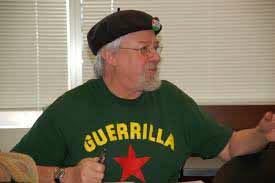

Jim Retherford in recent years

Long a premier journalist with prizes to his credit, Jim Retherford continues to publish. In 2004 the New York Times ran his op-ed, and, since its inception in ’06, several of his essays have appeared in the ‘Rag Blog’, a weekly online journal of the left edited by Thorne Dreyer in Austin, Texas.

A modest individual, Jim Retherford has compiled an amazing curriculum vitae of a lifetime on the left. This brings to a close Lives of the New Left, a series responsive to the historical question, What became of the Indiana New Left?

The essays in response, framed in the lives of the individuals profiled, are also meant to reflect the generation of ‘60s activists writ large of whom the IU group was an integral part.
________________________________

† There were additional speakers at the reunion assembly, but only the recordings of the remarks by the 15 individuals profiled in Lives of the New Left I-VI, were sufficiently audible.

†† For an account of Jeff Sharlet’s public exchange with the IU president, see, http://jeffsharletandvietnamgi.blogspot.com/2011/08/elvis-and-new-left-at-indiana.html

Links to music videos:


*Robert F Turner, as an IU undergrad, was President of the IU Conservative League, which brought various conservative speakers to campus and distributed literature. Later, Turner focused on the Vietnam War as national research director and Indiana State Chairman of the Student Committee for Victory in Vietnam. Following graduation he was commissioned an Army officer and served two tours in Vietnam. Professor Turner is currently Associate Director of the Center for National Security Law at University of Virginia Law School. See http://jeffsharletandvietnamgi.blogspot.com/2013/07/blueprint-fr-police-state-in-american.html.


**The late civil liberties lawyer and left-wing activist Leonard Boudin was involved in the defense of the ‘Bloomington Three’ (B-3) after their arrest following the IU demonstration protesting President Kennedy’s naval blockade of Cuba during the Missile Crisis of October ’62. Known for his representation of high profile anti-Vietnam War defendants such as Daniel Ellsberg and Dr Benjamin Spock, Boudin also served as defense counsel for less well-known individuals and organizations. On the case of the B-3, see the profile of Paulann Hosler Sheets in http://jeffsharletandvietnamgi.blogspot.com/2013/11/activist-legacies-in-hoosierland-lives.html.

***The Young Lords was a Puerto Rican nationalist organization that evolved from a Chicago street gang as a result of Mayor Daley’s political machine’s ‘urban renewal’ program during the ‘60s. When an entire Puerto Rican neighborhood was evicted in favor of up-market real estate development, the Young Lords confronted the machine in the Division Street Riots of 1966. In ’68 the Young Lords reorganized as a human rights movement and spread to cities across the country. They quickly achieved national prominence for mobilizing thousands of people in similar neighborhood actions in other places. The organization continues to exist to this day in the struggle for Puerto Rican rights and independence.

**** The Rag was a legendary alternative newspaper in Austin TX, a major center of the counterculture of the ‘60s. The paper covered radical politics, the war in Vietnam, civil rights struggles, the student freedom movement, Women’s Liberation Movement, and local protest politics as well as national and world news from the Liberation News Service. Closely associated with the SDS chapter at University of Texas-Austin, the Rag featured articles by national SDS and other New Left leaders. From a reunion of former staffers, the Rag Blog.com was founded in 2006. An online news magazine, it features much of the same content as its predecessor and is edited by Thorne Dreyer, one of the original Rag editors, who also hosts Rag Radio. This post has benefited from his Rag Radio interview with Jim Retherford in 2010; see https://archive.org/details/RagRadio02-23-2010.


Wednesday, January 16, 2013

Peace Corpsmen and War Hawks

Though thousands of miles apart in spring ‘64, my kid brother Jeff Sharlet and I were both wrapping up our time abroad – I following a research year in Moscow, Jeff finishing a military tour in Vietnam. He was heading back to finish college, and I – well, I wasn’t quite sure until one surprising day when out of the blue an international cable arrived offering me an academic position teaching students at a salary of $8,000. That sounds like poverty scale now, but nearly half a century ago it seemed munificent. Accustomed to $3,000 graduate fellowships, I swiftly cabled my acceptance.

Jeff and I finished up at about the same time in May ’64. He hopped a flight back to Saigon, his orders permitting a week’s leave in the South Vietnamese capital where he rendezvoused with buddies from the Army Language School in California. All of them Vietnamese linguists, they helped Jeff say a long goodbye to the Paris of the Orient and its night spots.


Saigon ladies in ao dai and French-built Saigon City Hall 1963
 
Mine was a quieter departure. My Soviet colleagues came to the Belorussky Station bearing flowers and candy to see me off. We said our goodbyes, and I went aboard the overnight train to Poland. Compared to austere Moscow, Warsaw with its blonde barmaids and cold beer felt like the ‘West’ – though I was still in the Soviet empire.
 
From Saigon, Jeff flew to Clark Air Base in the Philippines, home station of his unit, the 9th ASA, an Army Security Agency battalion. After a few days of exit processing, he boarded a military transport for the long haul across the Pacific with stops in Guam and Hawaii, finally landing at Travis Air Base north of San Francisco. My trip back was more circuitous. I made my way from Warsaw to Prague, then south to Yugoslavia. From Belgrade, I caught a transcontinental sleeper to Paris, a remnant of the famed Orient Express, and flew to New York.


Travis Air Base, northern California
 
Jeff and I soon returned to our respective academic haunts – he at Indiana University (IU), I at my new post at the University of Missouri (Mizzou). We were both in Political Science, Jeff a student, I a professor. By Spring term ’65, he was flourishing in his courses while I continued learning my craft.
 
By then the low intensity war Jeff left behind was heating up, and he grew concerned he might be recalled. As the first specialist on the USSR at Mizzou, I was preoccupied with teaching my course on Soviet politics & law. When President Johnson (LBJ) escalated the conflict with combat troops and bombing runs against the North a few months later, Jeff and I were on divergent paths. Each of us had our wars; for me it was the global Cold War, for him opposition to the Vietnam War, a very personal fight.
 
Jeff gravitated toward IU’s small band of New Left activists protesting LBJ’s new war policy; I signed on with the Administration to prepare for arms control negotiations with the Soviet Union. I had taken to heart President Kennedy’s (JFK) inaugural challenge: to “….ask not what your country can do for you, ask what you can do for your country.”
 
Our respective commitments dictated our summer plans. Jeff would hang out in Bloomington as the activist group laid the foundations for a chapter of Students for a Democratic Society (SDS) at IU; I took off for the University of Wisconsin in Madison to work on the arms control project. By the time I returned to Mizzou in September ’65, Jeff and fellow activists had SDS up and running at IU. Soon after they were part of a protest demo when Nixon spoke on campus in support of Vietnam policy.
 
Meanwhile the United States Peace Corps Agency (PCA) was training a flood of volunteers for work in underdeveloped countries collectively known as the ‘Third World’. The idea was to assist development in backward nations at the grass roots level, making the foreign aid blandishments of Soviet agents less appealing.


Mizzou was the site of the program for Thailand, a Southeast Asian country hosting American bases for the air war against North Vietnam, hence of strategic importance to the US. The volunteers were being trained in ‘Community Development’ or, in the glossary of Washington acronyms, CD. Thai language instruction was part of the curriculum. A young professor of Agriculture, a specialist in bovine diseases, was in charge.
 
Learning how to foster CD would mean placement in small villages in rural Thailand where Peace Corps volunteers would first assess local socio-economic resources, then strive to mobilize villagers to carry out manageable quality of life projects like bridging a small waterway to facilitate movement of crops from farm to market or water purification projects to ward off disease. However, PCA’s real purpose was neither bridges nor wells, but helping instill in locals, long under the spell of fatalism, a sense of community efficacy as a way of taking greater charge of their lives.
 
The Mizzou Peace Corps office invited me to lecture to the trainees. They would need to know the competition they’d be up against in the Thai countryside, and I was the one with a background in Marxism. I agreed and delivered several lectures on Communist political revolution and the Soviet strategy for rapid modernization. Apparently feedback was good because toward the end of ‘65 a PCA official flew in from Washington to talk with me.
 
The Agency was launching a major two-summer experimental program and had selected Mizzou to pioneer it. Previously trained only stateside, volunteers would also receive training in-country to facilitate language instruction and physical and psychological conditioning. I was offered the position of project director and $10,000 above my academic salary. Intrigued by the challenge and drawn by the extra money, I readily said yes.
 
The program involved a great deal of advance planning which took all my spare time outside of teaching. I had an office at the Mizzou PCA headquarters, an administrative assistant, a letterhead, and a hot line direct to Washington. First tasks were to create a curriculum for the new program, then recruit people to teach it, ideally academics with field experience as well as expertise on Southeast Asia, traditional societies, community development, and Thai language instruction.
 
To look after the volunteers’ physical and mental well-being, I also needed a staff physician, preferably one with some knowledge of tropical maladies, along with a psychiatrist and a phys ed instructor. I recruited mostly Mizzou faculty, but when necessary telephoned around the country until I found the right person.
 
While I was busy preparing to help ‘save’ Thailand for the West, up at Indiana Jeff and the SDS-ers were planning protests against the war in Vietnam. In late February ’66, General Maxwell Taylor, the WWII hero, arrived at IU – as the historian of the university put it – as an “apologist”* for Washington on the war. No surprise there, the general was invited by the IU president, Elvis Stahr, JFK’s former Secretary of the Army.† Taylor had served both JFK and LBJ on the ‘Vietnam front’, first as presidential military adviser, then as Chairman of the Joint Chiefs of Staff in the Pentagon, and finally as US Ambassador to South Vietnam.
 
Anxious that there might be a militant confrontation against his ‘friend’ the general, President Stahr took no chances in his introduction, devoting most of it to defending free speech for visiting dignitaries with minimal reference to the distant conflict driving the demonstrators to protest Taylor’s presence. Although the general was deeply implicated in the war policy, the occasion of his speech was a Midwestern Model UN General Assembly, so SDS decided to give their demo a positive spin. One of the Indiana senators, Vance Hartke, had criticized the war; hence Jeff and the activists marched in support of Senator Hartke, war critic.
 
 
General Maxwell Taylor at IU, February ‘66
 
Meanwhile back at Mizzou I was preoccupied filling out myriad forms and questionnaires required by Washington for my trip to Thailand. Especially time-consuming was the special form for Americans traveling abroad on government business. Questions included family demographics, military service, all the addresses I’d ever lived at, and previous employment. Then there were the daily immunizations against many exotic diseases, including cholera and yellow fever, both painful shots with lingering side effects.
 
By early spring the project was shaping up – curriculum approved and staff recruited, I was set to visit ‘the field’ as soon as classes ended for the midterm break. It was to be a brief visit to the training site in Thailand. Working in my Peace Corps office one afternoon, I received an unusual call from Washington, from an official with whom I’d had no previous contact.
 
The caller identified himself as the Agency’s Deputy General Counsel, and explained that he was calling about the travel clearance form I had submitted. I laughed and said that must have been an easy approval since I had held Top Secret and Cryptographic security clearances while serving with ASA-Europe during the ‘50s. On the contrary, he politely responded, that’s the problem.
 
                     You wrote you were in an Army intelligence
                     organization and Peace Corps has a firm rule.
                     No one with an intelligence background can
                     work for us abroad.

Puzzled and with yellow fever vaccine still raging through my system, I replied, “For chrissake! That was nearly a decade ago in the old brown-shoe army. I’m discharged, not even in the Reserves.” He reiterated that it was a firm rule and invoked the Cold War, which of course framed American involvement in Southeast Asia. “Look,” he calmly reasoned, “what would happen if they found out about your Army experience, and broadcast into the field that we’re sending secret agents out there. It’d be all over.”

Suddenly my deep background in Soviet Studies kicked in, and I thought to myself, of course he’s right. It’s a question of perceptions, appearances; the truth has nothing to do with it. We were locked in a struggle with the Soviets for hearts and minds in the Third World. Peace Corps was one of our instruments in the contest. Likewise, the USSR sent thousands of advisers into most of the same countries – agronomists, doctors, teachers as agents of social change promoting their development strategy.

Intellectual ruminations aside, I quickly and angrily got back to reality. I told the messenger that Peace Corps had been aware of my background as far back as the fall when I submitted paperwork to Washington to serve as one of their lecturers. I had even appended my professional resume that included my military service and the Certificate of Merit awarded attesting to my ability in Czech when I left the Army Security Agency.

“You’ve known all this for half a year – why the hell didn’t the man you sent out to recruit me for Thailand inform you of the ‘problem’ at the outset?” The lawyer at the other end smoothly replied, “Sorry about that, he’s a new man. Afraid he didn’t know the rule. I’m really sorry, but got to go.” Click.

As my plans for Thailand went into retreat, Jeff and SDS were mobilizing to confront yet another Vietnam war hawk headed for Indiana. Stahr had invited General Lewis Hershey to speak. A native Hoosier who had attended IU in 1915, Hershey had visited campus a number of times over the years. The general was well-known as the long-time director of the Selective Service System, known to every young male coming of age as ‘the draft'.

Dear Uncle Sam
I just got your telegram
And I can't believe that this is me
Shaking like I am
For it said, "I'm sorry to inform you”††
 
By ’66, the Vietnam conflict had become a major war with US troop totals surging toward 200,000. This meant soaring draft calls for young men across the country.  While college students had been deferred, General Hershey had recently issued a policy change subjecting poorly performing students to the draft. In his plain-spoken, folksy manner, Hershey’s topic was the necessity of the draft.

Kiss me goodbye and write me while I’m gone
Goodbye my sweetheart, Hello Vietnam†††
 
Heartened by the success of its foray against General Taylor, SDS planned a large demonstration for Hershey’s appearance, complete with speakers including Jeff, the only Vietnam veteran in the chapter. Other IU students organized a counter-demo in support of the war. On the day of Hershey’s speech, about 2,000 students, pro and con Vietnam, turned out at Showalter Fountain in front of the auditorium. 
 
 
General Lewis Hershey
 
Vastly outnumbered, the 300 antiwar marchers remained calm in the face of catcalling, heckling, and even egg-throwing. A historian wrote that in spite of the provocations, the protestors paraded in orderly fashion “thus making their point even more strongly.”** IU SDS had succeeded in elevating the Vietnam War to a campus-wide issue.

While Jeff and fellow activists enjoyed successes against the war hawks at Indiana, my relations with Peace Corps had deteriorated. Washington’s belated invocation of its ‘firm rule’ to abort my mission to Thailand had thrown my professional schedule and personal finances into disarray. I was not pleased.

Long story short: I owed Wisconsin a second summer on the arms control project, but managed to get my obligation deferred until fall ‘66. This in turn necessitated an unpaid leave of absence from Mizzou. I had expected to recover the lost income from Peace Corps, but I now found myself behind the financial 8-ball; the only thing to show for my effort was surefire protection against yellow fever for the next ten years.

Holding Washington responsible for my dilemma, I insisted on partial compensation for the time put in. No way, responded the General Counsel’s office, my contract with the agency didn’t formally begin until June, and federal law did not permit payment until services were rendered. I turned to the university to take up my case. Somehow when I had been appointed project director, the Ag prof who preceded me had morphed into a special assistant to the chancellor for Peace Corps liaison.
 
He was of no help, Mizzou’s hands were tied, they were under contract to PCA and subject to federal law. I pressed my claim with Washington to the point where they warned the university that my pursuit of the matter could endanger pending negotiations on contract renewal. Apparently an additional program was in the offing – Bolivia. Aha, I thought, now I’m getting somewhere – leverage.
 
When I was summoned to the chancellor’s office, I figured I’d finally get some satisfaction. Wrong. When I entered, an unusual scene greeted me. Five chairs were lined up in front of a desk resembling the prow of a ship, four of them occupied by the hierarchy of administrators – in descending order – who stood between me and the CEO sitting in silence behind the desk. He motioned me to the empty seat at the end.
 
I waited to hear what the chancellor had to say, but he never addressed me. Instead he spoke rhetorically to the executive vice president asking him, “Does Professor Sharlet understand the importance of the Peace Corps contract to the university.” Having never met me, the VP couldn’t be sure, turned to the Dean of Faculty and on down the line to the junior Ag prof at my left, now a flack for the front office. He nodded affirmatively.
 
And so the mime conversation went on, with the man in the big chair posing a series of self-evident if-then questions about the adverse effect on Mizzou’s well-being because of my insistence on compensation. That is, until I interrupted and cogently informed the chancellor of the adverse consequences for me of Peace Corps’ bureaucratic blundering. I closed, advising him I intended to continue to pursue the issue until my concerns were met, and left without further ado.
 
Furious now with Mizzou as well as Peace Corps and having exhausted normal remedies for relief, I fired off a special delivery letter to Washington putting them on notice that my next communication would be to a senior US senator and member of the Foreign Relations Committee, a friend of the family.
 
That did it; I had pushed the right button. Within 24 hours the university informed me a check was being cut per my request.
 
Thailand, the ancient Kingdom of Siam, managed to remain apart from the violence and turmoil in Southeast Asia as the ferocity of the war in Vietnam grew exponentially. Though I was no longer available to do battle with Soviet agents of change in the Third World, Jeff would later go on to make a significant contribution to bringing an end to America’s long, divisive war in Vietnam – but that’s another story.
 
 
Links to music videos
 

†††Hello Vietnam:  http://www.youtube.com/watch?v=Fs4puvFVRmI

*Thomas D. Clark, Indiana University: Midwestern Pioneer, Vol 3 (1977), 592.

**Ibid, 593.


Wednesday, September 26, 2012

The Generals March on Indiana

Back from Vietnam in ’64, my brother Jeff Sharlet returned to Indiana University (IU) to resume his education. Coincidentally, the same man under whom he had served in the long military chain of command was now president of the university. Elvis Stahr had been appointed Secretary of the Army by President Kennedy (JFK) in ’61. Stahr acquitted himself well during difficult times for JFK – the Bay of Pigs fiasco of spring ’61 and the Berlin Crisis, which culminated in the construction of the Berlin Wall that summer. Stahr held the Pentagon post until his departure for Indiana a year later.
 
His would not be an easy tenure at IU.  As the Vietnam War heated up with President Johnson’s (LBJ) major escalation in early ‘65, a small number of students organized, joining a Students for a Democratic Society (SDS) march on Washington DC in April of ’65, and sponsoring a local march in Bloomington in August. At the same time Robin Hunter, Bernella and David Satterfield, Jim Wallihan, Peter and Lucia Montague, and others worked on establishing an IU SDS chapter that Jeff soon joined.  As if providing grist for the antiwar mill during the next two years, President Stahr, who was well-connected in Washington, invited a series of major pro war speakers to campus.
 
It was quite an impressive roster, beginning with former Vice President Nixon, following with Generals Maxwell Taylor and Lewis Hershey, and concluding with Secretary of State Dean Rusk. Stahr invited no counter-balancing antiwar speakers of similar stature; Herbert Aptheker, theoretician of the American Communist Party, and a few other lesser known leaders of the left were all invited by tiny sectarian groups at the university with little following. IU, a sleepy Midwestern campus, was fundamentally a conservative place, and the pro war notables attracted very large audiences, while Aptheker drew only hundreds and was hung in effigy outside the student union.
 
What drew the Washington luminaries to the middle of the Great Plains? Presumably, Stahr had the contacts and the clout to persuade them to visit the campus as his distinguished guests. He clearly seemed to know some of them professionally since he often personally introduced the speaker in the university’s vast auditorium. For Nixon, accepting an invitation in the fall of ’65 was no doubt an easy decision. Out of office and working as a New York lawyer, he had ambitions to get back in the political game.
 
Indiana, long a Republican state, would be a good place to show himself to the thousands of conservatives who would come out to hear the former VP. Not many would have been aware that in ’54 then-Vice President Nixon had tried to persuade President Eisenhower (Ike) to save the beleaguered French colonialist forces, which were about to be overrun by Ho Chi Minh’s communist army at Dien Bien Phu—given Nixon’s anti-communist portfolio, it was a logical recommendation, but one which Ike wisely rejected.  However, the roughly 200 student activists marching in protest outside the auditorium that day were well aware of Nixon’s stance on Indochina.
 
The generals came marching onto campus the following spring of ‘66. General Taylor, a hero of WWII, came in March; he was so closely involved with Vietnam War policy that his arrival was unmistakably a pro war statement. After visiting Vietnam under JFK, Taylor recommended  the introduction of US combat troops and even the idea of ‘liberating’  Communist North Vietnam,  decisions the President declined to take. Subsequently Taylor served as Chairman of the Joint Chiefs of Staff and later as Ambassador to South Vietnam. He was an ardent supporter of the war.


President Stahr introducing General Taylor, ‘66
 
Taylor was followed to the rostrum in early May by a fellow flag officer, General Hershey, an avuncular 73-year-old whose military career went back to the Mexican Border War of 1916. He’d been head of the Selective Service System since ‘41. An Indiana native son, he was certainly a welcome guest at the Hoosier state’s largest university; like most schools, IU liked to bask in the glory of those with local connections who went far.  But for IU student activists as well as draft age male students, a protest was called for.  Hershey had recently told draft boards they could draft college men who were not performing well academically; prior to that, young men were automatically exempt from the draft while in college. 
 
Further, Hershey ordered an aptitude test to be resumed after a long hiatus that very month; performance on the test would determine who remained exempt and who did not.  For activists as well as poorly performing male students blindsided by the directive, the general represented the point of the spear marshaling young men to war in faraway South Vietnam.  A year later the general would issue another regulation aimed directly at college-deferred men, subjecting them to the draft immediately for demonstrating against a military recruiter. 
 
The last in the string of pro-war speakers was Rusk, a major hawk, at the end of October ‘67. Like Nixon, he carried personal baggage from the past that no doubt shaped his unremitting advocacy of the US mission in Vietnam. Rusk had been Assistant Secretary of State for Far Eastern Affairs in the postwar Truman Administration after the fall of China in ‘49. When the Republicans tarred the Democrats with ‘losing China’ to the ‘Reds’, Rusk made certain that his image as a tough-minded Cold Warrior was clearly visible.
 
Tapped by JFK for Secretary of State a decade later, Rusk had been prepared to throw himself with the zeal of a true believer into the young president’s crusade against international communism. However, it was understood by all that JFK would conduct his own foreign policy with Rusk as his diplomatic place holder, a status to which he accommodated himself without complaint. In Washington circles he was soon considered a mediocrity, a perception he subsequently did little to change.
 
After JFK’s assassination, Rusk continued to go with the flow and fly with the hawks on Vietnam. By ’67, other than LBJ himself and Defense Secretary McNamara, Rusk’s appearance before a student audience was guaranteed to serve as a lightning rod for antiwar protest, and IU was no exception. A special ‘reception’ was prepared by an activist group calling itself the “Dean Rusk Welcoming Committee.”
 
Each of the national advocates of the Vietnam War was met by an escalating level of antiwar protest at IU, albeit very small in scale compared to the size of the student body. At the time of Nixon’s arrival on campus, increased American involvement in the conflict in Southeast Asia was barely six months old. The campus protestors’ challenge was not students supporting the war; on the contrary, the war barely registered with the average IU student at the time – the main problem was student apathy.
 
The newly formed SDS chapter and a campus left group, YPSL or the Young People’s Socialist League, managed to mobilize nearly 200 demonstrators to march in protest of Nixon’s fall ’65 appearance. Predictably Nixon praised LBJ’s recent escalation – the start of a bombing campaign against the Communist North and the dispatch of combat troops to South Vietnam.
 
When the generals arrived on campus during the spring of ’66, the student activists were better prepared to mount protests, but as it turned out, a significant part of the campus population was also ready to counter-demonstrate on behalf of the war. Under a newly formed campus umbrella organization, the Committee to End the War in Vietnam (CEWV), a coalition of groups led by Jim Wallihan, Destiny Kinal Handelman, and brother Jeff for SDS; Professor Jim Dinsmoor, who was hoping to run for Congress as a peace candidate; and others, devised a different strategy for General Taylor’s visit in March.
 
Instead of protesting the general’s appearance on campus, a demonstration was organized in support of Indiana’s junior senator, Vance Hartke, who had come out publically against the war. Signs were made, marchers were urged to wear jackets, ties, skirts; and Taylor was greeted by a neatly dressed, orderly group of young people vocally supporting a Washington opponent of the war.
 
In May, General Hershey was met by a traditional demonstration that unexpectedly provoked a raucous counter-protest. Again, CEWV put out word and had no difficulty in bringing some 350 protestors to demonstrate in front of the auditorium. The general had recently changed the regs, advising draft boards they could begin considering student performance, i.e., those with poor grades could be drafted.
 
 
General Hershey and IU students ‘66
 
The demo, which moved on to Dunn Meadow, also included antiwar speakers who found themselves confronted by a crowd of 1500 to 2000 hecklers – including many fraternity boys -- waving American flags, throwing eggs and water balloons, and calling into question the demonstrators’ patriotism. Jeff, speaking as an ex-Vietnam GI, was hit by an egg, but, unfazed, he  issued the shouters a forceful challenge to put their money where their mouths were  since they were so gung ho for the war. Years later a fellow activist, Russell Block, remembered “the courage of the Vietnam vet and the cowardice of the frat rats who were all for the war as long as someone else had to fight it.”
 
 
Protesting General Hershey ‘66
 
By early ’67, it was evident that the only visiting speakers who were going to grace the podium of the campus auditorium with glowing introductions by President Stahr would be supporters of the war. In an exchange of public letters with the IU president, Jeff, by then doing his turn as SDS president along with vice president Bob Tennyson, challenged Stahr on the university’s one-sided speakers’ policy, but to no avail. Jeff had graduated and moved on to the University of Chicago by the time Rusk was welcomed to campus that fall. As a member of LBJ’s war cabinet, the antiwar students decided his appearance required a different strategy for opposing Vietnam policy.
 
CEWV, SDS, and the campus Progressive Reform Party (PRP), a New Left group led by Guy Loftman victorious in the previous spring’s student body elections, decided that heckling Rusk would be the best way to get the community’s attention, far more so than simply marching in front of the venue with signs, so-called speech on a stick. In an interview in the campus paper the day before, a protest leader made clear their intentions, saying that in view of the magnitude of the war issue, “a breach of good manners seems of rather little consequence.” In effect, he argued, “social nastiness to combat the nastiness of war.”*

The next day some 200 activists donned black armbands, briefly marched around the water fountain in front of the auditorium, then entered the building uneventfully, dispersing themselves among the 3,000+ people in attendance. As the Secretary of State spoke, individual black armbanders in various parts of the room would stand up and yell things like ‘liar’, ‘murderer’ and the like. By that point in the war, Rusk was no doubt accustomed to interruptions, and he continued speaking in spite of the cacophony of shouts. At the end he left by a side door under police escort.**

 
Dean Rusk at IU, a perturbed Elvis Stahr behind him, ‘67
 
The universal embarrassment about the behavior of the protesters was, however, to a degree counteracted by a protest which had occurred the day before Rusk’s arrival. Corporate recruiters from Dow Chemical, manufacturer of deadly napalm, were due at the Business School (B-school) that day, and it was decided by the New Left leaders that the visit should not pass unchallenged. A few weeks earlier the company had attempted to interview job candidates at the University of Wisconsin, a far more actively antiwar campus, where a full-scale melee ensued – complete with tear gas and dozens of demonstrators and police alike sent to the hospital.  Events in Madison made the national news, and the IU security chief laid plans to avoid anything similar on his watch.
 
Secretly, campus security scouted the interview venue, coordinated with local and regional law enforcement, and even reserved a university bus to transport arrestees if necessary. Unaware of the university’s preparations, approximately 40 activists showed up at the B-school to meet the Dow recruiters. Campus cops tried to block their access to the room, but the students pushed their way forward and, led by the newly elected head of SDS, Dan Kaplan, began a sit-in. That triggered phase two of the security plan with city police and deputy sheriffs decked out in riot gear arriving on the scene.
 
The occupiers were ordered to leave peacefully and get on the waiting bus for police processing. Most did so, but four young men refused, and the forces of law and order moved in with swinging riot sticks, putting two of the students, Dwight Worker and George Walker, in the hospital. It was clearly a police over-reaction; as news got around in the papers the next day, the occasion of the Rusk visit, there was outrage at the administration and the cops in some quarters. Thus, for two days in the normally placid heartland, there was uproar over a war thousands of miles away. To some extent the dueling outrages precipitated by the back to back Dow and Rusk visits mitigated each other depending upon one’s politics.
 
However, the cumulative protests were eventually too much for Elvis Stahr, who publically criticized and demonized the campus New Left. A former senior officer in WWII and member of the government, and, above all, a Rhodes Scholar long accustomed to a string of unruffled successes, Stahr couldn’t take the dissonance of university life in the midst of a divisive war and resigned in bitterness at the end of the academic year.
 
*Quoted from the Indiana Daily Student in M A Wynkoop, Dissent in the Heartland: The Sixties at Indiana University (2002), 55.