One
remarkable profile remains as we reach the end of this series on the Indiana
University (IU) New Left reunion, summer 2013.† Jim Retherford has had an
extraordinarily noteworthy and diverse career on the left from his early years
at IU to present day.
He
has been a fearless New Left editor, a political performance artist, part of a
guerrilla theater troupe, and along the way got acquainted with some of the
legendary figures of the unforgettable ‘60s/early ‘70s. Running through the
years of his rich resume, one sees he also has been an award-winning journalist
and graphic designer – a veritable man of the left ‘for all seasons’.
Jim
Retherford arrived at IU in ’60 with good student journalist credentials, but as
a typical politically naïve freshman. Campus events soon politicized him.
He
got off to a good start as a college journalist, landing a position on the
staff of the campus daily, the Indiana
Daily Student (IDS), his first semester
and by spring becoming the paper’s Sports Editor.
Then
he inadvertently witnessed an early IU New Left action and came away
politicized. A tiny group of students, the Fair Play for Cuba Committee (FPCC)
protesting the US naval blockade of Cuba during the Missile Crisis of fall ’62,
were jeered, harassed, and threatened by a crowd of several thousand hostile
students. Jim came away shocked and a lifelong supporter of the Cuban
Revolution.
As
an activist, Jim leaned toward dramatic action in matters political. A few
years after, Students for a Democratic Society (SDS) was organized at IU, and
Jim joined up. The group, opposed to the Vietnam War, had adopted a policy of
open meetings, open mike. On one occasion a conservative student leader took advantage
and filibustered a meeting with a pro-war rant.
Other
than shouts to end the harangue, the group sat passively, reluctant to violate
SDS’s policy of openness. Jim Retherford was not having it, so he and a fellow
activist took a large American flag off the pole in the corner, grabbed the
speaker, ‘wrapped’ him in the flag, and duck-walked him off stage to much
laughter and relief.
The
following year, 1966, several students created an alternative ‘underground’
campus paper, The Spectator, and several
months later Jim became the first editor. The experience would take him beyond
political awareness and radicalize him.

A
lively political-cultural alternative to IDS,
Spectator drew on Underground Press
Service and Liberation News Service (Jim worked with Marshall Bloom, the
founder) – both New Left wire services – for stories ignored by the mainstream
media. Under Jim’s aegis, the paper became increasingly critical of IU’s
administration and trustees as well as the local political establishment.
Spectator gave ample
coverage to the spirited IU New Left, of which the university president was
highly critical. When brother Jeff Sharlet, then SDS president, rebutted the
criticism in a major speech, Jim promptly published the full text. ††
The
paper afforded great visibility to the
major demos against the campus visits of Army General Maxwell Taylor;
General Lewis Hershey, Director of the Selective Service System; Secretary of
State Dean Rusk; as well as to the sit-in blocking Dow Chemical recruiters at
the Business School.
In
the midst of all the protest, Jim Retherford was summoned by his draft board.
He turned up at the induction center wearing Viet Cong-style black pajamas and
rubber sandals and handed out antiwar leaflets to the inductees. The feds
weren’t amused and responded with an over-the-top threefold indictment against
him for trivial technical violations of the Selective Service law, including
one for not carrying his draft card.
Meanwhile,
by early ‘68 the university authorities, who had become quite irritated with Spectator’s criticism of their policies,
moved to silence Jim and the irreverent paper. The Spectator staff was ordered to vacate its campus premises.
Impatient, the Dean of Faculty decided to expedite the eviction. With a fire
axe in hand, he broke down the door, destroyed equipment, and scattered files.
Undeterred,
Jim moved the paper off campus to what he called the ‘liberation zone’ and
continued the steady drumbeat of coverage and sharp criticism of IU’s administrators. Street sales of the paper in Bloomington
reached nearly 1,000; there were also mail subscriptions as well as orders from
bookstores as far away as Boston and San Francisco.
In
late spring ’68, Jim Retherford went on trial in federal court. He was convicted
and sentenced to six years in prison. His bond revoked, he languished in jail
for nearly three months until his conviction was overturned on appeal thanks to
a prominent New York lawyer on the left.
Jim
left Bloomington, moved to New York, and onto the national stage of the antiwar
struggle. Earlier in ’67 he had already played a role as an organizer of the siege
of the Pentagon when thousands of protestors from all over the country
encircled the immense building in an attempt to ‘levitate’ it.

Jim Retherford
at the Pentagon, Washington DC, 1967
In
New York, Jim soon hooked up with poet, singer, and activist Ed Sanders,
co-founder of the Fugs, a well-known psychedelic rock band of the day. He got
to know Yippie leader Jerry Rubin, whose book he agreed to ghostwrite. DO
IT! Scenarios of the Revolution was published in early
‘70 to much fanfare.
♫ Who
can train guerillas by the dozens?
Send them out to kill their untrained cousins?
F**king-a man!
CIA Man!†††
In
early ’69, federal conspiracy charges were filed in Chicago against Jerry
Rubin, Dave Dellinger, Tom Hayden, and others for their parts in the antiwar
demonstrations at the Democratic National Convention. With Rubin and Abbie
Hoffman in the lead, the defendants turned the trial into raucous political
theater with Federal Judge Julius Hoffman cast as villain. As Jerry’s friend
and ghostwriter, Jim was invited to Chicago to take in the wild courtroom scene.
Enroute
back to New York, he stopped off in Bloomington to visits friends and heard
that Clark Kerr, former President of the University of California and bête noir
of the ’64 Free Speech Movement at Berkeley, would be speaking at IU.
Jim
planned a Yippie counter-performance. As Kerr began his remarks, Jim, who’d
been hiding in the wings, rushed onstage decked out in a red devil costume and
threw a cream pie in the speaker’s face. Hoping to get away, the ‘red devil’
was nonetheless caught, arrested, convicted of disorderly conduct, and
sentenced to 90 days in jail. The ‘pieing’ of Clark Kerr made the nation’s papers.
The
‘70s were an eventful time on the East Coast, and Jim Retherford was in the
thick of it. In late spring ’70, he went to New Haven CT with the band
‘Elephant’s Memory’, an experimental rock group better known as backup for John
Lennon and Yoko Ono’s Plastic Ono Elephant’s Memory Band. The band performed at
a huge May Day demo on the ‘green’ across from the Yale campus as thousands
protested the trial of Bobby Seale and the New Haven Black Panthers.
♫ Hey little chile
don’t you put me on trial
You
got me burnin’ on a fiery pile††††
That
summer, Jim joined Abbie Hoffman’s ‘guerrilla theater’ for a Yippie happening
at Madison Square Garden in New York. Mocking a big band just back from a tour
of Communist East Europe covertly underwritten by the CIA, Hoffman and his troupe
dumped 20 pounds of manure at the Garden’s entrance just as the crowd was
arriving for the concert.
The
following year a New York federal grand jury subpoenaed Retherford and fellow
Yippies, ‘fishing’ for information about a bombing in Washington with which the
five had no connection. Calling themselves the ‘Ever-Expanding Number’, the
Yippie group duly appeared at the federal building with Jim sporting a King
Kong outfit. If they were looking for antiwar guerrillas he figured, why not
dress like a real gorilla.
Finally,
election night 1972 found Jim Retherford
walking the streets of Manhattan in the company of John Lennon and friends.
In despair over Nixon’s landslide victory over George McGovern, the group came
up with the idea of breaking the windows of a major bank. The tequila bottles
they tossed shattered, but the bank’s windows survived.
Later
in the decade, Jim left New York and relocated to Texas, first Houston, then
Austin, where he raised his young son. He eventually joined the staff at the University
of Texas-Austin.
Fast
forward to the present, Jim Retherford retired several years ago as Senior
Graphics Designer Emeritus, General Libraries, University of Texas at Austin.
However as a long time Austinite, he continues to take part in the city’s
progressive politics.
At
IU last summer, Jim, the final speaker, rose to talk about his life at the New Left
gathering, but time was short on the kick-off event, and he only had a chance
to sketch a few of his adventures. Let’s listen to him in his own voice:
Hi, I’m Jim
Retherford, and what a long, strange trip it’s been. I came to Bloomington a
farm boy from north central Indiana, 1960. I was skinny then. I kind of left
Bloomington in the summer of ’68, although I had a tendency to come back and
create some diversions for everybody.
In October ’69
when Clark Kerr began his lecture series at IU on how he had figured out [how to cope
with the ’64 Free Speech Movement at Berkeley], I decided to practice a little reverse Marxian repressive power … and
he ended up getting a pie in the face.

Jim Retherford in
costume, Bloomington IN, 1969
I came here as a
journalism student and spent two and a half years in the Journalism Department.
I left the department very angry at the chairman for lying to me about stuff.
It was during that time that I became politicized…. The Fair Play for Cuba march
[October
‘62] started a number of things going.
One, it started
in me a long-term quest that continues today – to understand and appreciate the
revolution in Cuba and what it accomplished. That was just the beginning.
The other thing
that it created – a strain that has continued – was when I was in the city room
of the Indiana
Daily Student (IDS) right after the Fair Play march when two
guys in trench coats, whom I recognized from pictures taken at the march, came
into the room and introduced themselves as graduate students. [laughter] …
They asked if me
and my friend, who was the IDS chief
editorial writer at the time, if we had known anything about those guys [the
pro-Cuba marchers]. I was only a sophomore
at the time, but I knew this was bullshit. That was the beginning of my
distrust of the intelligence apparatus.
In ’66 a group
of graduate students – by then I was in the English Department – started
talking about forming an alternative newspaper. I attended all their meetings
and helped launch the new paper [The
Spectator], but I didn’t really get
along with the other organizers. There wasn’t good chemistry, so I just helped
on the journalistic part of the paper – telling them how to lay it out and
stuff, but I didn’t get really active in it.
The grad
students all flunked out of school and a Spectator staff came together that following September. There was somebody who
the Dean of Students wanted to be the editor, but nobody wanted her so they
talked me into doing it. I edited The Spectator for the next two years.
That was a
radicalizing experience. From the very beginning I made space in The Spectator for all points of view, but when Robert
Turner* [a conservative student leader]
took advantage of it, we kind of got rid of that policy because it was
redundant to say the same thing over and over again. We’d heard enough of that.
During this
period of time, I became more questioning and more radical and it ended up that
I was moving up the FBI watch list as I found out later. In ’67 just 11 days
before my 26th birthday, which would have freed me from all my
draft-duty obligations, I woke up and had two federal indictments for Selective
Service violations which were non-existent. I wasn’t even a [draft] delinquent.
Then in January,
a third indictment was added. I went to trial in May ’68. I was convicted and
sentenced to six years in prison. My appeal bond was revoked as they [the feds] tried to block my right of appeal. I ended
up in jail for about two and a half months waiting for all that to shake out.
I moved to New York to be near my lawyer,
Leonard Boudin.** I got involved in the Movement in New York, spent seven or
eight years there. I worked with Jerry Rubin. I conceptualized and ghostwrote
his book [DO
IT! (1970)]. I was tied in with
the Yippies, did a bunch of stuff with the Artist’s Movement, and worked with
the Young Lords organization*** to take over a rock-and-roll festival in New
York and divert $20,000 to the People’s Community Clinic in the South Bronx.
I was [also] involved with a bunch of people who did some
crazy things, and I ended up doing a lot of defense committee work. Those of
you who’ve done that know how depressing and debilitating it is. It kind of
sucks the life out of you, you’re doing this instead of the stuff you need to
and want to be doing. You’re on the defensive.
I joined a group
that seemed like a ‘serve the people’ organization [Fred Newman’s
Centers for Change], but it turned out to
be a cult or turned into a cult. I had a son by a woman who was in that
organization. She almost killed him, her and the cult-leader. When the child
was in good enough health, I took him and left New York. I spent basically 17
years kind of hiding in Houston and then in Austin.
In Austin now I
am on the Board of Directors of the New Journalism Project. I’m one of the
people working on a project called the Rag Blog, which is a digital outgrowth of ‘The Rag’, one of the first underground papers in the country [during
the ‘60s].**** We also run a radio
station [Rag Radio], and we do a lot
of outreach things. That’s basically what I’m doing now and why I’m here.
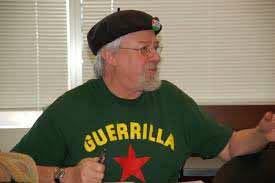
Jim Retherford
in recent years
Long
a premier journalist with prizes to his credit, Jim Retherford continues to
publish. In 2004 the New York Times ran
his op-ed, and, since its inception in ’06, several of his essays have appeared
in the ‘Rag Blog’, a weekly online
journal of the left edited by Thorne Dreyer in Austin, Texas.
A
modest individual, Jim Retherford has compiled an amazing curriculum vitae of a
lifetime on the left. This brings to a close Lives of the New Left, a series responsive to the historical
question, What became of the Indiana New Left?
The
essays in response, framed in the lives of the individuals profiled, are also
meant to reflect the generation of ‘60s activists writ large of whom the IU
group was an integral part.
________________________________
†
There were additional speakers at the reunion assembly, but only the recordings
of the remarks by the 15 individuals profiled in Lives of the New Left I-VI, were sufficiently audible.
††
For an account of Jeff Sharlet’s public exchange with the IU president, see, http://jeffsharletandvietnamgi.blogspot.com/2011/08/elvis-and-new-left-at-indiana.html
Links to music videos:
*Robert F Turner, as an IU undergrad,
was President of the IU Conservative League, which brought various conservative
speakers to campus and distributed literature. Later, Turner focused on the
Vietnam War as national research director and Indiana State Chairman of the
Student Committee for Victory in Vietnam. Following graduation he was
commissioned an Army officer and served two tours in Vietnam. Professor Turner
is currently Associate Director of the Center for National Security Law at
University of Virginia Law School. See http://jeffsharletandvietnamgi.blogspot.com/2013/07/blueprint-fr-police-state-in-american.html.
**The
late civil liberties lawyer and left-wing activist Leonard Boudin was involved in the defense of the ‘Bloomington
Three’ (B-3) after their arrest following the IU demonstration protesting President
Kennedy’s naval blockade of Cuba during the Missile Crisis of October ’62.
Known for his representation of high profile anti-Vietnam War defendants such
as Daniel Ellsberg and Dr Benjamin Spock, Boudin also served as defense counsel
for less well-known individuals and organizations. On the case of the B-3, see
the profile of Paulann Hosler Sheets in http://jeffsharletandvietnamgi.blogspot.com/2013/11/activist-legacies-in-hoosierland-lives.html.
***The
Young Lords was a Puerto Rican nationalist organization that evolved from a
Chicago street gang as a result of Mayor Daley’s political machine’s ‘urban
renewal’ program during the ‘60s. When an entire Puerto Rican neighborhood was
evicted in favor of up-market real estate development, the Young Lords
confronted the machine in the Division Street Riots of 1966. In ’68 the Young
Lords reorganized as a human rights movement and spread to cities across the
country. They quickly achieved national prominence for mobilizing thousands of people
in similar neighborhood actions in other places. The organization continues to
exist to this day in the struggle for Puerto Rican rights and independence.
****
The
Rag was a legendary alternative newspaper in Austin TX, a major center
of the counterculture of the ‘60s. The paper covered radical politics, the war
in Vietnam, civil rights struggles, the student freedom movement, Women’s
Liberation Movement, and local protest politics as well as national and world
news from the Liberation News Service. Closely associated with the SDS chapter
at University of Texas-Austin, the Rag featured articles by national
SDS and other New Left leaders. From a reunion of former staffers, the Rag
Blog.com was founded in 2006. An online news magazine, it features much
of the same content as its predecessor and is edited by Thorne Dreyer, one of
the original Rag editors, who also hosts Rag Radio. This post has
benefited from his Rag Radio interview with Jim Retherford in 2010; see https://archive.org/details/RagRadio02-23-2010.


