Wednesday, May 7, 2014

Cuba Dispatches – The View from Moscow

In the fall of ’62, brother Jeff and I were each doing our thing. He was reluctantly learning Vietnamese – he had wanted Russian – at the Army Language School (ALS) in Monterey while I hunkered down in Bloomington feverishly preparing for my PhD exams at Indiana University (IU).

One day in October I was surprised to find the Cold War swirling around me. I had thought that day-to-day reality was behind me when I finished my tour on the front lines of the great East-West conflict in Europe four years earlier. However, the Soviets had secretly begun their build-up in Cuba during late summer. First, ground troops were sent by sea from Leningrad. To avoid detection by US and British aircraft routinely surveilling Soviet shipping out of the eastern Baltic, the troops were kept out of sight below decks by day.
         
Even when the literary-minded infantry commander requested permission to go topside as the ship was passing through the narrow strait off the Danish coast – just to glimpse the legendary castle at Elsinore where Shakespeare’s Hamlet was set – the ship’s captain turned him down. To all intents and purposes, the vessels that NATO overflights observed were just ordinary Soviet freighters routinely carrying cargo to Cuba.
         
Not until early October when Soviet missile launchers had been emplaced in Cuba and the defensive ground force was encamped ashore did the US detect Khrushchev’s near fait accompli. The ominous ’13 days in October’ ensued with National Security Advisor Bundy convening an ad hoc ‘executive committee’ (Ex-Comm) chaired by the President and his brother to cope with the crisis.
__________________________________________________________

During the crisis, anticipating missile strikes on their bases, the Strategic Air Command dispersed 200 bombers with nuclear loads to civilian airports.
_________________________________________________________

Meanwhile at normally placid IU, a fellow grad student in Soviet Studies, the left activist George Shriver had done his political work well. Although he had withdrawn from grad school in the spring of ’62, moved to New York, and opted for a career as a Socialist Workers Party (SWP) staffer, George left behind at the university a solidly organized, albeit small SWP affiliate, the Young Socialist Alliance (YSA), and its off-shoot, the Fair Play for Cuba Committee (FPCC).
         
Coming to the end of my time at IU that fall semester, I was unaware of those small campus activist groups. A typical liberal, left politics were not my thing. My PhD coursework completed, I was intensely studying for the doctoral exams in November.

The exams loomed large in a grad student’s life. If one passed successfully, one was admitted to ‘candidacy’, meaning you moved on to researching and writing a dissertation – in effect, a book-length manuscript – toward attaining a PhD degree and beyond, an academic career.

For me then, nothing had higher priority in October ’62 – not even the hair-raising confrontation between the United States and the USSR over little Cuba just 90 miles off-shore. Likewise, the unfolding Cuban Missile Crisis made barely a ripple in the routine at ALS on the California coast. Jeff and his fellow GI students continued to attend language classes six hours a day while the Kennedy (JFK) Administration was quietly building up its assets for the low-key but escalating war in Vietnam.

Meanwhile off the Florida coast, tensions were rising. Soviet anti-aircraft missiles brought down an American U-2 over Cuba while another US spy plane, actually on a high altitude weather mission, accidently strayed into Soviet airspace, a provocation even at the best of times. Soviet MiGs scrambled, US fighters rose to meet them, and the errant U-2 pilot barely escaped, not to mention that an aerial dogfight was avoided.

Serious people in the States feared the possibility of full-scale armed conflict between the superpowers, one that could rapidly escalate into nuclear war. They weren’t far off the mark as we subsequently learned. In the Ex-Comm meetings in the White House, shielded from public view, the generals were strongly pushing JFK to attack Cuba and take out the Soviet missile batteries soon expected to be ready to threaten American cities and military installations.
_____________________________________________________________

The protestors – Fair Play for Cuba stalwarts – were trying to march down a 
broad avenue amidst several thousand shouting and cursing fellow students.
____________________________________________________________

Anticipating missile strikes on Strategic Air Command (SAC) bases, the Pentagon dispersed 200 bombers loaded with nuclear bombs to civilian airports from Portland to Philadelphia. In turn, the Army mobilized a quarter of a million troops for an invasion of Cuba – my parents living in Miami told me the roads south to the sea were clogged with military vehicles. Even inexperienced, first-year student nurses in training at hospitals across the country were put on alert for casualties from a nuclear attack.

Naturally I was deeply concerned – who wouldn’t be – and I had to make a very fundamental decision. Time was short before my PhD exams, but so was the nuclear fuse lit between the superpowers. With WWIII waiting in the wings, should I hang it up – forget about studying day and night and have a final fling before everything came to an end – or should I push on. I voted for a future.

As the missile crisis deepened, I was walking across campus to the library one afternoon to collect more books and saw a clutch of people – perhaps eight in number – carrying signs critical of the President’s naval blockade of Cuba. American warships were on station to prevent Soviet freighters from delivering the missiles, the final step in the dangerous contretemps underway. The protestors – FPCC stalwarts – were trying to march down one of IU’s broad avenues amidst a huge crowd of several thousand shouting and cursing fellow students.†


Occasionally a hostile student would dash out of the crowd, snatch a protester’s sign, and tear it up to stormy cheers. Farther along the march route,
another onlooker ran out, threw a punch, and a brief scuffle ensued – the marcher slugged was trying to shield the two women at the center of the group.

Throughout the ordeal, campus security and the city cops stood by impassively as the FPCC folks struggled on, advocating at that moment as the nation was rallying around the flag probably the most unpopular position imaginable. As I walked on, I thought, ‘God, those people are brave’.

Fortunately for the world, cool heads prevailed in the Kremlin and at the White House, and the crisis came to a peaceful resolution. We all breathed a sigh of relief. It might have been otherwise if JFK had not fended off General Curtis LeMay and other hawks on the Ex-Comm pushing for a preemptive air and land attacks on Cuba.

After the USSR collapsed in ’91, it was revealed in Moscow that the Soviet combat brigade in Cuba had been equipped with tactical nuclear weapons, and the commander was authorized to use them if American forces came ashore.

Castro was furious the Soviets had backed off and pulled their missile batteries, leaving revolutionary Cuba high and dry. He was well aware of the CIA’s attempts to assassinate him and assumed the ‘imperialist’ United States would not stop at taking him out, but would launch another invasion of the island.

At IU, but for a few bruises, IU’s pro-Cuba contingent survived its ordeal to protest another day. Jeff finished at the language school and shipped out to Vietnam, and I passed my PhD exams and headed for Moscow late summer ‘63 for a year of dissertation research for my doctorate.

I had been selected for the official US-Soviet graduate student exchange designed to encourage better mutual understanding to help avoid war. The idea was that each side’s young scholars would get an up-close experience in their respective societies. I was assigned to the law school at Moscow University. It was to be a remarkable year.

My arrival at Moscow Law School in September ’63 was preceded by Castro’s state visit to the USSR that spring. Khrushchev wanted to make amends to the unhappy Cuban leader for the Soviets’ abrupt retreat from Cuba. Castro had agreed to go to Moscow to discuss a very generous Soviet aid package as a kind of reparations. The trip was organized around the May Day celebrations, the second most important holiday in the Soviet calendar.

It was the most elaborate welcome ever extended to a foreign head of state. A red carpet was laid out from Lenin’s Tomb to Swan Lake. Castro reviewed the gala May Day parade in Red Square from atop Lenin’s Mausoleum along with the Soviet leadership – a rare honor for a foreign leader.


Castro & Khrushchev, May Day parade, 1963

Soviet crowds were ecstatic over the charismatic Cuban leader, a genuine revolutionary hero. In the late ‘50s American media had lionized the guerrillas for their daring forays against the Batista regime, so one can easily imagine the exuberant Soviet press adulation that preceded Castro.

For Khrushchev, the visit was of the utmost significance as it helped repair the damage to his image with his comrades after the humiliating withdrawal from the Caribbean. It also shored up his flagging leadership position in the international communist movement – for the time being.
________________________________________________________

Soviet crowds were ecstatic over Castro, a genuine revolutionary hero.
______________________________________________________

Fidel understood the great leverage he had and extracted a huge political, economic, and military aid package. On the symbolic side of the state visit, the USSR heaped honors and laurels on him, including an honorary Doctorate of Laws from what would shortly become my Soviet alma mater, Moscow University (MGU). The degree was conferred in the Great Hall at MGU’s Lenin Hills campus high above the River Moskva. The citation noted Castro’s contribution to the “application of the Marxist-Leninist doctrine to State and Law.”

In his acceptance remarks before the throng of students, including my soon-to-be fellow law students, Fidel told them that his first big mistake in life was to study law in a capitalist society with its main emphasis on commercial, property, and real estate law, “laws of a society doomed to disappear.” He assured his audience to rousing cheers that Marxism-Leninism would guide the solutions to all of Cuba’s constitutional, legal, and institutional questions.

Castro went on to tour the length and breadth of that vast country from Murmansk near the Arctic Circle to ancient Samarkand in the Soviet Central Asian desert. At every stop he was enthusiastically feted by the local establishment and the general public. After more than 40 days, he returned triumphantly to Havana.


Castro and Soviet sailors in Leningrad, 1963

I arrived in Moscow for my research year in early September. The university was still on summer break so I had time to look around. I made a point of going to several Soviet movies – nothing remarkable, ordinary fare – primarily to ‘tune up’ my Russian language ear. The only one I recall was a WWII drama which, given the country’s staggering losses of 27 million dead, was in ’63 still well within living memory of nearly all.

The scenario followed a predictable plot line – first the Soviet forces suffered serious reverses, but then regrouped and through great heroism exacted a terrible toll on the enemy. What surprised me though was that all around me in the theater older men were weeping.

A few weeks later I was no longer the only occupant on my floor of the dorm – the law students had come back for fall semester. Most had been working in Kazakhstan, one of the Soviet Union’s Central Asian republics, performing their pro bono ‘social duty’ helping bring in the harvest. Moscow Law School soon came alive, and it was time for me to present myself to my Soviet advisor.

The law school was near the city center, lodged in a time-worn 18th century building not far from the Kremlin. It was a rather ornate structure and must have been at one time the grand residence of a wealthy merchant.

At the appointed hour, I climbed the stairs to the Jurisprudence Department on the second floor. The door stood open, and I entered the cavernous room with elaborately ornamented flourishes along the high ceiling, décor I’d never before seen in an academic office.

My advisor, Dr Professor A I Denisov, a nationally known jurist, chaired the department and had assembled his faculty to welcome the American visitor. For me, a rookie in Russia, it was somewhat daunting as they all rose to greet me with customary handshakes. Andrei Ivanovich introduced me to each colleague, several of whose names I recognized from having read their books.

Everyone was cordial, but it was still little overwhelming since the huge windows overlooking the street below were open – AC not an option – and noise rising from passing buses and trolleys sometimes drowned out the chair’s deep hoarse voice. Finally, an ice-breaker of sorts as I was introduced to a junior docent about my age.

He asked where I lived in the States. Told him my parents lived in south Florida, at which he lit up with a big smile and said, “I’ll be flying over there in a few days.” He was bound for Havana for the academic year to lecture at the law school through simultaneous translation on Soviet administrative law.

The docent was part of the vanguard of the big Soviet aid package negotiated by Castro during his spring visit – one of a number of law profs being dispatched to Cuba, effectively to transmit the Soviet legal model. Coincidentally, a generation earlier when East Europe fell behind the Iron Curtain, Professor Denisov, as a young scholar, had performed the same function in Communist Bulgaria as the new regime there struggled to put a Soviet-style system in place.

As had been the case in Communist East Europe earlier, by the late ‘60s most of the textbooks used in the Cuban law schools were verbatim translations of Soviet texts into Spanish.

I soon settled into a routine in Moscow – research at the Lenin Library, classes at the law school, and occasional forays into the impressive world of Soviet high culture, music, ballet, and theater. One evening that fall I was at the Bolshoi Theater with a group of fellow American exchange students. We had gone to see the Russian opera Boris Godunov. As foreign visitors in the USSR, we were privileged to have excellent orchestra seats at nominal cost.


Bolshoi Theater, Moscow

We arrived early and waited for the curtain, which was delayed a few minutes. I had noticed that the theater’s first three rows were empty and cordoned off by ushers. Finally, some 75 Cuban Army officers trooped in and filled the seats as honored guests of the evening. They doubtlessly didn’t know Russian, so what they might have thought of that melodramatic opera – a dark tale of royal intrigue in the 17th century Kremlin – we’ll never know.

During intermission in the lobby, the officers kept to themselves. Just as the US trained allied Latin American military personnel in our higher command schools, the Bolshoi’s guests were also part of the Soviet aid program to revolutionary Cuba. They were in Moscow for advanced tactical training in Soviet Army schools.
______________________________________________________________

North Vietnamese students posted a large sign in our dorm lounge gleefully  welcoming Kennedy’s death; Russian students tore it down in a fury. _________________________________________________________

During my Moscow sojourn, I became aware of Cuba for the last time in late ’63. I was in my room in the Lenin Hills dorms when the terrible news arrived that JFK had been assassinated in Dallas just an hour earlier on the other side of the world.††

There were just a few Americans in the dorm, and we were desperate for information. From what we could glean from special Soviet news announcements interspersed with funereal music, Voice of America shortwave broadcasts, and phone calls to the embassy, the assassin, Lee Harvey Oswald, had a possible Cuban connection. He was married to a young Soviet woman and had lived for a time in the USSR. Once back in the States, he identified himself with the Fair Play for Cuba Committee.

My Russian dorm mates greatly admired Castro and were quite upset at the suggestion that Cuba might be involved in the death of the President. Paradoxically, they also thought well of JFK even though he was the chief adversary of their country.

Sub rosa they appreciated JFK’s youth and vigor as a leader. Unspoken, but well understood, was an implicit comparison with their own sluggish, geriatric leadership. When North Vietnamese students from the floor below posted a large Russian-language sign in our dorm lounge that gleefully welcomed Kennedy’s death, the Russian students tore it down in a fury.

Two days later, when Jack Ruby shot Oswald before the cameras of the world, the Soviet public was shocked and dismayed by our gun-crazy culture, and nothing further was heard of a Cuban link. For me, dissertation research beckoned, and Cuba fell off my radar screen.

I returned to the States the following summer, and several months later Khrushchev’s comrades ousted him in a bloodless coup. The bill of particulars against him included a number of his policies dubbed ‘harebrained schemes’, among which the USSR’s Cuban debacle loomed large.

___________________________________________


Wednesday, April 23, 2014

Catching Sight of A Revolution – From Harvard to IU

In the time between the world wars, our father, like so many Americans, had visited Cuba’s exotic capital in the interwar period. He was in Havana in 1930 during the country’s heady Republican Period, but decades later my brother Jeff and I had only passing awareness of revolutionary Cuba of our own time.  We’d both seen the family photo of Irving as a young man – he was 21 – dressed to the nines with a good looking blonde at the bar in Sloppy Joe’s – the famous celebrity hangout on Cuba’s Golden Riviera.


Irving Sharlet (l), our father, in Havana, 1930

Irving had grown up in comfortable circumstances; he had some money and was something of a playboy. At the time, Prohibition reigned as the law of the land in the States. To get a drink without a password in a back alley speakeasy, well-heeled Americans would sail off to Europe or head to the Caribbean to relax with a highball in fashionable public places. Sloppy Joe’s was one of the in-places, just off-shore so to speak, where one might see John Wayne or Clark Gable or even Cuba’s most famous North American visitor, Hemingway, down the bar.

Decades afterward during the postwar period when dramatic changes began happening in Cuba, the island country was on the periphery of our young lives. Jeff in his short life – he died at 27 – had been heavily involved with Vietnam. Serving there early in the growing conflict, he later became an international leader of GI opposition against the war. I became an academic, a specialist on the Soviet Union, where I had studied and visited periodically. I spent most of my adult years teaching and writing about the country.

Still, as the Cuban Revolution emerged in the ‘50s and consolidated in the early ‘60s, quite serendipitously Jeff and I bore witness to some of the salient moments of the island’s transition from a popular Caribbean tourist destination to the epicenter of the global Cold War. Cuba first came to my attention unexpectedly in late fall ’56. In the phrase of the day, I was fulfilling my military obligation in the army.

___________________________________________________________________________

The rebellion in Cuba is over, and students of foreign affairs can now 
give  themselves again to Hungary and the Middle East.
_________________________________________________________

I was fortunate, having been assigned to a congenial posting for a year of study at the Army Language School (ALS) on the sunny California coast. I was being trained in a Slavic language, my only duties six hours a day of class and a little homework. At lunch break, I always had the latest issue of the airmail edition of the British paper, Manchester Guardian, in my back pocket as I waited in the chow line. Reading it was a pleasant respite from the morning’s grammar lessons, pronunciation drills, and vocabulary tests.

One noontime I was glancing through the early December ‘56 issue of the Guardian. Hungary and the Suez Canal were the lead stories. The Soviets had just bloodily crushed the Hungarian Revolution while the Israeli, British, and French forces had defeated the Egyptians, whose nationalization of the Canal had touched off a brief but fierce war.

Perusing the back pages, my eye fell on an unfamiliar story, ‘The battle for Cuba’, with a dismissive opening line, “The rebellion in Cuba is over, and students of foreign affairs can now give themselves again to Hungary and the Middle East.” Reading on, I found a lighthearted account, rife with British irony, of a hapless invasion of the island by a band of Cuban revolutionaries sailing from Mexico.

As I would learn a few years later, the Guardian had some of the key details wrong, but it was right on the end of the affair – the armed forces of the dictator Batista had quickly routed the invaders – killing or capturing most of them on the beach.

The invasion group – 82 of them – had arrived offshore aboard a yacht perilously overloaded with men, weapons, and ammo and leaking to boot. Departing from the Gulf of Mexico, most of them became seasick and were depleted as the boat twice nearly capsized in rough waters. Then, after crossing the Caribbean Sea, they missed their landing spot on the Cuban coast, ran aground in a swamp, and had to wade ashore in chest-high water. Needless to say, the would-be revolutionaries were sitting ducks for the defenders.

The leader of the unlucky band, Fidel Castro, an exiled revolutionary, was reportedly killed, but he actually made it off the beach and into the mountains along with some 20 survivors to fight again another day. But in late ’56, the Guardian wrote the expedition off with the sardonic line that the “invasion fleet” (the yacht) “was badly damaged and might be unfit for charter for the rest of the tourist season.”*

I had reached the mess hall food line, laughed off the Caribbean caper, and gave neither Fidel nor Cuba any further thought. Afternoon classes awaited, and it was back to the Cold War. But to my surprise, Cuba briefly reappeared on my radar just over a year later while I was serving in the forces in West Germany. On an off-duty weekend, I had covered the German Grand Prix – an international Formula 1 car race in the Eifel Mountains – for an American paper.

It was an exciting, closely contested race at staggering speeds – won by the reigning world champion, the Argentine Juan Fangio at the wheel of a Maserati, edging out his British challenger in a Ferrari by a margin of three seconds. I filed my story stateside and it was again back to the Cold War. So much for the glamorous world of F-1 racing.†

But then, El Maestro Fangio, whose name was usually found on the world’s sports pages, turned up as front page news in the Paris Herald Tribune. He had gone to Havana in ‘58 for the Cuban Grand Prix to defend his title and was ‘politely’ kidnapped by the Fidelistas – by then a formidable guerrilla movement with broad support, they constantly tweaked Batista’s forces in classic hit and run encounters.

They held Fangio just a few days to garner maximum international publicity. When released unharmed, the champion spoke favorably of his captors, a propaganda coup for Castro. He had shown he could snatch a world famous figure right off the streets of Havana with impunity, a sure sign the regime was on its last legs.

Later that year I got out of the Army and was back in college, just in time for fall semester at Brandeis University outside Boston. My father had gone bust financially, so I was on my own, on borrowed money for tuition and working nights as a cabbie for Boston Checker. To be closer to my job and because it was a cool place, I rented inexpensive digs on Eliot Street just off Harvard Square, Cambridge.

While I was settling back into the world of books and classes, Castro and his revolutionary army finally defeated Batista. Entering Havana as victors, they took power on New Year’s Day ’59. The old regime had been notorious for its cruelty and corruption, so the Cuban Revolution was greeted warmly by Americans as well as Europeans, not to mention the Communist Bloc and Third World nations.
_________________________________________________________ 
At Harvard I was in the crowd of 10,000 exuberantly welcoming Castro.
_______________________________________________________
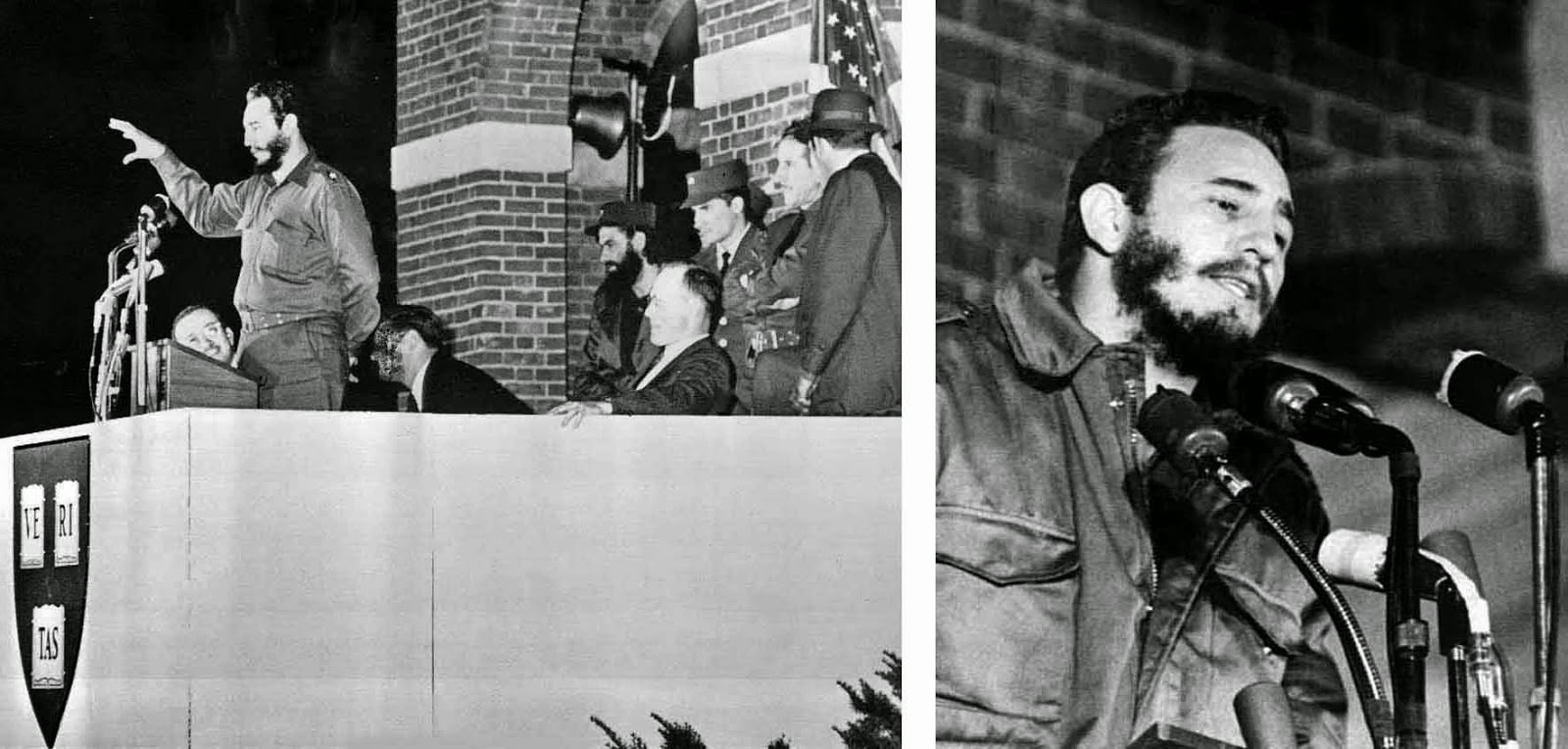
Several months after the victory Castro was invited to the States. Landing in Washington – although coolly received by the Eisenhower (Ike) Administration – the charismatic Maximum Leader took the country by storm, making his way up the East Coast city by city in a triumphant tour. Castro looked and acted the hero, and the American public took to him.

Not everyone was happy about his visit though – there were death threats at every stop. As a result, when Castro reached New York, the city organized the greatest security cordon in its history, even more so than for a president. His final stop in the US was Boston where he was scheduled to speak at Harvard. I saw the posters in Harvard Square and decided to go hear him.

It was late April ’59 – actually 55 years ago this week – when Castro  appeared at the Harvard Field House on a warm Saturday evening. After a bomb scare in New York, Boston was taking no chances. The Cuban leader’s train had been met at Back Bay Station by 300 of the city’s finest. As he was driven the several blocks to his hotel, cheering crowds lining the route were held back by a wall of blue.

______________________________________________________________

Cuba’s Ethan Allen leading the Green Mountain boys had taken on and defeated King George III in the guise of Fulgencio Batista.
____________________________________________________________

A few hours later, Castro was accompanied to Harvard by a combined force of Boston cops, Metro police, State Department security, and the FBI. As he walked across the grounds of the field house complex, he was flanked by a phalanx of tall Massachusetts State Troopers in their sky blue jackets, jodhpurs, and black boots.


Castro being escorted by Massachusetts State Troopers, 1959

I drove down Boylston Street to the Charles River, crossed the Eliot Bridge, and walked on up Soldiers Field Road to the field house. There I found myself part of an enormous crowd of some 10,000 students and others exuberantly welcoming the Cuban leader. He took the salute from a speaker’s stand high above the field where we all stood.

Harvard Law School was his host – Fidel was educated as a lawyer – although he was introduced by the Dean of Harvard College, McGeorge Bundy. It turned out that Fidel had applied to the law school as a young man in ‘48, but was turned down. Dean Bundy made light of this, saying that Harvard wanted to make amends and would now accept him.

Cuban and American flags were on display, and Castro was decked out in his trademark olive-green military fatigues and field cap. Standing at the podium above the Harvard crest, he was unobtrusively shielded on both sides by personal bodyguards and Boston security. When he was introduced, the roar of the crowd was deafening – Fidel and the guerrillas were seen through the prism of American legend. Cuba’s Ethan Allen leading the Green Mountain boys had taken on and defeated King George III in the guise of Fulgencio Batista.


Castro speaking at the Harvard Field House

Fidel was a forceful rather histrionic speaker given to dramatic gestures. His remarks were billed as ‘The Cuban Revolution’, but he didn’t dwell long on past battles. Instead he gave a thoughtful, albeit rambling, speech on the problems of backwardness and underdevelopment plaguing revolutionary Cuba.

From the press, he well understood that Americans, in their enthusiasm for his victory over a dictatorial regime, were expecting democracy and the rule of law to follow, but he patiently explained the more immediate problems facing his government were hunger, mass illiteracy, and a level of unemployment greater in scale than during the American Depression.

Castro went on to say all things would come in due time, but for now elections – absent political parties – would have to be put off at least two years. And he added pointedly that rights of the criminally accused would have to wait until the revolution dealt summarily with the many who had administered the terror and carried out torture under the old regime.

Up to that point, he still had the majority of the audience with him, but then a law student called out a question about a recent criminal case in Havana. A couple of Batista’s pilots had attempted to bomb the presidential palace. They received a stiff prison sentence, but Castro, dissatisfied, ordered a retrial.
Second time around they got the death penalty.

Wasn’t that double jeopardy the questioner persisted? Castro bridled at the challenge, responding aggressively that the second trial was justified by the higher right of the revolution to defend itself. At that, a chorus of boos floated up from below.

Fidel grew visibly angry, and his speech dissolved into a rant as he occasionally slipped from English into Spanish. The crowd’s good will toward him began to ebb. The atmosphere in the field house complex had changed, and the evening ended on a down note for many there.

I went off to grad school a year later. Indiana University (IU) had given me fellowship money to study Soviet Russia. As it happened, brother Jeff also arrived in Bloomington for his Freshman year. I was delighted with the lively, competitive graduate school milieu – in the midst of the Cold War, Soviet Studies was the hottest field around.

Jeff, however, was unhappy at the university. He had graduated from a small Eastern prep school and felt lost on the vast campus, a virtual small city in itself. He had hoped to go to an Ivy League school where all his friends were, but Pop’s business reversal precluded a costly private college.

One of my friends in the Russian Institute was George Shriver. Like me, he had come out to IU from the East – from Harvard where he’d majored in Russian. While I was in the Political Science PhD program, George’s focus was Russian language and literature. Although I didn’t realize it at the time, George was also a left political activist.

At IU that fall he had quietly organized a campus chapter of the Young Socialist Alliance (YSA), the youth affiliate of the Trotskyist Socialist Workers Party (SWP). Then, from the small band of campus Trotskyists, George also spun off a local branch of the national Fair Play for Cuba Committee (FPCC) in support of the Cuban Revolution.


George Shriver speaking at an YSA meeting, Indiana University

As fall term ‘60 was coming to an end, George, as FPCC chair, was organizing a trip to Cuba over Christmas break. Jeff got wind of the trip and put his name down, but even though the cost was modest, he didn’t have the money. He wrote home for funds. While our parents were apolitical, they were wary of anything controversial when it came to their sons, so Jeff had to make a persuasive pitch since the US government considered Cuba leaning toward Communism.
____________________________________________________________________________________

Yet to come, the ill-fated Bay of Pigs invasion was an open secret in Miami émigré circles, and Castro’s forces were more than ready for them.
__________________________________________________________

In his letter, he explained that the trip was sponsored by FPCC, a national organization dedicated to offsetting critical media coverage of Cuba and giving the revolution a fair shake. He added:

   The Cuban government wants Americans to come there and judge the situation and the results of the revolution for themselves. There is nothing political involved. It’s just to have a good time and get informed on the real situation in Cuba.

Jeff asked me to add an endorsement to his letter, which I was happy to do. I knew he was drifting at IU and was glad to see him finally taking an interest in something.

Apparently the parents were persuaded, but in the end Jeff never made it to revolutionary Cuba. There weren’t enough takers, so the trip was called off. Not long after he dropped out of school and a year later found himself in my old military outfit. However, instead of sailing off to Europe as I did, he was taught Vietnamese and landed in Southeast Asia in the middle of a small war.

But I’m getting ahead of the story. By that spring of ’61 Cuba was back in the headlines. The time was JFK’s first 100 days, and he had adopted Ike’s animus toward Castro and, worse, his predecessor’s misbegotten plan to remove him from power – another hamhanded invasion of the island by Cuban exiles – although this time not a revolutionary vanguard, but a brigade of CIA-trained anti-Castro ‘patriots’.

Once again McGeorge Bundy, by then JFK’s National Security Advisor, was out front – serving as White House liaison to the Agency’s invasion planners. The ensuing Bay of Pigs fiasco is well-known – the whole ill-fated enterprise had become an open secret in Miami’s Cuban émigré circles, and Castro’s forces were more than ready for them.
         
The operation was a personal tragedy not just for the hundreds of brigadistas who survived, languishing in harsh Cuban prison camps for nearly two years – it was also a political disaster for America’s new young president. However, the image of his administration as a bunch of bunglers and himself personally as lacking in resolve only steeled JFK’s determination to get Castro. One of the President’s favorite maxims was ‘Don’t get mad, get even’.
         
After purging senior CIA people responsible for the debacle, JFK tasked the Agency to covertly eliminate Fidel – in a word, assassinate him. The hit plan, code-named ‘Operation Mongoose’, enlisted Cuban émigrés again, but this time the American Mafia as well – the very guys whose Havana casinos had been seized by the Castro regime in ’59.  

By summer ’62 the bizarre plotting to decapitate Communist Cuba was well underway.  Some of the looney ideas the plotters came up with included a lethal exploding cigar, exposing Castro to a fountain pen treated with poison, and, perhaps looniest of all, slipping a chemical into his shoes to cause his signature beard to fall out – that wouldn’t have worked anyway.

Unbeknownst to the US, that very summer Khrushchev was planning clandestine operations to carry out regime change in Guatemala, Honduras, and El Salvador, Latin American dictatorships firmly in the Western camp.

However, sensing that Kennedy might attempt another attack on Cuba, Khrushchev changed his mind and decided instead to secretly reinforce his new Caribbean client state, a move which would erupt in the coming months into the Cuban Missile Crisis – arguably the most dangerous moment of the long Cold War – but that’s a story for another post.
____________________________________________
*Manchester Guardian (December 4, 1956).


Wednesday, April 9, 2014

Springtime in Academe – ‘Truth Squad’ Meets Its Match

In the annals of the Vietnam War, the year 1965 has long been remembered as the year of the great escalation. The date of course pales in significance and consequence to 1941, but for those who opposed the war in Vietnam, springtime ’65 will always have a special place in memory.

American involvement in Southeast Asia had begun a decade earlier when the French were still fighting to retain their Indochina colony, but it was limited to military hardware and a few hundred technical advisors. President Kennedy (JFK) set in motion the first escalation in ’61 when he began a 20-fold buildup of US troops in South Vietnam, by then an independent country. South Vietnam was under constant pressure from Communist North Vietnam’s proxy military formation, the Viet Cong (VC), a tough and seasoned guerrilla outfit.

From his predecessor, JFK inherited a contingent of under a thousand military advisors, which he then increased to 16,000 American officers and men advising South Vietnamese Army units fighting the VC. Several years later however, after the VC had made great gains, it was the speed, scale, and composition of President Johnson’s (LBJ) escalation that set 1965 apart as US troop levels soared to 165,000 by year’s end.

In the history of the American antiwar movement, 1965 also became a marker date. Although there was some popular opposition to JFK’s low intensity war, it was minimal, barely achieving media notice. However, LBJ’s dramatic escalation beginning late winter/early spring ’65 was quickly met by a counter-escalation of protest on many college campuses.


LBJ’s dramatic escalation beginning early ’65 was quickly met by a counter-escalation of protest on many college campuses.
____________________________________________________________

The reciprocal escalation of troops and protesters occurred against a backdrop of continual VC terror attacks on US military personnel billeted in the cities and towns as the countryside was steadily slipping out of Saigon’s control. A particularly deadly VC bombing of a US barracks in February ’65 brought forth a punishing response from LBJ – fighter bombers launched to attack North Vietnam.†

In Washington, the retaliatory air strikes were spun as a spontaneous reply to North Vietnamese aggression in the south, but, as we would later learn when the Pentagon Papers – the secret history of the war – were leaked to the media, the raids had been planned months in advance behind the scenes. The White House had merely been waiting for an appropriate pretext, a sufficient provocation, which the VC provided.

The ensuing attacks on the North were actually dress rehearsals for the secretly planned full-scale escalation set in motion the following month – a systematic bombing campaign code-named ‘Rolling Thunder’ – along with the landing in South Vietnam of the first US combat units. We were at war in Asia.

Stateside, the universities were quick to react to LBJ’s move. It was springtime in academe for what would gradually become a nationwide antiwar movement. First out of the gate was the University of Michigan in Ann Arbor, one of the more liberal and free-spirited campuses in the country.


Stateside, the universities were quick to react to LBJ’s move. It was springtime in academe for what would gradually become a nationwide antiwar movement.
____________________________________________________________

On March 23, ‘65 Michigan faculty and students organized the first ‘teach-in’, an all-night gathering at which professors reviewed Vietnam’s history and the conflict between north and south and led discussions on the major issues with the hundreds of students who turned out. The idea of the teach-in caught on quickly as some 20 other universities followed suit the next week. ††

Meanwhile, Students for a Democratic Society (SDS), a New Left organization founded in ’62 at Michigan, led the way, rapidly signing up many new campus chapters and hundreds of new members. With its ranks growing, SDS coordinated a major challenge to LBJ’s war policy, staging a 25,000-strong march on Washington on April 17th. The lines of the emerging divide on the homefront between the government and the New Left were now clearly drawn.


I was then a young academic, a first-year Political Science prof at the University of Missouri (Mizzou) where a teach-in was also held. A relatively conservative campus, our event was sedate by comparison with Michigan’s. I was a co-organizer, but my motive was to support the war, not oppose it.

My younger brother Jeff Sharlet, an ex-Vietnam GI then back at Indiana University (IU), was on the other side of the issue. Later, after the Tet Offensive of ’68, I came around to Jeff’s view.

We held the Mizzou teach-in at a 500 seat auditorium. The place was packed with students and faculty, the overflow sitting in the aisles and standing at the back. I was joined on the pro-war side by a senior American historian. Our opponents, junior faculty like me, were both specialists in South Asia.

They argued against the war based on their extensive knowledge of Southeast Asia, the previous fate of the French colonialists, and the idea that Vietnamese nationalism was the essential driving force in what they considered a civil war.

As a JFK liberal internationalist, I placed the Vietnam conflict in the context of the global Cold War between the United States and the Soviet Union. I argued that North Vietnam’s campaign against the South was being facilitated by indispensable Soviet military materiel and was a challenge to the US policy of ‘containing’ the USSR within its imperial frontiers.

I did not dismiss Vietnamese nationalism, but insisted that Communist ideology was the major factor; hence, for me the conflict was a Soviet proxy war using North Vietnam and, in the South, its surrogate, the VC.


Teach-in, University of Missouri, 1965 – author at far right pondering

Both sides to the debate received supportive applause from the audience, but when a straw vote was taken at the end, the pro-war position had prevailed.

While I doubt that Washington took note of Mizzou, historical accounts tell us that LBJ was upset and offended that the learned community was leading the burgeoning protest against his policy.

Shortly after the antiwar left carried its opposition to the streets of the nation’s capital, the administration began marshalling its forces against the growing tumult at some of the nation’s foremost institutions of higher learning.

Meanwhile, since February’s retaliatory air attacks, the State Department (USDS) had been getting telephone calls hourly from citizens asking for an explanation of the sudden escalation that followed. In addition, by April of ’65 USDS had received over 20,000 letters of inquiry about the war. As a presidential advisor commented, the administration clearly wasn’t doing its “propaganda job right.”*

On April 25th, Secretary of State Rusk commented briefly in an aside in a speech on an unrelated subject that he found much of the criticism he had heard against the war ‘nonsense’ and expressed surprise at the ‘gullibility’ of the academics leading the charge. The following day USDS began planning to counter the protests by ‘explaining’ the war policy to academe.

A Washington speaking team was dispatched to visit five universities in the Midwest. Leading the group, officially called the ‘Inter-Departmental Speaking Team on Vietnam Policy’, but soon dubbed the ‘truth squad’, was Thomas Conlon, a mid-level Foreign Service officer.

Conlon, an experienced 40-year old diplomat, was well qualified to lead the group, having served at the US Embassy in Saigon for two years. He’d even learned Vietnamese in the process and was an articulate and forceful public speaker as well. A ‘hawk’ on ‘containing’ Communism, Conlon strongly supported drawing the line in Southeast Asia.

He was variously accompanied by an official of the Agency for International Development (AID) and one or the other of two assigned senior Army officers – all with Vietnam experience as well. The rep from AID was Earle Young, a specialist in rural development who had served both in Laos and South Vietnam.


Earle Young, USAID, 1981

Young’s field experience was extensive. While working in South Vietnam, he had witnessed Saigon losing ground in the countryside. One of his postings was in Long An province abutting the capital region, which, on the cusp of LBJ’s escalation, was increasingly falling under VC control. One village, a mere 12 miles from Saigon, was so completely under VC sway that the government flag could not be flown there.

The Washington civilians were backed up by two colonels who had served as advisors to the South Vietnamese Army in its counter-insurgency campaign against the VC. In effect, it was a well-informed truth squad that landed in America’s heartland, confidently expecting to set the record straight on US involvement in Vietnam and quiet the spreading campus unrest.


The truth squad landed in America’s heartland confidently expecting to set the record straight on Vietnam and quiet the spreading campus unrest.
____________________________________________________________

Their first stop on May 4th – during the weeks following the early March landing at Danang when Marine combat reinforcements were pouring in as a result of LBJ's ongoing buildup – was at the University of Iowa where the truth squad received its baptism by fire. The Iowa Socialist League organized a raucous evening reception before a hooting and jeering crowd of 200 students and faculty.

The government team argued the US was responding to Communist aggression from North Vietnam, a claim that flew in the face of the Iowa critics’ belief that we had intervened in a Vietnamese civil war. That first experience became a rude awakening for Washington’s experts, who had anticipated being heard by a typically tranquil and polite academic forum.

Braving shouts and provocative statements, Conlon soldiered on, replying to questions about why Vietnam was important to US national security with standard Cold War rhetoric; to wit, if we let North Vietnamese aggression go unanswered, it could lead to world war.

Toward the end of the evening at Iowa, Conlon began to lose his cool, agreeing with a questioner that it was a “crummy war,” but “the only war” we’ve got.** Predictably, the place erupted in hoots of derision.

The truth squad moved on to Drake University in Des Moines where they found some respite from the battle zone. The Drake audience was mildly critical but respectful, and the team was able to get its points across without incident. Traveling north, the next stop was University of Wisconsin at Madison, and it was back into the cauldron of antiwar protest.

Well before the Vietnam War heated up, Wisconsin-Madison was primed to play a role in opposition. Back in the ‘50s, the campus had a small but critical group of professors on the left led by Hans Gerth, an émigré German Marxist in Sociology, and William Appleman Williams, a Marxist historian. They were the cynosures of a graduate student Marxist study group that published a journal on left politics.

A week after Michigan’s teach-in, reacting to LBJ’s Vietnam escalation, Wisconsin activists mounted their own massive teach-in attended by 5,000 students and faculty with television coverage by CBS. A month later, Conlon and company were unknowingly heading into a buzz saw in Madison.

The truth squad had been invited to Wisconsin by the campus ‘Committee to Support the People of South Vietnam’, but on arrival at the evening’s venue with 650 people awaiting, it was also met – ‘confronted’ would be more apt – by the ‘Committee to End the War in Vietnam’ (CEWV), a 200-strong umbrella group drawing on SDS and other campus left groups.  

Although there were empty seats in the room, the CEWV activists wearing black armbands insisted on standing along the walls and greeting the team’s pronouncements with a cacophony of hisses and heckling.

I happened to arrive at Wisconsin as a visiting professor a few weeks later   and found the campus still abuzz over the ever rising American troop levels and expanding bombing runs over North Vietnam. From my office window on the campus green, I saw occasional rallies and periodic marches up the hill to the Administration Building.


A police-student confrontation, the Wisconsin green a few years later

Though no doubt the majority population of a large Midwestern university was mostly mainstream politically, the campus left in Madison was highly visible, well beyond its numbers.

Battered but not cowed, Conlon and colleagues went across the state to the university’s Milwaukee campus for a relatively quiet evening of Q & A on the war, and then headed south.

At Indiana University the military officers held informal afternoon meetings with small groups of interested students and professors. A former IU grad student critical of the war told me that the colonels responded to queries about the fighting in rural areas forthrightly and with candor, earning the respect of those present.

However, the truth squad’s full-dress appearance in Bloomington that evening turned out differently. National press coverage on the uproar at Iowa and Wisconsin had preceded the team, and the large auditorium was full – a mix of supporters of the war, a sizable minority of opponents – liberals, the New Left, and even a few Old Left – and the largest group, people curious to hear both sides of the issue. 

Brother Jeff, who had returned to college from Vietnam the previous fall, was no doubt in the audience and well informed on the conflict. He had returned from ‘Nam highly critical of the war, but at that point in time was mainly preoccupied with getting back into the academic groove.

However, from his IU letters of the previous several months, I knew Jeff was worried about the possibility of the war flaring up and, as a Vietnamese linguist, being recalled to duty – a prospect he didn’t relish.

Although battle-scarred, Conlon led off with a strong, assertive line on Washington policy in his opening remarks to the IU audience; during the Q & A that followed, the critical minority dominated the floor, firing off challenging questions and often greeting the government’s responses with vocal disbelief.

In the audience that evening was Bernard Morris, who had only recently left a career at the State Department to join the IU faculty. Addressing a question to Conlon, Professor Morris became incensed with the answer, responding “I never thought I’d see the day when my government would lie to me.”†††


“I never thought I’d see the day when my government would lie to me.”
____________________________________________________________

At their final destination, the University of Illinois on May 11th, the truth squad got more rough sledding from many in the hall who had followed the team’s rocky reception elsewhere. They flew back to Washington, Conlon unfazed by the Midwest reception, but the others no doubt relieved to be off the firing line.

In the end, what was the outcome of the first of what would become numerous confrontations over the war between the government and its critics, initially a very small minority which would eventually become legion? To read Thomas Conlon’s subsequent published account of the truth squad’s spring ’65 tour, one might come away with the impression that his team had successfully taught the students ‘the facts of life about Vietnam’.

He believed that the truth squad had rescued the universities from those who had fallen prey to ‘communist propaganda’. Of course he was referring to the ‘extremist’ professors he had encountered    often, as he pointed out, in fields like psychology, the sciences, and literature, hence not qualified by training and therefore lacking in expertise on Vietnam.

On the other hand, tapping back into activist circles at Iowa, Wisconsin, Indiana, and elsewhere, one hears the cheers of victory, ‘we have met the enemy and he is ours’. The klaxon had been sounded – rise up in protest against the war.

As for the canard about the need for expertise to understand Vietnam – a notion popular in Washington foreign policy circles – one of the country’s foremost critics of the war, Noam Chomsky of MIT, shot that one down a year later. As he wrote, “There is no body of significant theory or … relevant information, beyond the comprehension of the layman, which makes policy [on the war] immune from criticism.”***

In reality, the New York Times correspondent covering the truth squad’s tour, called its running battles with its foes a draw. Both sides came away with something. The government succeeded in reinforcing the “views of supporters” of  its Vietnam policy while the campus activists, with their critical positions “strengthened” by the clashes, emerged energized for the encounters to come.****

*Quoted in T Wells, The War Within: America’s Battle over Vietnam (1994), 29.

**D Janson of the New York Times, who reported on the truth squad in the Midwest, quoted in The Militant (June 14, 1965).

***N Chomsky, “The Responsibility of Intellectuals” (1966) in American Power and the New Mandarins (1967), 335.

****D Janson writing in The Nation (May 24, 1965).